Teaching Dogs to Heel Consistently During Fast-Paced Jogging Sessions
Start by confirming your dog is physically ready-avoid jogging with pups under 12–18 months and brachycephalic breeds. Train heel at a walk using a 4–6 foot leash, aligning your dog’s shoulder with your knee and marking correct position within 0.5 seconds. Gradually increase speed by 0.5 mph per session, using cues like “jog” and maintaining 4–6 inches of leash slack. Reinforce focus in escalating distractions, then practice on consistent routes. Correct pulling, lagging, or zipping immediately with precise timing. You’ll discover refined techniques that guarantee reliability even in high-demand conditions.
Notable Insights
- Ensure your dog is physically mature and has no respiratory or joint limitations before starting fast-paced jogging training.
- Build a solid heel foundation at walking speed using consistent cues, treats, and short training sessions in low-distraction areas.
- Gradually increase speed in 0.5 mph increments, using verbal or visual cues to signal pace changes and maintain proper heel position.
- Strengthen focus amid distractions by progressively introducing environmental challenges and reinforcing attention with high-value rewards.
- Use a no-pull harness and precise timing of rewards to correct pulling, lagging, or zipping during real jogging routes.
Start With Your Dog’s Fitness and Temperament
You need to assess your dog’s fitness and temperament before starting any jogging routine. A dog’s exercise tolerance determines how long and intensely it can perform without strain. Young dogs under 12–18 months should avoid prolonged jogging due to developing joints. Brachycephalic breeds, like Bulldogs, have low exercise tolerance due to respiratory constraints. Behavioral readiness is equally critical. Your dog must remain focused, respond reliably to basic cues, and show no signs of reactivity or over-excitability. Observe off-leash behavior in controlled environments to gauge impulse control. Large, high-energy breeds such as Huskies often have high physical capacity but may lack behavioral readiness without training. Use a heart rate monitor or GPS tracker to measure exertion-sustained heart rates above 160 BPM in dogs suggest fatigue. Temperament tests, including response to distractions, help predict jogging compatibility. Never confuse enthusiasm with readiness. Senior dogs can also benefit from monitored exercise using a pet health tracker to ensure safe activity levels.
Train Heeling First at a Walking Pace
While building on your dog’s fitness and temperament foundation, begin training the heel command at a walking pace to establish proper positioning and focus. Use a 4–6 foot leash to maintain consistent leash tension, preventing drift. Stand with your dog at your left side; give the “heel” cue as you step forward. Keep treats hidden until the correct position is achieved. Reward timing is critical-deliver the treat within 0.5 seconds of correct alignment to reinforce behavior. Use short, consistent markers like “yes” to signal accuracy. Practice turns, stops, and speed changes to build compliance. Gradual repetition strengthens muscle memory. Avoid jerking the leash; instead, use gentle corrections to guide positioning. Heeling requires the dog’s shoulder aligned with your knee. Train in low-distraction environments for precision. Each session should last 5–10 minutes, 3–4 times daily, ensuring focus without fatigue. A reliable way to monitor your dog’s activity during training is through a pet location tracker.
Increase Speed Gradually With Clear Cues
A gradual speed increase is essential to shifting from walking to jogging heelwork, ensuring your dog maintains proper position and focus. Start by introducing pace signals-verbal or visual cues like a raised hand or the word “jog”-to indicate acceleration. Use consistent speed markers, such as sidewalk cracks or measured intervals (e.g., every 10 feet), to incrementally raise your pace. Begin at 2 mph, then increase by 0.5 mph per session until reaching a jogging speed of 5–6 mph. Reinforce correct alignment with immediate treats or praise. Maintain a short leash (4–6 inches slack) to guide positioning without restricting movement. Each session should last 10–15 minutes, allowing muscle memory to develop. Avoid sudden changes-your dog needs predictable shifts. Properly timed cues paired with structured progression build reliability. Track performance weekly using a running log to note response time, lag, and marker accuracy.
Strengthen Focus in Distracting Environments
What happens when the sidewalk ends and the real world takes over? Distractions test your dog’s focus immediately. Noise exposure from traffic, bicycles, or other animals challenges their concentration. You need to train for impulse control in stages. Begin in low-distraction areas, then systematically increase environmental complexity. Use high-value treats to reinforce attention amidst distractions. Practice the “look” command until your dog checks in with you automatically. Gradually introduce louder sounds using recordings, starting at 40 decibels and increasing by 5-decibel increments. Each session should last 10–15 minutes to maintain mental sharpness. Consistent repetition builds neural pathways that support reliable focus. A well-trained dog maintains heel position despite sudden movements or sounds nearby. Impulse control isn’t suppression-it’s conditioned decision-making. Strengthen it with structured exposure, precise timing, and clear consequences for inattention.
Practice Heeling on Actual Jogging Routes
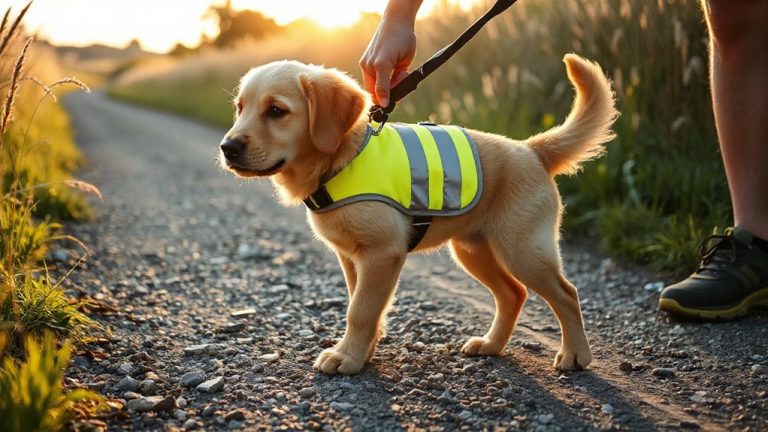
When the training environment shifts to real-world jogging paths, your dog’s ability to maintain heel position is tested under dynamic conditions. Start with consistent route repetition to build predictability, reinforcing muscle memory and focus. Perform three to five sessions weekly, each lasting 15–20 minutes, at a steady jogging pace of 6–8 km/h. Gradually introduce jogging path variety-paved trails, gravel paths, and grassy routes-to simulate real conditions. Vary terrain texture and footfall resistance to assess stability and attention. Use a 1.2-meter no-pull harness and 1.5-meter leash to maintain control without restricting motion. Maintain a heel position within 15 cm of your left leg. Short, frequent drills improve coordination. Over time, this structured exposure increases your dog’s adaptability and precision across diverse environments, ensuring dependable performance during actual runs. Do not advance until heel discipline is consistent across three different routes.
Fix Pulling, Lagging, and Zipping Before They Stick
Although your dog may seem focused during early training, subtle deviations like pulling, lagging, or zipping can quickly become ingrained without immediate correction. Address pulling by releasing leash tension the instant your dog returns to heel position. Maintain consistent leash tension to signal correct positioning-ideally 4–6 inches of slack with a 6-foot nylon or biothane lead. Lagging often results from delayed reinforcement timing; reward within 0.5 seconds of proper heel alignment to solidify accuracy. Zipping ahead occurs when dogs anticipate forward motion; preempt it with a quick verbal cue (“heel”) and a slight shoulder block. Reinforcement timing must be precise-use high-value treats or a clicker to mark exact behaviors. Practice short bursts (2–3 minutes) at a moderate jog (5–6 mph) to sustain focus. Immediate feedback reduces error repetition, ensuring reliable heeling under dynamic conditions.
On a final note
You must condition your dog’s responsiveness before attempting high-speed heeling. Start with structured walking drills using a 4-foot nylon leash and well-timed treats. Gradually increase pace, maintaining consistent verbal cues like “heel” at 120 words per minute. Use front-clip harnesses to reduce pulling forces by up to 70%. Reinforce position every 15–20 feet during jogs. Distraction-proof with randomized stimuli at 70% compliance before route transfer.