Sensory Changes With Age: How to Help Your Senior Pet Adapt
Your senior pet may show delayed responses to sounds or decreased interest in scented toys due to age-related sensory decline. Hearing loss often starts at 10–12 years, with cochlear degeneration reducing sound detection. Use 5–10 Hz vibrating collars for alerts. Install 20-lumen motion-sensor lights and 5000K LED bulbs to support vision. Place textured rugs every 30–45 cm as tactile guides. Warm food to 38°C and use 1–2% essential oil scents for olfactory stimulation. Consistent layouts and signal combinations improve adaptation-further strategies are available to enhance your pet’s daily function.
Notable Insights
- Install motion-sensor nightlights and maintain consistent furniture layouts to support aging pets with vision loss.
- Use hand signals, facial expressions, and gentle touches to improve communication with hearing-impaired pets.
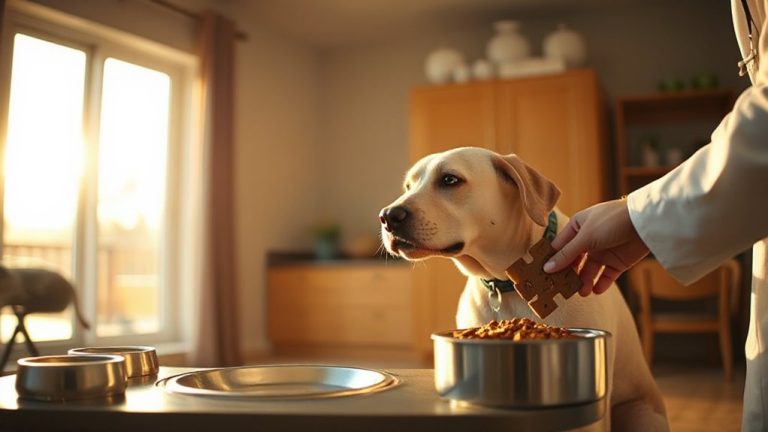
- Warm food to 38°C and use scent-dispensing collars to enhance meal appeal for pets with reduced smell.
- Place textured rugs and tactile markers to help visually impaired pets navigate familiar spaces safely.
- Schedule biannual veterinary exams to monitor sensory decline and adjust care for older dogs and cats.
Spot the Early Signs of Sensory Decline in Senior Pets
Why might your senior dog no longer respond when called from another room? Behavioral shifts like this often signal early sensory decline. Your pet may exhibit decreased responsiveness due to diminishing auditory function, a common age-related change. Notice if they startle easily-this could indicate noise sensitivity, where ordinary sounds feel amplified or distressing. These shifts aren’t just forgetfulness; they reflect neurological adaptations to sensory input changes. Look for patterns: failing to react to doorbells, squeaky toys, or verbal cues supports auditory impairment suspicion. Unlike sudden deafness, this progression is gradual, making early detection critical. Monitor for compensatory behaviors, such as lip reading or vibration sensing, which pets adopt to navigate sensory gaps. Identifying these signs around ages 10–12 in dogs (earlier in larger breeds) allows timely adaptation. Early intervention improves quality of life markedly.
What Hearing Loss Means for Aging Dogs and Cats
How can you tell if your older dog or cat isn’t hearing as well as they once did? Subtle behavioral shifts often signal hearing loss. Your pet may not respond to their name, seem startled when approached, or ignore familiar commands. Hearing tests conducted by vets can confirm auditory decline. Age-related degeneration of cochlear hair cells reduces sound transmission. Some pets develop sound sensitivity, reacting adversely to loud or high-frequency noises.
| Behavior | Dog | Cat |
|---|---|---|
| Response to soft sounds | Delayed or absent | Ignores |
| Startle response | Increased | Heightened |
| Response to owner’s voice | Inconsistent | Minimal |
Hearing loss impacts safety and communication. Regular hearing tests help track progression. Sound sensitivity may require environmental adjustments. Early detection supports timely intervention.
How to Help a Pet With Vision Changes
Vision changes in senior pets often go unnoticed until they begin affecting daily activities. You can help by implementing consistent vision support strategies in your home. Lighting adjustments are essential-install motion-sensor nightlights (minimum 20 lumens) along pathways and near stairs. Use LED bulbs with a color temperature of 5000K to enhance contrast, improving visibility. Avoid glare by placing mats under glossy floors. Keep furniture in fixed positions to aid spatial memory. Use tactile cues, like textured rugs, to mark entryways. Avoid using strong-scented cleaners, as they may interfere with non-visual navigation. Consider prescription lenses for dogs with cataracts-typically plano-convex, 1.5x magnification. Anti-reflective coated lenses reduce distortion. While full restoration isn’t possible, these steps slow functional decline, improving orientation. Regular veterinary ophthalmic exams every six months help track progression and adjust support measures accordingly.
Compensating for Your Pet’s Fading Sense of Smell
Your senior pet’s diminishing olfactory function can substantially impact their environmental awareness and food motivation. As olfactory receptors degrade, typically after age 10 in dogs and 12 in cats, scent detection thresholds increase by up to 50%. You can counteract this decline through structured odor enrichment. Introduce safe, concentrated scent sources like diluted essential oils (e.g., lavender or rosemary at 1–2% concentration) on rotating fabric squares placed in fixed household locations. These scent trails stimulate neural pathways and maintain sensory engagement. Use a consistent spatial sequence-place markers every 30–45 cm along a path-to guide exploration. Devices such as scent-dispensing collars (emission rate: 0.15 mg/hour) provide continuous olfactory input. Combine with mealtime aroma enhancement, such as warming food to 38°C, to amplify volatile organic compound release. These methods support cognitive stability by preserving olfactory-hippocampal connectivity.
How to Communicate With Sensory-Impaired Pets
Even though sensory impairments become common in aging pets, effective communication remains achievable with targeted adaptations. Use deliberate body language to convey messages clearly. Facial expressions, hand signals, and posture shifts are detectable even with diminished hearing or sight. Position yourself in your pet’s line of sight before signaling. Pair visual cues with tactile cues to reinforce understanding. Gentle touches-like a two-finger tap on the shoulder for “attention” or a stroking motion for “relax”-act as specific signals. Consistency in pressure, location, and timing guarantees reliable interpretation. For deaf pets, vibrating collars set to 5–10 Hz pulses offer non-auditory alerts. For blind pets, guide them with a soft lead attached to a harness, using light pressure to indicate direction. These methods function like calibrated input devices, translating intent into perceivable input. Training with these cues takes 2–4 weeks of daily 10-minute sessions.
Simple Routine Changes to Build Your Senior Pet’s Confidence
While aging can erode sensory input, predictable environments help maintain orientation. Establishing consistent daily routines supports your senior pet’s confidence by reducing disorientation. Use environmental enrichment like puzzle feeders or scent trails to stimulate cognitive function. Rotate toys weekly to sustain engagement without overwhelming them. Install tactile cues such as textured mats at doorways or stairs-rubber-backed, 24” x 40” mats with raised nubs enhance paw feedback. Keep furniture placement fixed; rearrangement increases navigational stress. Use low-level nightlights (under 8 lumens) to avoid glare while maintaining visibility. Feed at the same times and locations-consistency in sound, smell, and layout reinforces spatial memory. Limit loud noises and sudden movements, which amplify anxiety. These structured modifications enhance sensorimotor integration. With precise adjustments, your pet adapts more efficiently, preserving autonomy despite sensory decline. Confidence grows when cues are reliable and accessible. A supportive resting place, such as an orthopedic pet bed for senior pets, can further improve comfort and mobility.
On a final note
You can help your senior pet adapt to sensory changes. Age-related decline in hearing, vision, and smell is common in pets over 10 years. Use consistent verbal cues and vibration collars to support hearing loss. Install nightlights and maintain furniture layout to aid navigation. Scent trails guide pets with reduced olfaction. Provide textured mats as tactile markers. These strategies preserve independence, reduce anxiety, and improve quality of life in aging animals.