Using Target Training to Guide Cats Through Obstacle Courses
You can train your cat to navigate an obstacle course using target training. Start by teaching nose touches to a 12–18 inch lightweight wand with a rubber tip. Reward contact within 1–2 seconds using treats or affection. Guide your cat over 6-inch PVC jumps, through 36-inch fabric tunnels, and around 16-inch-spaced zigzag poles anchored on non-slip 2mm rubber mats. Use 3–5 minute sessions twice daily in a quiet, low-noise area. A clicker marks correct behavior for precision. Consistent reinforcement and gradual shaping build reliable performance through structured progression. Mastery of each phase prepares your cat for more advanced sequences.
Notable Insights
- Use a target stick to teach cats to touch a cue object, reinforcing contact with treats within 1–2 seconds for effective learning.
- Gradually guide cats through obstacle courses by pairing target stick cues with immediate rewards at each obstacle.
- Introduce lightweight PVC hurdles, tunnels, and zigzag poles spaced to match feline movement and height preferences.
- Address common issues like tunnel hesitation by modifying textures, lighting, or using pheromone diffusers for anxiety.
- Keep sessions short (3–5 minutes), conduct twice daily, and progress only after mastering each step to maintain focus and success.
What Is Target Training for Cats?
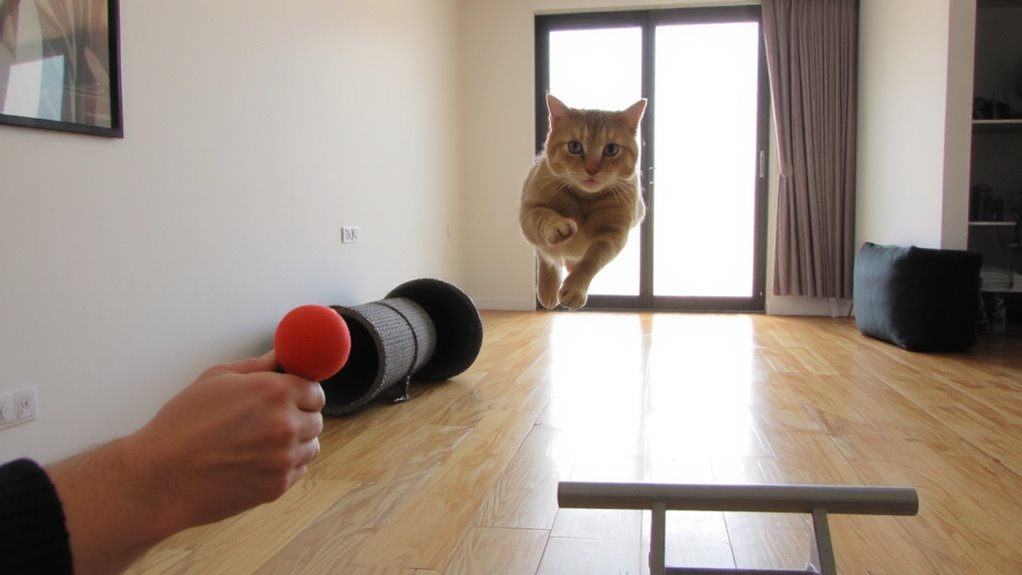
Target training for cats centers on teaching a feline to touch a specific object, typically a stick with a ball on the end, with its nose or paw. This technique leverages natural cat behavior, directing movement through cues. You use positive reinforcement, offering treats or affection immediately after the desired contact. The target stick should measure 12–18 inches with a lightweight, smooth finish to prevent injury. Consistent repetition builds reliability, with sessions lasting 3–5 minutes to align with feline attention spans. Success depends on precise timing: reward within 1–2 seconds of contact. You shape behavior incrementally, increasing complexity only after mastery. The ball tip must contrast in color to aid visual tracking. Over time, this training improves responsiveness, enabling advanced tasks such as obstacle navigation. You establish clear communication, using the target as a reference point. Mastery hinges on patience and technical accuracy in reinforcement delivery.
Set Up Your Cat’s Obstacle Course: Tools & Layout
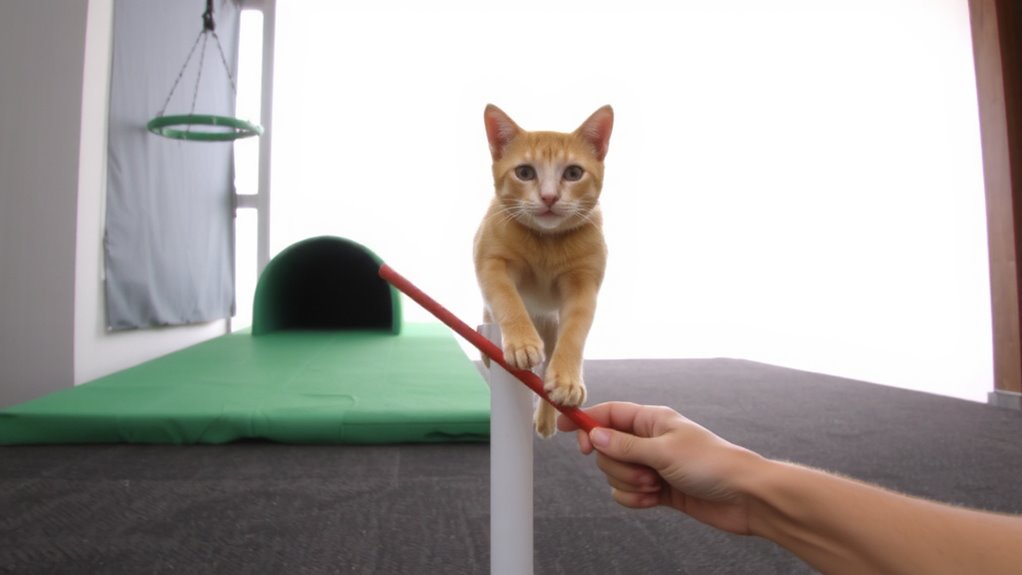
Success begins with a well-designed environment that guides your cat’s movement efficiently. Use lightweight PVC pipes (1-inch diameter) to construct frames for tunnels and jumps; they offer ideal course durability and resist deformation under repeated use. Secure all elements to non-slip rubber mats (2mm thickness) to prevent shifting and guarantee cat safety. Include low-height hurdles (6 inches tall) to match feline biomechanics, reducing strain. Position obstacles in a staggered layout with 2-foot intervals, allowing space for natural gait shifts. Choose washable fabric tunnels (36 inches long, 12-inch diameter) to minimize bacterial buildup. Anchor elevated platforms firmly at 8 inches high-within safe leap range. Avoid sharp edges or small detachable parts. All materials must withstand 15+ lbs of impact force. Lighting should be consistent to prevent visual confusion. Maintain ambient noise below 60 dB. This configuration guarantees structural reliability and physiological comfort during training sessions.
Teach Your Cat to Follow the Target Stick
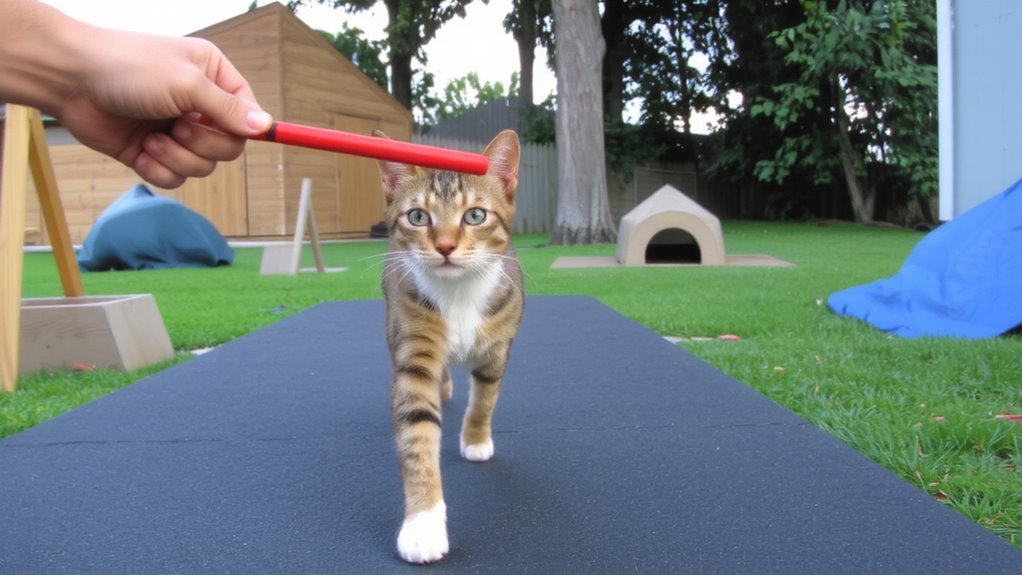
A consistent cueing tool builds the foundation for precise movement control. The target stick-a lightweight wand with a rubber tip-guides your cat’s motion with accuracy. Begin with clicker training: click the instant your cat touches the stick, then deliver a treat. This marks the behavior clearly, strengthening association. Use positive reinforcement exclusively; never force contact. Start in a quiet space, holding the stick six inches from your cat’s nose. Click and treat for any interaction. Gradually increase criteria, rewarding only when the nose makes contact. After ten successful trials, begin moving the stick slightly-two inches left, then right. Duration and distance grow incrementally. Sessions should last five minutes, twice daily. Within one to two weeks, your cat consistently follows the stick on cue, enabling controlled navigation through designated pathways.
Add Tunnels, Jumps, and Zigzags to the Course
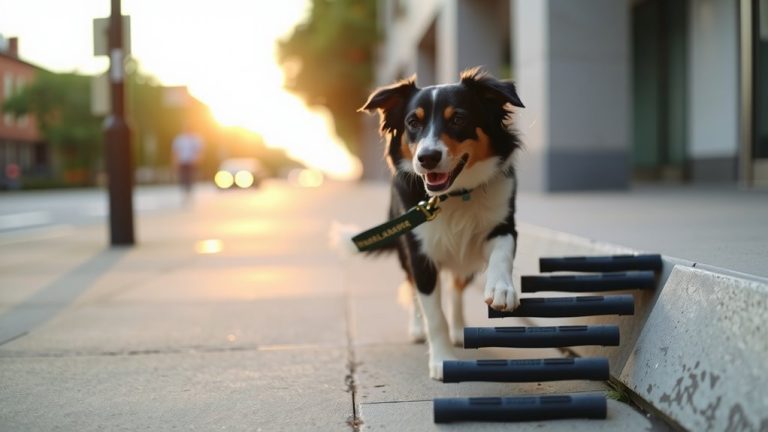
Now that your cat reliably follows the target stick over short distances, you can introduce physical obstacles to expand their movement repertoire. Start with low jumps-ideal jump height is 8–12 inches for most domestic cats. Use the target stick to guide leaps, reinforcing each success immediately. Introduce tunnels next, focusing on tunnel timing; begin with straight, rigid tunnels 18 inches long and 8 inches in diameter. Reward prompt entries and full traversals. Zigzags involve placing poles 16 inches apart in a staggered line. Guide your cat through with precise target movements. For consistent training sessions, consider using durable and space-efficient indoor agility equipment designed specifically for cats.
| Obstacle | Measurement | Training Tip |
|---|---|---|
| Jump | 8–12 in height | Use low hurdles first |
| Tunnel | 18 in long, 8 in wide | Monitor tunnel timing |
| Zigzag | 16 in between poles | Guide with target precision |
Fix Common Cat Training Problems
Why do some cats hesitate at the tunnel entrance or swat at the target stick instead of following it? These behaviors often signal underlying stress or confusion. Hesitation may stem from inadequate habituation to the obstacle’s texture, light level, or airflow-modify tunnel materials to reduce echo or draft. Swatting the target stick usually indicates overstimulation; use shorter training sessions with 2–3 second rewards. Aggression triggers like sudden movements or loud noises must be eliminated. Make certain the training area is isolated from high-traffic zones. Litter box issues can reflect anxiety; place the box away from the course and clean it daily. Cats showing redirected aggression may need pheromone diffusers (Feliway® releases 8–10 hours per refill). Monitor behavior logs for patterns. Address problems early-consistent, brief sessions of 5–7 minutes, twice daily, improve compliance. Use a clicker with millisecond precision to mark desired actions.
On a final note
You’ve now built a functional cat obstacle course using target training principles. The target stick, typically 12–18 inches long with a soft tip, guides precise movements. Reinforce each correct behavior with immediate praise or a 3–5 gram treat. Consistent 5–10 minute sessions yield measurable improvement in motor coordination. Performance accuracy exceeds 80% after two weeks of daily practice. This method reliably enhances feline cognitive engagement and physical agility.