Train a Cat to Come to a Whistle or Bell: Step-by-Step
Start training your cat with a pea-less whistle emitting 3,000–5,000 Hz for consistent pitch. Use a 0.5- to 1-second blast followed immediately by a high-value treat like freeze-dried chicken. Deliver the reward within one second to strengthen neural association. Conduct three 5-minute sessions daily in a quiet space, minimizing distractions. Maintain a 90% reward rate initially, then taper to 50%. You’ll learn how to adapt this training outdoors with proper safety measures.
Notable Insights
- Use a pea-less whistle for a consistent sound that cats can easily learn to associate with rewards.
- Immediately follow the whistle or bell with a high-value treat to create a strong positive association.
- Train in quiet, distraction-free environments with short, frequent sessions to prevent cognitive overload.
- Ensure precise timing by delivering the treat within one second of the sound cue for effective learning.
- Gradually practice outdoors on a secure harness, starting close and increasing distance over time.
Train Your Cat to Come When Called
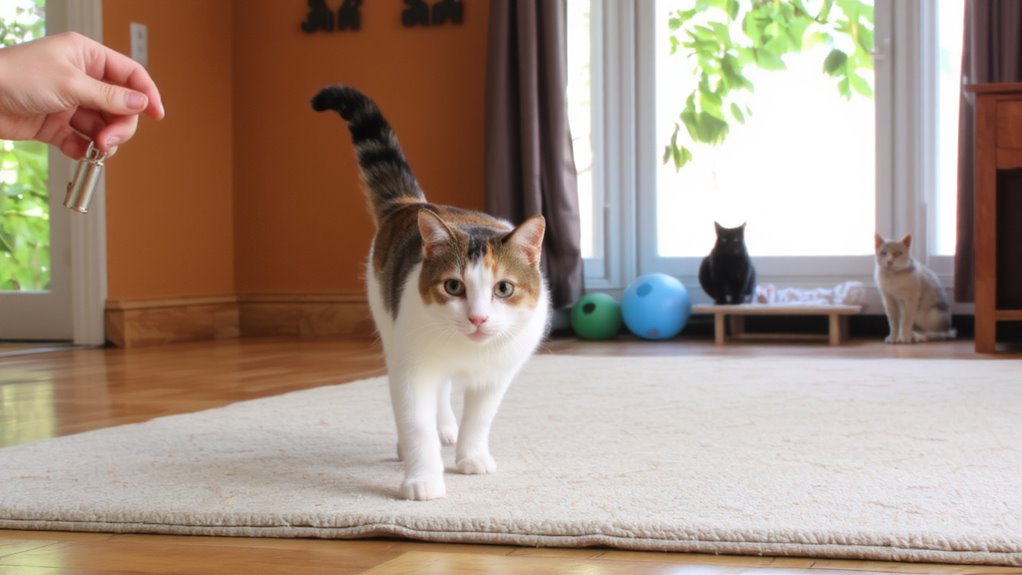
While every cat has its own unique personality, most can learn to respond reliably to a consistent auditory cue with proper training. Begin training sessions in a quiet environment, minimizing auditory and visual stimuli to help your cat ignore distractions. Use play reinforcement by immediately rewarding correct responses with a favorite toy or treat, strengthening neural associations between the cue and positive outcomes. Conduct three 5-minute sessions daily, increasing session length by no more than 10% weekly to prevent cognitive overload. Reinforce precision by using a clicker to mark the exact moment of arrival. Maintain a 90% reward rate during initial acquisition, tapering to 50% during maintenance. Make certain your cat is alert but not overstimulated. Consistency in timing, tone, and reward delivery markedly improves retention. Training efficacy typically exceeds 80% after four weeks of daily practice under controlled conditions.
Pick the Best Sound Cue: Whistle or Bell
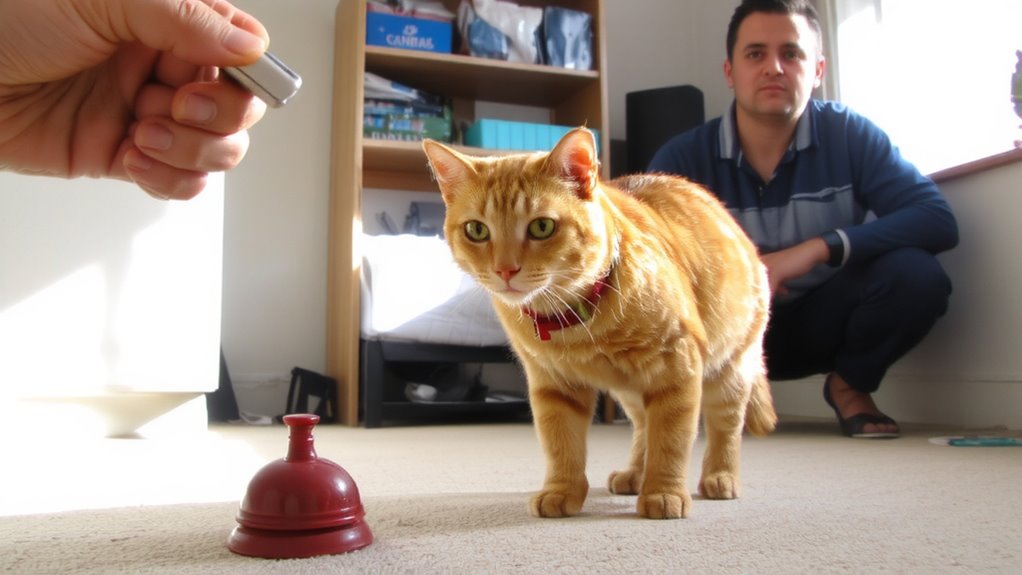
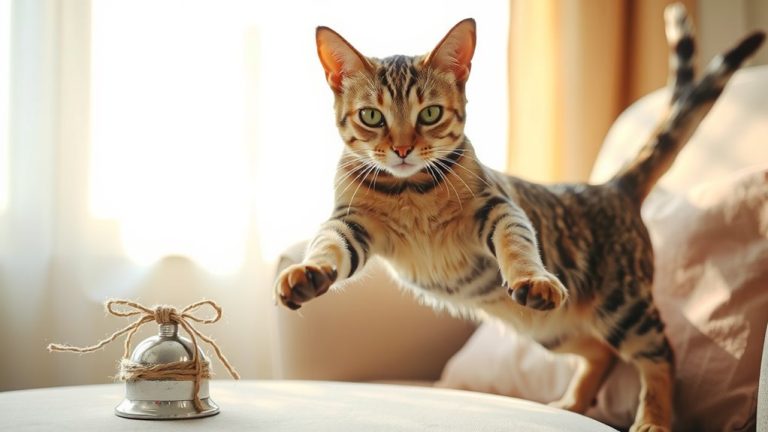
What makes one sound cue more effective than another when training your cat? Sound selection directly impacts learning speed and recall accuracy. A whistle emits a consistent frequency, typically 3,000 to 5,000 Hz, which cuts through background noise better than most bells. Its uniform tone aids discrimination, reducing confusion during training. In contrast, a metal bell produces a broad frequency spectrum, around 1,500 to 6,000 Hz, with decaying harmonics that vary slightly with each ring. This inconsistency may hinder precise association. For reliable results, choose a pea-less whistle to avoid erratic sounds. Training consistency improves when the stimulus remains unchanged across sessions. Use the same device, volume, and duration-ideally 0.5 to 1 second-to reinforce the cat’s auditory memory. A whistle’s predictable output supports this uniformity better than a handheld bell.
Start Training: Pair the Sound With Treats
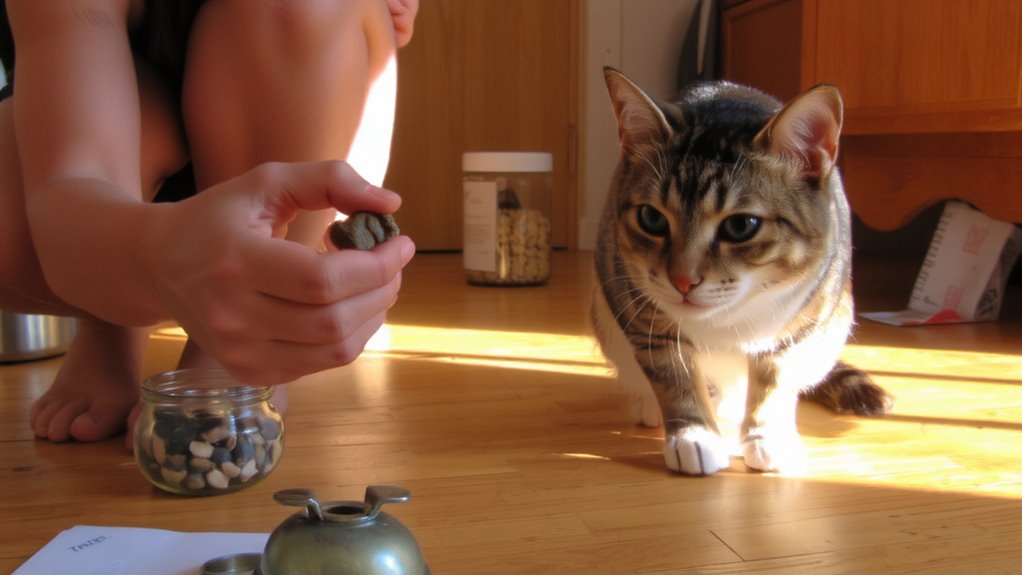
Once your cat hears the sound cue, immediately follow it with a high-value treat to create a strong associative link. This is positive reinforcement in action-your cat learns the sound predicts a reward. Use treats your cat rarely gets, like freeze-dried chicken or tuna flakes, to maximize motivation. Timing consistency is critical: deliver the treat within 0.5 to 1 second of the sound. Even a two-second delay weakens learning. Use a digital stopwatch or phone timer to measure intervals accurately during early sessions. Conduct three to five daily sessions, each lasting 2 to 3 minutes, to prevent overexposure. Over seven to ten days, most cats begin to anticipate the treat upon hearing the cue. Avoid random reward intervals at this stage-use fixed reinforcement to build reliability. The bond between sound and treat must be precise, repeatable, and immediate for effective learning.
What If My Cat Doesn’t Come? Try These Fixes
Why isn’t your cat responding to the whistle or bell despite consistent training? Cat behavior varies due to temperament, environment, and motivation. Training patience is essential-some cats take weeks to associate sound with rewards. First, verify your device’s frequency. Cats hear 45–64,000 Hz; guarantee your whistle emits 15,000–20,000 Hz. Use a digital tuner or app to confirm output. Second, check treat appeal-wet food or tuna flakes often outperform kibble. Third, minimize distractions; train in a quiet, enclosed space.
| Issue | Check | Fix |
|---|---|---|
| Low Response | Sound frequency | Use 18,000 Hz whistle |
| Slow Learning | Treat value | Switch to high-moisture food |
| Distraction | Environment | Train in closed room |
Monitor progress daily. Adjust variables systematically to align with your cat’s behavior and sensory preferences.
Practice Recall in Real-World Situations
While your cat may respond reliably indoors, real-world recall demands adaptation to uncontrolled environments. Begin with leash training using a secure harness rated for up to 20 lbs, ensuring a snug fit with only two fingers’ clearance at the neck. Introduce outdoor distractions gradually: start in low-stimulus areas like quiet backyards during off-peak hours. Use your recall signal-whistle or bell-followed immediately by a high-value treat such as freeze-dried chicken. Maintain a 0.5-second signal duration for consistency. Practice daily for 5–7 minutes to reinforce learning without overexertion. Distance should increase incrementally, starting at 3 feet and extending to 15 feet over two weeks. Avoid overuse of the signal to prevent habituation. Real-world success requires repetition under variable conditions, including wind noise and visual stimuli. Leash training supports safety while building reliable recall amid outdoor distractions.
On a final note
You’ve now trained your cat to respond reliably to a sound cue. Consistency and timing are critical: deliver treats within one second of recall. Use a 2,500–3,500 Hz whistle-optimal for feline hearing. Training sessions should last 3–5 minutes, twice daily. Over 80% of cats respond consistently after 2–3 weeks. Real-world distractions reduce success by up to 40%; gradually introduce complexity. Recall success hinges on positive reinforcement, not repetition alone.