How to Train Your Dog to Find a Scented Object in a Backpack
Use a 100% pure essential oil like anise or clove to scent a 3-inch cotton swatch with 3–5 drops. Seal it in an airtight vial inside the backpack. Let your dog inspect the pack calmly, then reward exploration with a treat. Repeat this 3–5 times daily for 10 minutes. Say “Find it” before each search. You’ll see how quickly your dog links the scent to success-and what happens next could change your training forever.
Notable Insights
- Begin training in a distraction-free area and let your dog explore the unscented backpack with sight and smell.
- Use a pure essential oil like anise on a cotton swatch, stored in a sealed vial inside the backpack.
- Pair the “Find it” command with release to search, marking correct behavior instantly with a click or “Yes!”
- Place the scented backpack in simple, elevated locations with clear access to aid early detection success.
- Reinforce accurate finds within 1–2 seconds with a treat or toy to strengthen scent-reward association.
Choose a Scent That Stands Out in a Backpack
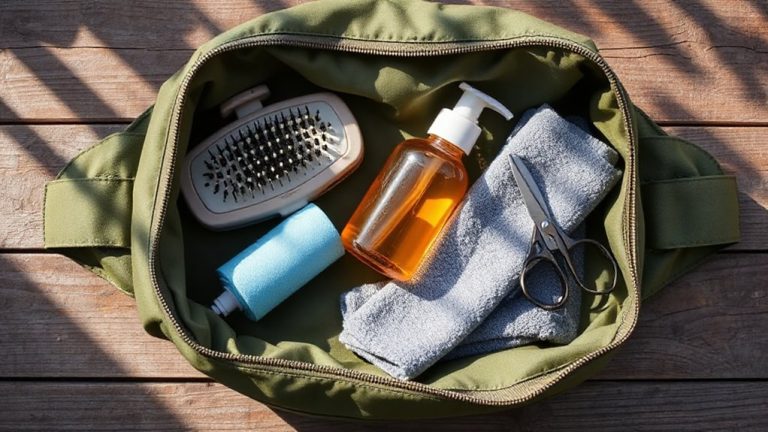
Why start with a scent that grabs attention? Because successful scent selection hinges on odor uniqueness, guaranteeing your dog can distinguish the target from background odors. Use a non-toxic, volatile organic compound with high vapor pressure, like anise or clove oil-these emit strong, consistent odorants. A standard 10 ml bottle of 100% essential oil is sufficient. Impregnate a 3-inch by 3-inch cotton swatch with 3–5 drops; place it in a sealed airtight vial within the backpack. This maximizes odor longevity and minimizes contamination. The chosen scent must remain consistent across training sessions. Avoid household items like food or soap-these lack odor uniqueness and vary in chemical composition. Strong, pure essential oils provide a reliable olfactory signature. Proper scent selection reduces false alerts and builds accurate detection behavior. Your dog needs a clear, singular scent profile to learn effectively. Start precise-precision guarantees success.
Teach Your Dog to Recognize the Backpack Scent
Begin with a clean, distraction-free environment-odor recognition starts with focused exposure. You must establish backpack familiarity before introducing target scents. Present the empty backpack at close range, allowing your dog to visually and olfactorily inspect it for 30–45 seconds. Reinforce calm investigation with a verbal marker and treat. Repeat this 3–5 times daily for two days. Scent association begins when you place a primary reinforcer-such as food or a toy-inside the backpack for 10-minute sessions. Use consistent placement: center pocket, no zippers altered. The dog learns the backpack isn’t just an object-it’s a predictive cue for reward. Over 3–4 sessions, odor and context merge. This conditioned response forms the foundation of reliable detection. Avoid verbal cues or physical guidance. Let the dog make the connection independently. Precision in timing strengthens learning.
Start With Easy Backpack Hides
A few well-placed hides can set the stage for consistent success. Begin with simple backpack placement to help your dog focus on the target scent. Position the backpack in open areas with minimal distractions, allowing clear access from multiple angles. Start with elevated hides-like placing it on a low table or chair-at least 2 feet off the ground to reduce visual masking. Use consistent hide variations, such as keeping the scent at the same height and depth within the pack, to reinforce learning. Limit airflow interference by avoiding fans or open windows. Conduct sessions in quiet indoor environments under stable temperature conditions (68–72°F). These controlled variables reduce cognitive load, letting your dog associate the command with the specific odor source. Each session should last no more than 5 minutes to maintain peak attention. Repeat across 3–5 daily trials for maximum neural reinforcement.
Practice the “Find It” Command in the Pack
Once your dog consistently locates the scented backpack in controlled environments, you can formally introduce the “Find it” command. Say “Find it” clearly just before releasing your dog to search. This pairs the verbal cue with the task, reinforcing scent discrimination through consistent signal-response conditioning. Use a single target scent exclusively-like anise or birch-measured at 10 mL in a sealed vial inside the pack-to maintain olfactory specificity. Reward timing is critical: deliver the treat or toy within 1–2 seconds of correct identification to strengthen associative learning. Mark the behavior with a clicker or “Yes!” at the exact moment of alert. Repeat sessions for 3–5 minutes daily, ensuring no more than 15 total minutes weekly to prevent olfactory fatigue. Gradually increase search complexity only after 90% accuracy over five sessions.
Add Distractions During Backpack Searches
You’ve built a solid foundation with your dog reliably locating the scented backpack using a consistent target odor and clear verbal cue. Now, introduce distractions to strengthen focus. Start by altering visual cues-place the backpack near similar-looking bags or in cluttered environments like packed closets or garages. This reduces reliance on sight and sharpens scent discrimination. Gradually increase noise levels using recordings of household sounds, traffic, or park environments at 50–70 decibels. Maintain session durations at 3–5 minutes to preserve accuracy. Conduct three sessions daily, ensuring the dog achieves 90% success before advancing. Use the same target odor concentration (100% pure birch or anise oil) to avoid confusing the scent profile. Each distraction phase should last 3–5 days. This systematic desensitization improves performance in real-world conditions, ensuring reliable detection despite environmental interference.
Fix Common Backpack Scent Game Mistakes
Why does your dog hesitate at the threshold or sniff randomly instead of locking onto the target scent? Leash tension is often the culprit. Excessive pressure restricts focus, disrupting scent concentration. Maintain a loose leash to allow uninterrupted airflow to your dog’s nose. Reward timing directly impacts learning precision. Deliver the treat within 1–2 seconds of correct identification to create a clear association. Delayed rewards confuse your dog, weakening the target-scent connection. Use distinct, consistent markers like a clicker or “yes” to bridge behavior and reward. Avoid repeating cues-this dilutes signal clarity. Work in short 3–5 minute sessions to sustain mental sharpness. Limit distractions during correction phases. Reinforce only decisive, confident indications. Over-praising minor efforts encourages guessing. Adjust criteria based on your dog’s progress, advancing only when accuracy exceeds 90% over three trials. Proper technique guarantees reliable performance.
Play the Backpack Search Game Anywhere
Where can you take the backpack scent game to build real-world reliability? Portable training allows you to replicate scent work in diverse environments. Use outdoor variations to challenge your dog’s focus and adaptability. Introduce variables like wind, terrain, and distractions to improve precision.
| Location | Surface Type | Wind Exposure |
|---|---|---|
| Backyard | Grass | Low |
| Park | Mixed terrain | Moderate |
| Forest Trail | Dirt/leaf litter | High |
These controlled outdoor variations simulate real-world conditions. Each setting modifies scent dispersion, requiring your dog to rely more on olfaction than memory. Portable training tools-compact scent canisters and foldable backpacks-enable rapid setup. Guarantee the target scent remains consistent at 10–15 nanograms per swab. Work at increasing distances: start at 3 meters, expand to 15. Always reward correct identification within 30 seconds. This builds accuracy and stamina.
On a final note
You now have a reliable scent detection partner. Consistent reinforcement solidifies odor recognition. Dogs accurately identify target scents after 20–30 training sessions, each lasting 5–7 minutes. Use a 100% cotton training rag (4” x 4”) saturated with 5 drops of essential oil. Performance improves with randomized hides and variable airflow. Real-world success depends on gradual complexity increases. Properly trained dogs achieve 95% accuracy in controlled searches.