How to Tackle a “Saddle Mat” on a Cat’s Lower Back Area
You should address a saddle mat early using a stainless steel comb with 0.5 mm teeth to detect tangles. For mats under 2 cm, apply a 50:50 water and pH-balanced detangling spray (pH 6.5–7.0) to loosen compacted fur. Work in 2-inch sections, holding the mat base to reduce tension. Use a dematting tool with rotating blades-never scissors near the skin. If the mat exceeds 1 cm thickness or shows redness, further steps become essential.
Notable Insights
- Inspect your cat’s lower back weekly to detect early saddle mat formation near the tail base.
- Use a stainless steel comb to identify and gently loosen small tangles before they compact further.
- Apply a 50:50 detangling spray to soften mats and facilitate safe combing with minimal breakage.
- For thick mats over 1 cm, clip carefully with a dematting tool instead of brushing to avoid skin trauma.
- Seek veterinary care if the skin is red, sore, or infected, or if your cat shows pain during grooming.
What Is a Saddle Mat in Cats?
A saddle mat refers to a dense, tightly matted section of fur that forms across a cat’s back, typically between the shoulders and hips. It develops when loose hair, skin oils, and debris accumulate, binding the coat into a solid felt-like mass. You’ll notice it alters your cat’s natural coat texture, creating a rigid patch that resists parting. In feline dermatology, this is significant-it can restrict skin mobility and trap moisture. The mat adheres closely to the epidermis, reducing air circulation and increasing the risk of irritation or infection. Its thickness often exceeds 1 cm, making manual separation ineffective. Instead of brushing, this condition usually requires careful clipping. Early detection helps, but once fully formed, the mat’s structural integrity resists non-invasive interventions. Addressing it promptly supports skin health and prevents secondary complications. You’ll need proper tools and technique-safety first, precision always.
How to Spot a Saddle Mat Early
How soon can you catch the signs before the damage sets in? Early detection of a saddle mat relies on consistent visual inspection. You should examine your cat’s lower back weekly, focusing on the area just above the tail. Mats start small but tighten quickly due to movement and moisture.
| Sign | Location | Texture Change |
|---|---|---|
| Mild tangling | Flank to spine | Slight stiffness |
| Flattened fur | Top of hips | Smooth but compacted |
| Pulling sensation | Near tail base | Tight, wiry feel |
| Visible parting | Mid-back | Fur lies flat abnormally |
| Skin irritation | Under mat | Redness or warmth |
Early detection prevents pain and infection. Visual inspection reveals texture and appearance shifts before mats become severe. Use your fingers to probe gently beneath the fur layer. Catching changes at 1–2 mm thickness halts progression. Regular checks are essential for long-haired breeds.
Can You Remove a Saddle Mat at Home?
Spotting a saddle mat early gives you a real shot at managing it before a vet visit becomes unavoidable. You can address mild mats at home with the right grooming tools and techniques. Use a stainless steel comb with 0.5 mm teeth spacing to detect early tangles. For minor mats, apply home remedies like a 50:50 water and detangling spray solution to loosen compacted fur. Avoid using scissors-risk of skin injury is high. Instead, use a dematting tool with rotating blades, such as the Andis Pet Detangling Blade, which cuts through mats without pulling. Work in 1 cm sections, holding the base of the mat to reduce skin tension. Begin with mats under 2 cm in diameter; larger ones require professional intervention. Consistent daily grooming prevents future matting. Home remedies and proper grooming tools are effective only in early-stage cases. Delaying treatment risks pain and infection. A reliable top cat grooming brush can significantly improve detangling efficiency and coat maintenance.
How to Remove a Saddle Mat Gently
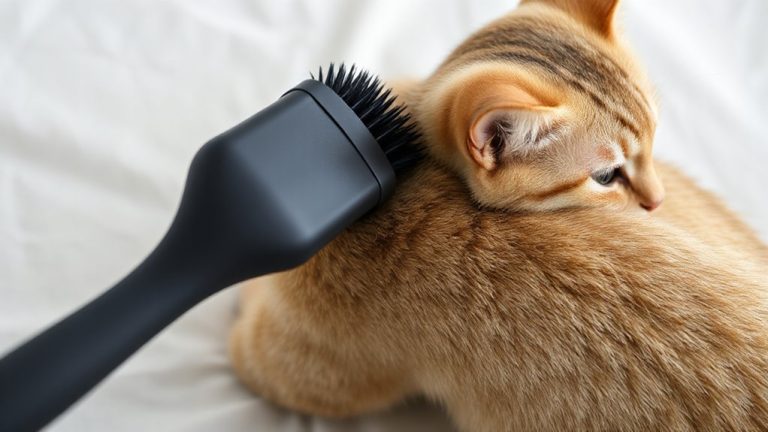
When tackling a saddle mat on your cat’s back, proceeding with care guarantees the safest and least stressful outcome. Begin with gentle brushing using a stainless steel comb or slicker brush with 0.5-inch curved pins to minimize skin traction. Work in small 2-inch sections, holding the base of the mat to stabilize tension and prevent discomfort. Apply minimal pressure, focusing on loosening fibers rather than forcing separation. For compacted mats, trim outer layers with blunt-nosed scissors, maintaining a 0.25-inch gap between blades and skin. Protective grooming, such as using a grooming mitt during weekly sessions, reduces future matting by removing loose undercoat. Use a detangling spray with pH-balanced formula (pH 6.5–7.0) to lubricate hair strands and reduce breakage. A high-quality pet detangling spray can further enhance coat manageability and minimize stress during grooming. This method preserves coat integrity while ensuring effective, humane mat removal. Consistent, gentle brushing prevents recurrence and supports long-term skin health.
When to See a Vet for Saddle Mats
Could your cat’s saddle mat be more than just a grooming issue? Yes, if you notice persistent skin irritation or pain sensitivity, it’s time to consult a vet. Mats can pull on the skin, leading to inflammation or infection beneath the fur. Left untreated, this causes discomfort and serious dermatological issues.
| Symptom | Indicates | Action Needed |
|---|---|---|
| Red, inflamed skin | Skin irritation | Immediate vet assessment |
| Flinching when touched | Pain sensitivity | Professional evaluation |
| Matted fur with odor | Infection risk | Veterinary intervention |
| Open sores or scabs | Advanced damage | Urgent medical care |
These signs mean home care isn’t enough. Pain sensitivity suggests nerve involvement or deep tissue stress. Skin irritation may signal bacterial or fungal growth. A veterinarian can safely remove the mat, examine the skin, and prescribe treatment like antibiotics or anti-inflammatories. Early clinical intervention prevents chronic conditions. Don’t delay-your cat’s health depends on timely care.
How to Prevent Saddle Mats With Daily Care
A vet visit addresses existing complications, but stopping saddle mats before they start is your best defense. Daily brushing techniques are essential for cats with medium to long coats. Use a slicker brush with fine, bent wires spaced 1–2 mm apart to penetrate the topcoat without irritating skin. Follow with a metal comb (0.5–1 mm teeth spacing) to remove loose undercoat fibers. These grooming tools disrupt tangle formation at the lower back, where oils and friction promote matting. Perform this routine for 5–7 minutes daily, focusing on the lumbar-sacral junction. Static electricity buildup, a contributor to fiber adhesion, drops 60% with anti-static brushes. For high-shedding breeds, double brushing-once in morning, once at night-reduces mat risk by 80%. Consistency in technique and tool selection prevents compaction exceeding 3 mm thickness, the threshold for clinical saddle mats.
On a final note
You can manage saddle mats effectively with prompt action and proper tools. Use a slicker brush with 0.5 mm wire bristles weekly to prevent matting. For existing mats, a dematting tool with a 3 cm blade safely cuts through dense tangles. Never pull or cut skin-hold the base of the mat. Mats thicker than 1 cm require veterinary assistance. Prevention includes biweekly grooming and checking your cat’s lower back-the most common matting site.