Feeding Guidelines for Large-Breed Puppies to Support Healthy Bone Development
Feed your large-breed puppy a diet with 22–28% high-quality protein and 8–12% fat to support steady growth. Maintain a calcium-to-phosphorus ratio of 1.2:1 to 1.4:1, with calcium levels at 1.0–1.5% on a dry matter basis. Feed three to four meals daily until six months, then switch to two. Use AAFCO-approved, breed-specific formulas and measure portions precisely. Avoid overfeeding to prevent orthopedic issues-consistent monitoring sets the foundation for lifelong skeletal health.
Notable Insights
- Feed a large-breed puppy food with a calcium-to-phosphorus ratio of 1.2:1 to 1.4:1 to support proper bone development.
- Provide 22–25% protein and 8–12% fat from high-quality sources to meet growth needs without excess energy.
- Feed three to four meals daily until six months, then transition to two meals to control growth rate.
- Avoid overfeeding by measuring portions precisely and monitoring body condition weekly.
- Choose AAFCO-approved diets with calcium levels between 1.0–1.5% to prevent skeletal disorders.
Why Large-Breed Puppies Need Special Nutrition
While all growing puppies require proper nutrition, large-breed puppies face unique developmental challenges that demand specially formulated diets. Their rapid growth rate increases the risk of skeletal abnormalities. You must regulate nutrient intake to support steady, controlled development. Large-breed puppies develop a more complex skeletal structure, requiring precise calcium and phosphorus ratios-typically 1.2:1 to 1.4:1-to promote strong, healthy bones. Excess calories or minerals can lead to uneven bone growth and joint issues like osteochondrosis. A diet with 22–28% protein and 8–12% fat from quality sources supports tissue development without overstimulation. Energy density should be moderate-around 3,000–3,500 kcal/kg-to prevent accelerated growth. You’re not just feeding a big puppy; you’re building a foundation. Proper nutrition balances growth rate and skeletal structure, reducing lifelong orthopedic risks. Formulated diets meet these demands with scientific precision.
How Much to Feed Your Large-Breed Puppy
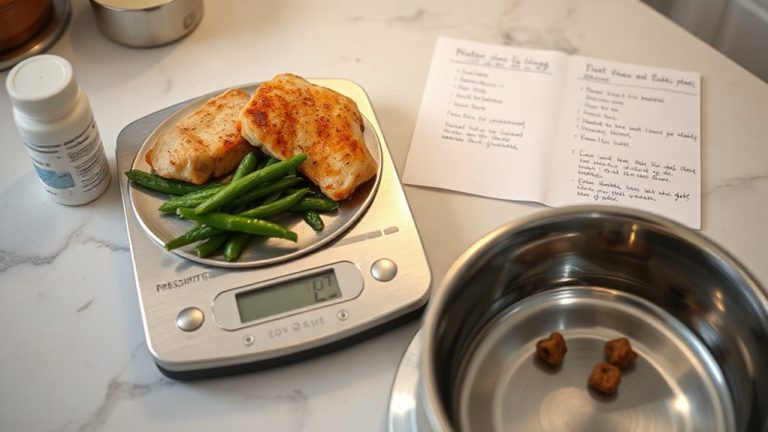
How do you know if you’re feeding the right amount? Proper portion control is essential to prevent rapid growth that can compromise joint and bone health. Feed your large-breed puppy three to four times daily until six months; this feeding frequency supports steady nutrient absorption. After that, shift to twice-daily meals. Follow the feeding guidelines on your food’s label, but adjust based on your puppy’s body condition-ideal weight shows a visible waist and palpable ribs without excess fat. Overfeeding increases risks of developmental orthopedic diseases. Use an 8-ounce measuring cup or a kitchen scale for accuracy. Most large-breed puppies need 25–30 kcal per pound of body weight daily. Monitor growth rate closely-consistent, moderate gains are safer than rapid spikes. Adjust portions weekly as needed. Portion control helps maintain metabolic balance and skeletal integrity.
Picking the Right Large-Breed Puppy Food
What makes a puppy food truly suitable for large breeds? It’s not just about protein levels-it’s about balanced nutrition tailored to skeletal growth. You need breed specific formulas designed to control growth rate and support joint health. These diets typically contain 22–25% protein and 8–12% fat, with ideal calcium levels between 1.0–1.5% on a dry matter basis. Too much calcium or excess energy can lead to developmental issues. Prioritize ingredient quality: look for whole meat sources like chicken or lamb listed first, with minimal fillers. Avoid foods with excessive grains or by-products. High-quality formulas use DHA for brain development and chondroitin for cartilage support. Always check the AAFCO statement confirming the food meets nutritional profiles for growth. Your puppy’s long-term joint and bone health depends on these choices-don’t compromise.
Preventing Overfeeding in Large-Breed Puppies
Because rapid growth can strain developing bones and joints, preventing overfeeding is critical for large-breed puppies. You must practice strict portion control to avoid excessive weight gain, which increases the risk of developmental orthopedic diseases. Follow feeding guidelines on your puppy food label, adjusting portions based on age, weight, and activity level. Use a measuring cup or digital scale for accuracy-overestimating by just 20% can disrupt healthy growth. Implement daily growth monitoring by weighing your puppy weekly and tracking trends on a growth chart. Ideal growth curves show steady, moderate increases, not sharp spikes. Rapid weight gain correlates with skeletal abnormalities like osteochondrosis. Feed no more than recommended, divide meals into two or three feedings, and avoid free-choice feeding. These practices guarantee structural integrity during formative months.
Calcium & Phosphorus: The Bone-Health Balance
Why do so many large-breed puppies end up with joint problems despite perfect feeding routines? The issue often lies in an improper calcium-to-phosphorus ratio. You need to maintain a 1:1 to 1.3:1 calcium-to-phosphorus ratio for ideal bone development. Excess calcium disrupts calcium absorption, leading to abnormal growth plates. Insufficient phosphorus impairs phosphorus metabolism, weakening the skeletal matrix. Large-breed puppies require 0.8–1.2% calcium and 0.6–1.0% phosphorus in dry matter for balanced mineral support. These minerals must be highly bioavailable-dicalcium phosphate or calcium carbonate are proven sources. Imbalances cause osteochondrosis or hypertrophic osteodystrophy, even with ideal caloric intake. You can’t compensate for poor mineral ratios with portion control. Absorption efficiency drops when ratios exceed 1.5:1. Monitor formulated diets for guaranteed analysis values. Your puppy’s lifelong mobility depends on getting this balance right from day one. Choosing a diet formulated with best hip and joint support can further enhance skeletal health through optimized nutrient profiles.
When to Switch Your Large-Breed Puppy to Adult Food
When should you make the shift from puppy to adult food for your large-breed dog? Most large breeds mature slower, requiring the change between 12 to 18 months of age. Switching too early can disrupt growth monitoring and skeletal development. These dogs reach full skeletal size later, often not until 18–24 months. A gradual seven-day change prevents digestive upset. Use portion control to match your puppy’s current weight and projected adult size. Overfeeding contributes to rapid growth, increasing the risk of developmental orthopedic diseases. Monitor body condition score monthly-ideal puppies have a visible waist and palpable ribs without excess fat. Continue growth monitoring through regular vet checkups, evaluating weight gain trends and growth plate closure. Adult food typically has lower calories and reduced calcium than puppy formulas, supporting maintenance rather than growth.
On a final note
You must prioritize controlled growth to protect skeletal health. Large-breed puppies need diets with 22–25% protein and 8–12% fat from high-quality sources. Calorie intake should stay below 400 kcal per kg of body weight daily to prevent rapid growth. Calcium levels between 1.0–1.5% and phosphorus at 0.8–1.2%, with a Ca:P ratio of 1:1 to 2:1, support proper bone mineralization. Overfeeding increases orthopedic risks. Shift to adult food at 12–24 months, depending on breed-specific growth rates.