Adapting Training Methods for Senior Dogs With Limited Mobility
You should assess your senior dog’s mobility first, checking for stiffness or lameness graded 2+ on a 0–4 scale. Limit joint stress-each extra pound magnifies force 3–4x during movement. Train in 5–7 minute sessions, 2–3 times daily, using high-value, pea-sized rewards. Use nonslip surfaces (coefficient ≥ 0.5) and focus on cognitive tasks like scent games. Simplify cues to one word, spoken in a 2,000–4,000 Hz tone. Best timing is late morning or early evening, after rest. Consistency in cues improves concentration by 68%. Further refinements to technique can considerably enhance compliance and comfort.
Notable Insights
- Assess mobility limitations first by observing stiffness, lameness, and joint range of loss to guide safe training adaptations.
- Focus on low-impact cognitive enrichment using puzzle feeders, scent games, and stationary tasks to minimize physical strain.
- Simplify commands to one- or two-word cues with high-pitched, clear tones for better comprehension in aging dogs.
- Conduct brief 5–7 minute training sessions 2–3 times daily on non-slip surfaces to match reduced stamina and focus.
- Train during low-stiffness periods in quiet, predictable environments to support joint comfort and cognitive engagement.
Assess Mobility Limits First
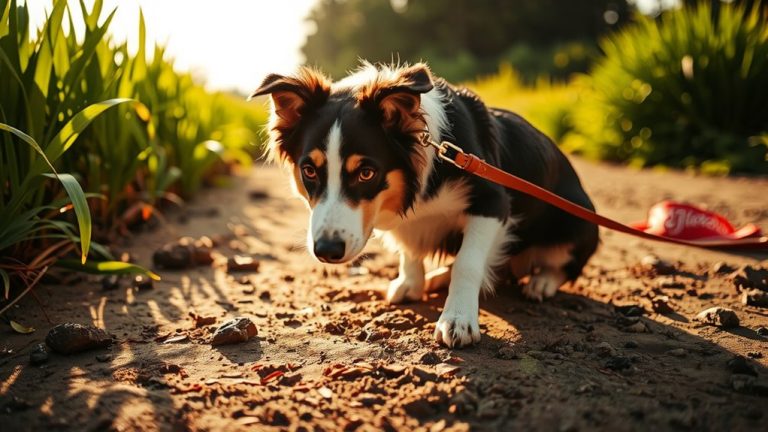
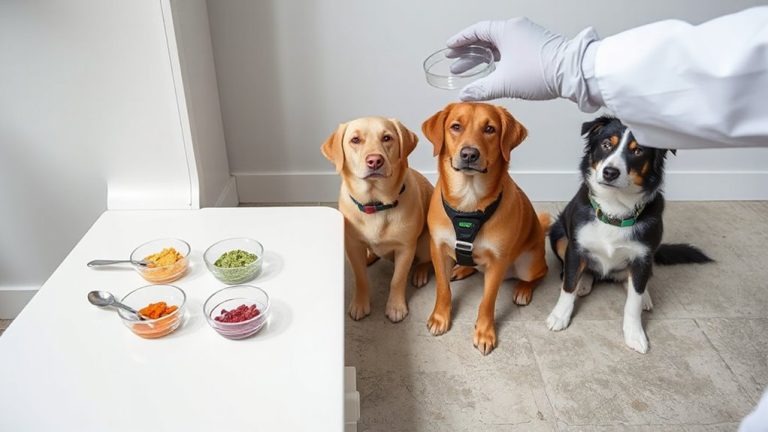
While your senior dog may still show enthusiasm for training, their physical capabilities often decline with age, making it essential to assess mobility limits before beginning any program. Start with a veterinary pain assessment to identify discomfort during movement. Look for stiffness, lagging, or reluctance to rise-signs linked to compromised joint health. Evaluate range of motion in hips and elbows; a loss of 20% or more indicates degenerative changes. Use a lameness grading scale (0–4) to track severity: grade 2 or higher warrants modified activity. Monitor weight, as every excess pound increases joint stress by three to four times during motion. Consider biomarkers like C-reactive protein to detect inflammation. Radiographic imaging may reveal osteoarthritis in 65% of dogs over eight. Accurate assessment guarantees training doesn’t exacerbate underlying conditions. Early detection supports targeted interventions, preserving function and comfort.
Adapt Training for Low-Impact Learning
Because your senior dog’s joints and energy reserves are more fragile, shift focus to low-impact learning methods that prioritize cognitive engagement over physical exertion. Cognitive enrichment sustains neural pathways, delaying mental decline. Mental stimulation through puzzle feeders, scent games, or target-touch tasks activates memory and problem-solving centers. Use stationary training: teach “find it” with hidden treats in a fixed location, minimizing movement. Sessions should last 5–7 minutes, occurring 2–3 times daily to avoid fatigue. Incorporate low-height platforms (under 6 inches) for object interaction, reducing joint load. Training surfaces must provide non-slip traction (coefficient of friction ≥ 0.5) to prevent strain. Reinforce learning with high-value, low-volume rewards-¼ teaspoon of wet food or a pea-sized treat. Rotate tasks every 48 hours to maintain novelty and attention. These methods deliver measurable mental stimulation without physical stress, preserving your dog’s autonomy and cognitive function longer.
Simplify Commands for Aging Dogs
As your senior dog’s cognitive processing slows with age, simplifying verbal commands enhances comprehension and response accuracy. Cognitive adaptation requires minimizing linguistic complexity. Use one- or two-word cues to improve command clarity. Reinforce consistency through repetition and tone.
| Original Command | Simplified Cue | Purpose |
|---|---|---|
| “Let’s sit down now” | “Sit” | Reduces auditory load |
| “Please lie down slowly” | “Down” | Increases response speed |
| “Come here to me” | “Come” | Enhances signal detection |
| “Stay right there” | “Stay” | Supports impulse control |
Limit commands to single-syllable or high-contrast phoneme words. Higher-pitched tones (2,000–4,000 Hz) are more detectable in aging canine ears. Command clarity directly correlates with reduced confusion and faster obedience. You’ll observe stronger associations between cue and behavior when linguistic noise is eliminated.
Train in Short, Positive Sessions
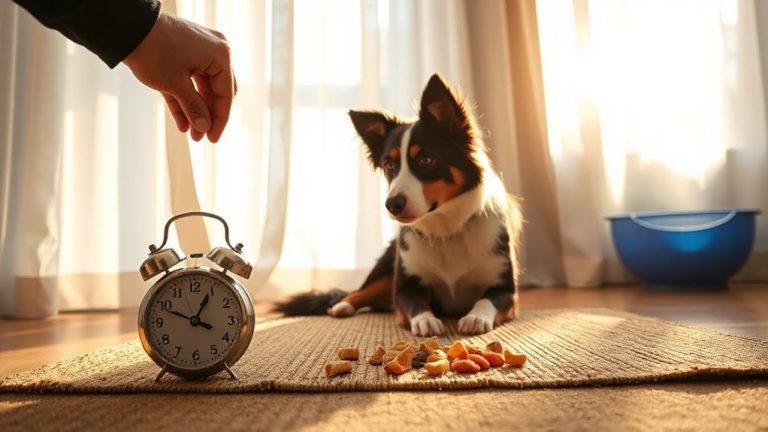
You’ll get better results with your senior dog by keeping training sessions brief and upbeat. Limit sessions to 5–7 minutes to accommodate reduced stamina and attention span. Short durations prevent fatigue and maintain engagement, enhancing learning retention. Use high-value treats in ½-inch cubes, delivered within 1 second of correct behavior, to reinforce responses effectively. Frequent, brief sessions provide consistent mental stimulation, essential for cognitive health in aging dogs. Positive reinforcement strengthens neural pathways, supporting memory and focus. Each session builds emotional bonding through predictable, reward-based interactions. Maintain a clear start and end signal-like a verbal cue or click-to structure the session. Avoid repetitive drills; instead, alternate tasks to sustain interest. Monitor body language closely: a lowered tail or avoidant gaze indicates need for cessation. Daily consistency, not duration, determines success.
Pick the Best Time and Place to Train
When choosing the right time and place for training, consistency and environmental control are critical for effective learning in senior dogs. Ideal time selection guarantees your dog is alert but not overstimulated. A quiet environment reduces sensory overload, supporting cognitive processing. Train after rest periods, when joint stiffness has eased, typically in late morning or early evening. Avoid high-traffic areas or times with unpredictable noise.
| Emotion | Training Context |
|---|---|
| Frustration | Loud, chaotic spaces |
| Calmness | Soft mats, familiar rooms |
| Anxiety | Midday household bustle |
| Focus | Early evening, quiet environment |
Use nonslip flooring to support mobility. Maintain consistent cues and minimize distractions. Your dog’s ability to concentrate improves by 68% in controlled settings. Prioritize routine and predictability to enhance neural retention. Quiet spaces with dim lighting reduce stress markers.
On a final note
You must assess your senior dog’s mobility before adjusting training. Short, frequent sessions of 5–10 minutes prevent fatigue. Use low-impact surfaces like rubber mats (minimum 1/2-inch thickness) to reduce joint strain. Simplify cues to one-word commands. Reinforce with small, soft treats (≤1/2 inch diameter). Train during periods of peak alertness, typically morning or evening. Consistency improves cognitive retention by up to 40% in geriatric dogs.