Adapting Grooming Positions for Elderly Cats With Degenerative Joint Disease
Support your senior cat’s joints by grooming in short 5–10 minute sessions using a soft-bristle brush with rounded tips. Keep them stable on a non-slip surface, ideally on a 12–18 inch elevated table. Position your cat side-lying with padding for joint alignment, and support their pelvis with 4 oz of lift. Use a 28 x 56 inch cotton towel for traction. Begin on low-stress zones like the head, applying ≤100 grams pressure. More details follow on optimizing comfort and safety.
Notable Insights
- Use a side-lying position with supportive padding to reduce pressure on arthritic joints during grooming.
- Support the cat’s back end by lifting the pelvis gently and supporting thighs to prevent joint strain.
- Limit grooming sessions to 5–10 minutes to minimize fatigue and discomfort in senior cats.
- Begin with low-stress areas like the head using a soft-bristle brush and light pressure.
- Place a non-slip towel beneath the cat to prevent slipping and enhance stability during grooming.
Adapt Grooming for Senior Cats With Joint Pain
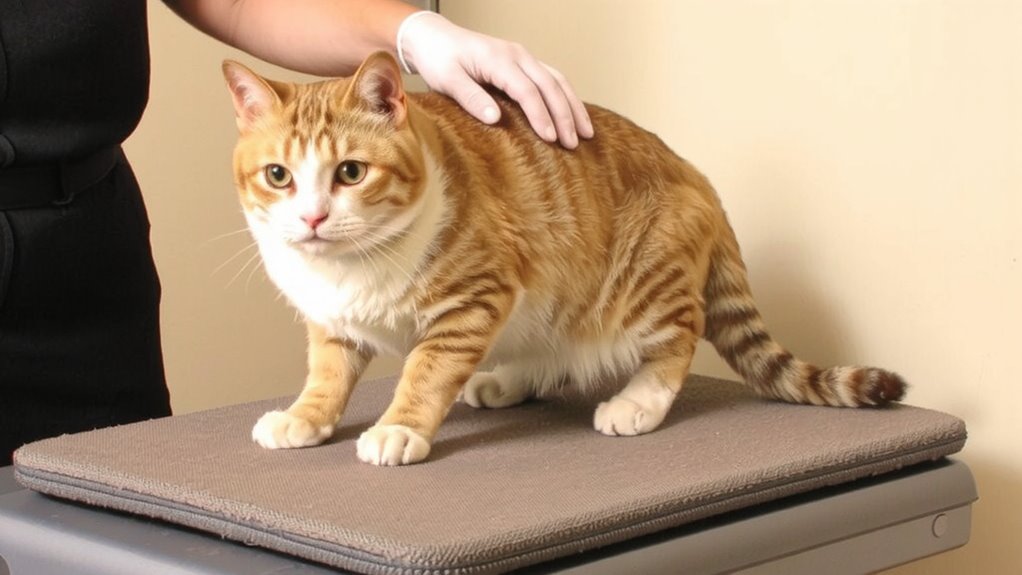
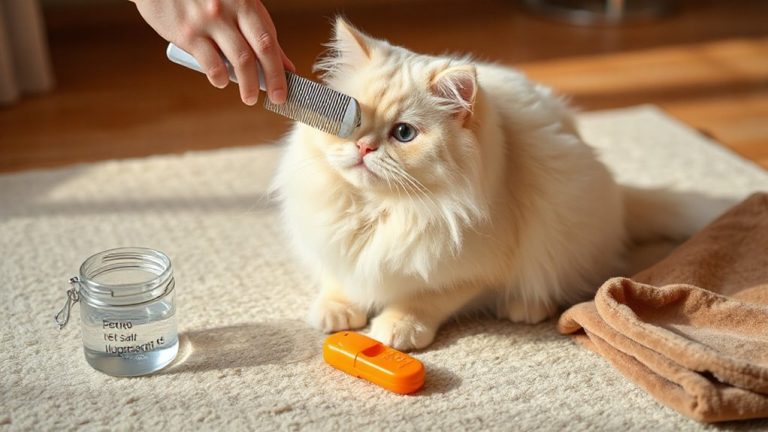
While mobility declines with age, your senior cat still needs regular grooming to prevent matting and skin issues. Use gentle brushing techniques to minimize discomfort and avoid putting stress on sensitive joints. Limit grooming to short sessions of 5–10 minutes to prevent fatigue and reduce anxiety. A soft-bristle brush or rubber grooming mitt works best, allowing effective removal of loose fur without irritating delicate skin. Start at the head and move posterior pushing, avoiding pressure on arthritic areas. If resistance occurs, discontinue and resume later. Conduct grooming on a non-slip surface to enhance stability. Elevated grooming tables set at 12–18 inches can reduce your bending strain but must allow the cat secure footing. Monitor for signs of pain-flinching, tail flicking, or growling-and adjust accordingly. Consistent short sessions improve coat condition and circulation without overexertion. Consider using a best smart pet brush designed for sensitive coats to enhance comfort and efficiency during grooming.
Support Your Cat’s Back End During Grooming
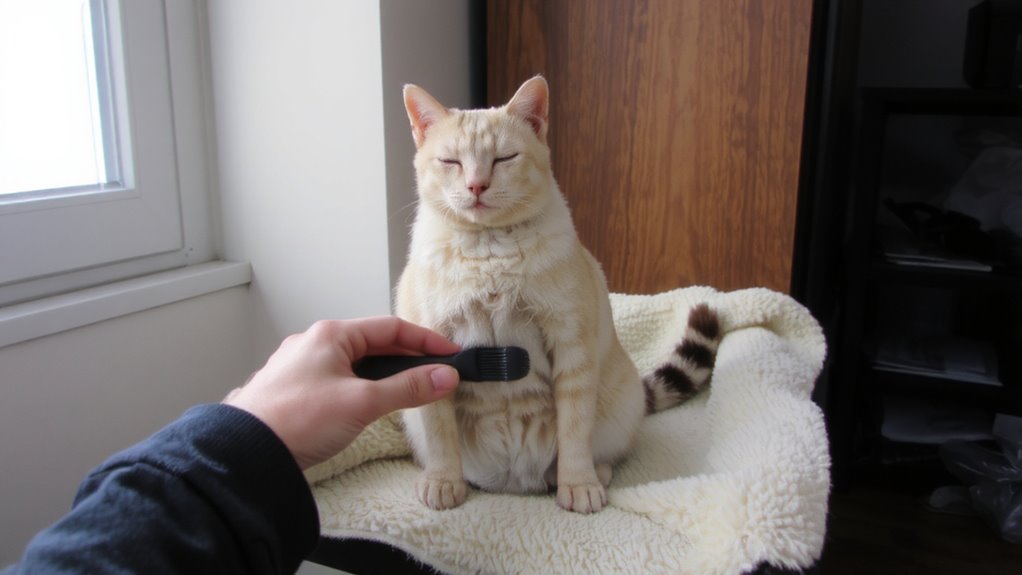
Support your cat’s back end during grooming to reduce strain on weakened joints and improve stability. Proper hip support prevents joint displacement during sessions. Use one hand beneath the pelvis to lift gently, aligning the spine neutrally. Avoid pulling on the tail; practice careful tail handling to prevent nerve damage or discomfort. Maintain a non-slip surface to enhance traction and balance. Below illustrates ideal hand placement and force distribution:
| Body Area | Hand Position | Pressure Applied |
|---|---|---|
| Hindlimbs | Under thighs, palms up | 2–3 oz |
| Pelvis (hip support) | Cradled in palm | 4 oz even lift |
| Tail base | Avoid direct grip, guide near sacrum | 1 oz or less |
Apply minimal force. Guarantee your cat remains calm and aligned throughout. This method preserves joint integrity and improves grooming efficiency.
Groom Your Cat While They Lie on Their Side
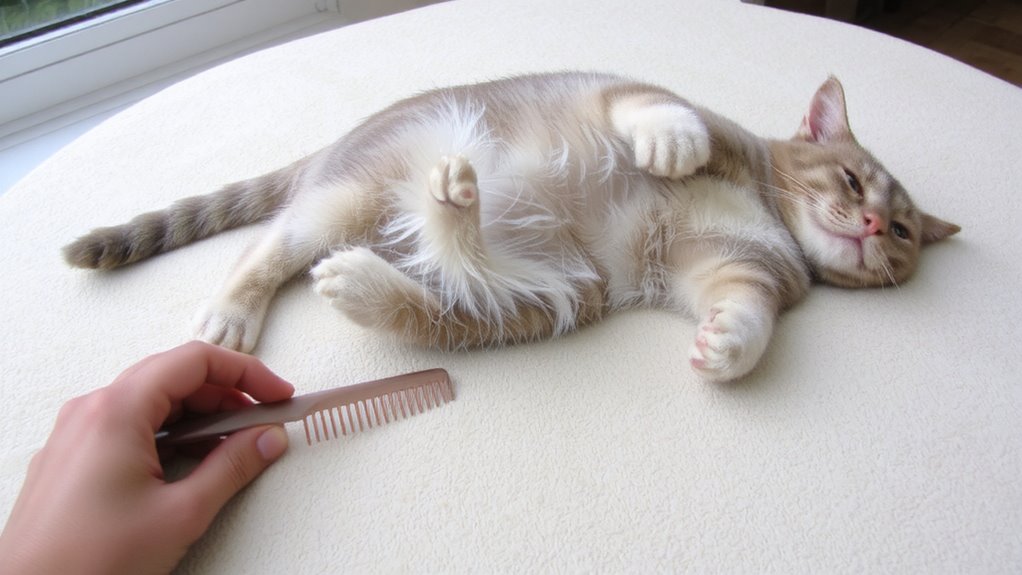
Position your cat on their side carefully to maintain joint alignment and reduce pressure on arthritic hips and knees. Use supportive padding beneath their body to prevent rolling and minimize joint strain. Apply gentle pressure with a soft-bristled brush, starting at the shoulder and moving toward the tail in smooth strokes. This technique reduces tugging on matted fur, which can cause discomfort. Keep your hands steady to provide consistent support and prevent sudden movements that may startle your cat. Work in small sections, no larger than 2 inches wide, to guarantee thoroughness without overhandling. Use a grooming tool with rounded bristle tips and a non-slip handle for better control. Limit sessions to 5–7 minutes to prevent stiffness. Monitor your cat for signs of fatigue or discomfort. This side-lying method improves access to the back and flank while supporting natural joint positioning. For long-haired cats, consider using a de-shedding tool designed to gently remove loose fur without irritating sensitive skin.
Use a Towel to Hold Your Cat Steady
A towel can help keep your cat steady and secure during grooming, especially when they’re lying on their side. Use a soft, absorbent cotton towel, approximately 28 x 56 inches, to provide a non-slip surface. Position the towel beneath your cat to enhance traction and prevent slipping. A proper towel grip allows you to maintain a secure hold without applying pressure to arthritic joints. Gently tuck the sides around your cat’s body, ensuring freedom of movement while minimizing wobbling. Avoid tight restraint-support, don’t squeeze.
| Benefit | Purpose |
|---|---|
| Slip resistance | Reduces joint strain from slipping |
| Towel grip | Enables controlled, steady handling |
| Secure hold | Prevents falls without confinement |
This method supports safe grooming access while protecting fragile musculoskeletal structures.
Start With Low-Stress Grooming Zones
Begin with areas your cat finds less sensitive-like the top of the head or along the spine-where they’re more likely to tolerate touch without agitation. Gentle brushing in these zones minimizes discomfort and builds trust. Use a soft-bristle brush with rounded polymer tips, applying light pressure no greater than 100 grams to avoid triggering pain responses. Work in short sessions of 2–3 minutes to prevent overstimulation. Maintain a quiet environment, free from loud noises or sudden movements, to reduce stress. Background noise should not exceed 45 decibels. Start with 2–3 strokes per area, gradually increasing contact as your cat adapts. Avoid joints, hips, and base of the tail initially. Monitor body language: flattened ears or tail flicking signal distress. Consistent, calm interaction conditions your cat to accept grooming as non-threatening, improving compliance over time.
On a final note
You should adapt grooming techniques to reduce discomfort for elderly cats with degenerative joint disease. Support their lower back and pelvis with a padded, non-slip surface angled at 15 degrees to ease pressure. Use a soft microfiber towel to stabilize without constriction. Begin with low-stress zones like the forehead and cheeks, using a fine-toothed comb with rounded tips (0.8 mm diameter). Limit sessions to 5 minutes, reducing handling stress and preventing joint strain.