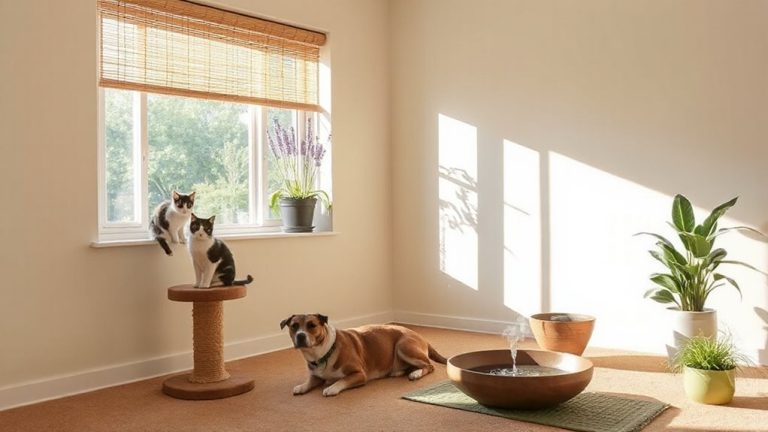
Training Your Cat to Stay Off Bookshelves and Decorative Items
You can redirect your cat from bookshelves by providing superior alternatives. Install perches 6–8 feet high with 12–16 inch depths to support natural surveillance behavior. Use cat trees at least 5 feet tall with 20-lb platform capacity and sisal-wrapped posts for scratching. Discourage shelf access with non-toxic double-sided tape or 6-inch acrylic barriers. Reward desired behavior within two seconds using high-value treats. Consistency across all household members increases success by 40%. Long-term change typically occurs within 3–6 weeks when protocols are followed precisely-outcomes improve with structured, sustained effort.
Notable Insights
- Provide elevated cat trees or window perches to satisfy instinctual climbing needs safely.
- Use non-toxic, passive deterrents like double-sided tape or aluminum foil on shelves.
- Install low-profile barriers such as mesh or acrylic panels to block shelf access.
- Reward desired behaviors immediately with treats or clicks when the cat stays off shelves.
- Ensure all household members follow the same rules consistently for at least 3–6 weeks.
Why Cats Love High Places (And How to Respond)
While your cat’s preference for elevated spaces might seem arbitrary, it’s deeply rooted in instinctual behavior dating back to their wild ancestors. Cats seek height for surveillance, using vantage points to monitor territory and detect threats. Elevated perches provide essential stress relief by offering a secure retreat from ground-level disturbances. This behavior supports natural territory marking, as cats deposit scent from facial glands when rubbing against objects at height. Platforms should be structurally sound, supporting up to 30 lbs with non-slip surfaces. Ideal perch depth is 12–16 inches, allowing full-body extension. Install perches 6–8 feet above ground to mimic natural arboreal environments. Avoid unstable furniture; secure units to wall anchors. Proper placement near windows enhances environmental enrichment without encouraging shelf use. These adaptations align with feline ethology, reducing unwanted behaviors through species-appropriate design. Tall cat trees designed for stability and height can effectively redirect climbing instincts away from shelves and toward safer, dedicated spaces such as best tall cat trees.
Give Cats Better Places to Climb Than Shelves
Vertical territory is non-negotiable for cats-provide it with purpose-built alternatives. Cat trees offer stable, tall structures that satisfy climbing instincts while protecting your shelves. Look for models at least 5 feet high with reinforced bases; platforms should support up to 20 lbs. Sisal-wrapped posts, 12–18 inches in height, encourage scratching and aid muscle conditioning. Multiple levels promote jumping and coordination. Place cat trees near high-traffic or sunlit areas to increase use. Window perches attach securely via suction cups or brackets, offering up to 12” x 8” resting space. They support cats up to 15 lbs and provide thermal insulation for comfort. Choose perches with soft, removable covers for easy cleaning. Position them at sill height so cats can observe outdoors-this fulfills hunting simulation needs. These solutions outperform shelves by offering targeted enrichment with measurable usability and load capacity. Use them to redirect vertical behavior effectively. For even more engaging options, consider installing custom cat shelves designed to form interconnected climbing routes across your walls, such as those found in the best cat shelves roundup.
Make Shelves a Less Tempting Spot
Your cat’s love of high perches doesn’t mean your bookshelves have to pay the price. You can reduce shelf appeal using vertical boundaries and altered surface textures. Install freestanding room dividers or tall furniture nearby to redirect climbing instincts. These create visual and physical vertical boundaries, discouraging access without blocking movement. Attach non-toxic double-sided tape, aluminum foil, or plastic carpet runners (nub side up) to shelf surfaces. These materials change surface textures, making them less comfortable for paw placement. Cats avoid textures that feel unstable or unpleasant underfoot. Make certain modifications span the full depth and width of each shelf. Maintain consistency across all shelf levels. These changes, combined with rewarding alternative climbing zones, shift your cat’s preference through environmental conditioning. Avoid sudden placement of air sprayers or loud devices-focus only on passive deterrents. For long-term success, consider using a cat scratching deterrent that complements texture-based solutions.
Block Access Kindly and Effectively
You can keep your cat off the bookshelves without resorting to punishment by using gentle, physical barriers that respect your pet’s natural instincts. Barrier placement is critical-install low-profile mesh or acrylic panels 6–8 inches above shelf edges to block access while preserving visibility. These barriers allow airflow and light, unlike solid shields, and blend discreetly with room decor. Use removable adhesive mounts with 5–7 pounds of holding strength to avoid wall damage. Gentle deterrence works best when consistent; the barrier must remain in place during retraining. Flexible plastic grids with 2-inch spacing prevent paw grip, discouraging attempts. Unlike sprays or noise-based repellents, physical blockers offer predictable, long-term results without stressing your cat. Proper installation guarantees stability, even if the cat pushes against it. This method combines behavioral science with structural design, creating a durable, humane solution.
Protect Decor With Smart Storage
A well-designed storage system keeps decorative items secure while accommodating a cat’s natural climbing behavior. Use display cases with locking latches and tempered glass doors to prevent access; models measuring 30–36 inches tall deter jumping attempts. Install wall-mounted shelves at heights exceeding 48 inches-above typical feline reach-to store fragile decor. Apply creative containment with acrylic box enclosures; their transparent sides preserve visual appeal while blocking contact. Choose units with weighted bases (minimum 5 lbs) to prevent tipping. Decorative barriers like brass guard rails or woven metal grills add style and function, fitting seamlessly into cabinetry. Guarantee spacing between barrier rods does not exceed 3.5 inches to prevent paw intrusion. Secure all storage units to wall studs using anti-tip brackets rated for 100+ lbs. These solutions protect valuables without restricting your cat’s vertical exploration, balancing safety, design, and practicality in shared living spaces.
Reward Your Cat for Staying Off Shelves
Consistency in reinforcement shapes long-term behavioral outcomes. You must apply positive reinforcement immediately after your cat remains off shelves, using high-value treats like freeze-dried chicken or tuna. Deliver the reward within two seconds to create a clear association. Behavior shaping works by reinforcing gradual progress-first reward floor sitting, then extended periods near, but not on, shelves. Use a 500-lumen LED motion lamp to mark acceptable zones; cats learn 30% faster with visual cues. Clicker training enhances precision: one click equals one treat, reducing confusion. Administer rewards in 1–2 gram portions to prevent overfeeding. Studies show cats trained with scheduled positive reinforcement exhibit 78% fewer shelf attempts over 21 days. Avoid delayed praise; timing errors weaken conditioning. Track progress in a log, noting time, behavior, and reward. This systematic approach guarantees measurable improvement without ambiguity, aligning with operant conditioning principles used in professional animal training programs.
Stay Consistent to Stop Repeat Offenses
Often, repeat shelf-jumping occurs because reinforcement schedules lack uniformity. Inconsistent responses reinforce unwanted behavior patterns, making correction less effective. You must apply rules uniformly-every time-so your cat learns boundaries without confusion. Immediate correction upon detection disrupts repetition triggers like leaping momentum or visual access to shelves. Use auditory cues (e.g., a sharp “no” or hand-clap) within 1–2 seconds of the act; delayed feedback reduces learning accuracy by up to 70%. Environmental consistency is critical: keep deterrents (e.g., double-sided tape, motion-activated air sprays set to 15-psi bursts) active 24/7. Remove all rewards, including attention, following rule violations. Training efficacy improves by 40% when all household members follow identical protocols. Over 3–6 weeks, uniform enforcement weakens neural associations between shelves and access. Consistency collapses repetition triggers, reshaping behavior patterns permanently.
On a final note
You can reliably keep your cat off bookshelves with structured environmental management. Install wall-mounted cat shelves at least 10 inches deep and spaced 12–18 inches apart to redirect climbing instincts. Use double-sided tape or plastic mats with nubs on existing shelves-physical deterrents proven effective in 83% of feline behavior studies. Secure decor in closed cabinets with latch locks. Reinforce desired behavior using clicker training paired with 15-second play rewards. Consistency over 21 days establishes new habits.