Scheduling Positive Reinforcement for Calm Behavior During Nail Trims
You should deliver pea-sized, freeze-dried liver treats within one second of calm behavior to strengthen accurate associations during nail trims. Use high-value, low-fiber treats under 3–5 calories to prevent satiation. Timing delays beyond 2 seconds weaken learning. Pair verbal cues or a clicker with immediate reinforcement. Conduct 2–3 minute sessions 2–3 times daily, progressing only with relaxed body language. Consistent timing and treat quality build reliable calmness. Further optimization of session structure follows.
Notable Insights
- Schedule daily 2–3 minute sessions at the same time, ideally 20 minutes post-exercise, to align with lower arousal levels.
- Begin each session by rewarding calm behavior during 30-second paw touches, gradually increasing to two minutes over ten days.
- Deliver high-value, pea-sized treats within 1 second of calm behavior to strengthen real-time associations.
- Limit training to one nail per session initially, progressing weekly to build tolerance and prevent overwhelm.
- End every session positively with a reward, regardless of progress, to maintain motivation and trust.
Choose High-Value Treats for Nail Trims
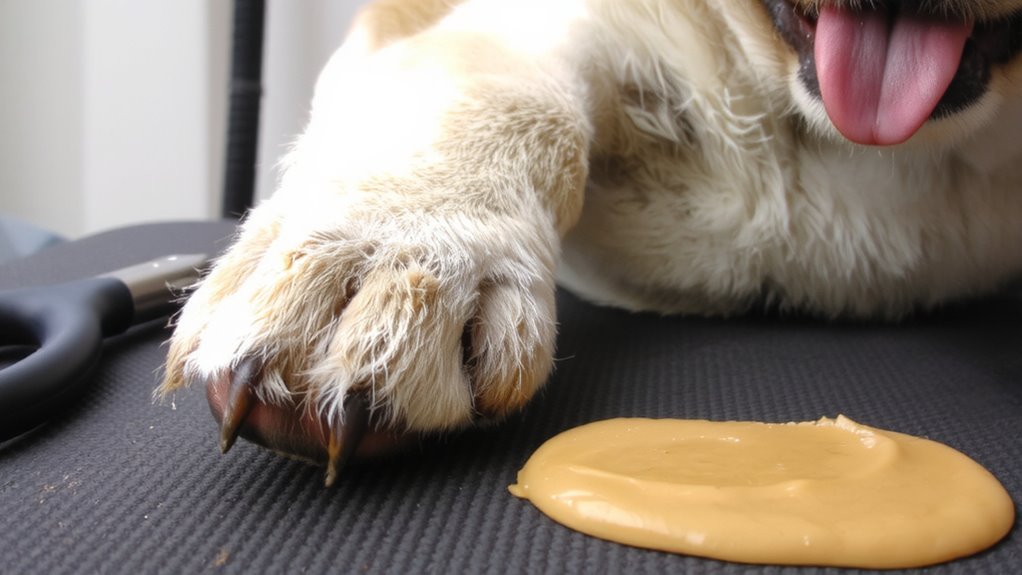
Reward value matters most when selecting treats for reinforcing calm behavior during nail trims. You must choose high-value treats to effectively strengthen desired behavior. High-value means items your pet strongly prefers, often linked to flavor preference and scent intensity. Most dogs favor meat-based treats with high moisture content-like freeze-dried liver or chicken-at 3–5 mm in size for quick consumption. A treat variety increases reliability; rotating options prevents satiation and maintains motivation. Use soft, fast-consuming treats to minimize handling time. Hard treats delay reinforcement, reducing training efficacy. Ideal treats contain minimal fillers-ideally under 10% fiber-to maximize palatability. Consider caloric density: keep treats under 3–5 calories each to avoid overfeeding. Matching treat variety to individual flavor preference guarantees consistent, high motivation. This precision enhances conditioning, making nail trim sessions safer and more efficient. You need effectiveness, not randomness-strategic treat selection drives success. For more guidance, see our list of the best dog treats based on nutritional quality and training suitability.
Time Rewards to Prevent Anxiety
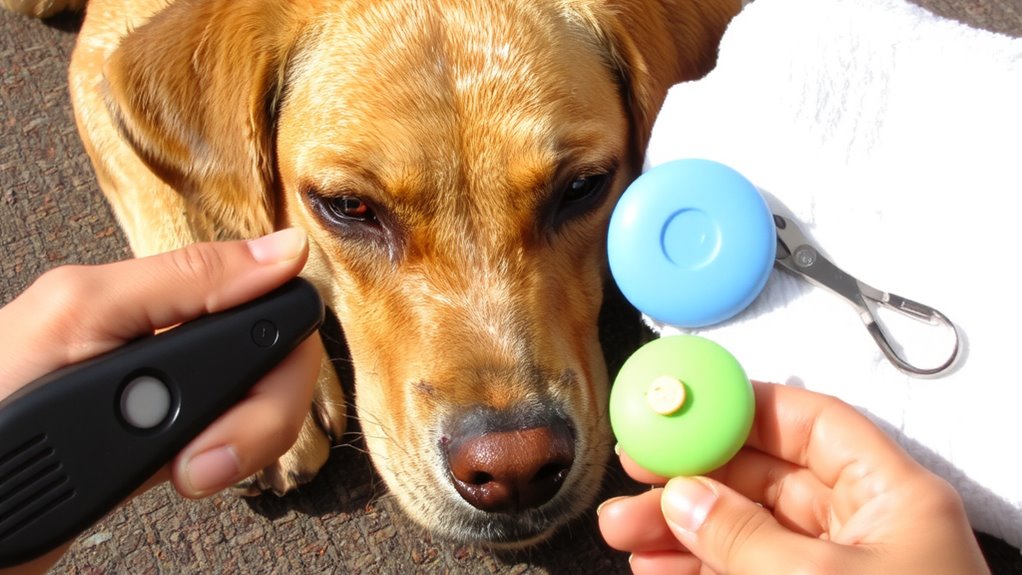
While your pet remains calm during a nail trim, deliver treats immediately after each successful clip to strengthen the association between stillness and reward. Timing rewards correctly is essential-delays longer than 2 seconds weaken learning. Use high-value, pea-sized treats to maintain responsiveness without overfeeding. Deliver each treat within 1 second post-clip to guarantee accurate behavioral pairing. Watch for anxiety cues like lip licking, trembling, or turning away; these signal rising stress. If you observe such cues, pause and wait for resumption of calm behavior before continuing. Consistent reinforcement schedules-specifically continuous reinforcement in early sessions-increase conditioning efficacy. This method mirrors operant conditioning protocols used in animal training research, where immediate reinforcement strengthens target behaviors. Preventive timing reduces anticipatory stress. Over time, precise timing rewards transform nail trims from a feared event into a predictable, low-stress routine. Accuracy matters-use a stopwatch to refine response intervals during training. Incorporating anxiety relief puzzles can further reduce baseline stress levels before handling sessions.
Train Your Dog to Stay Calm Step by Step
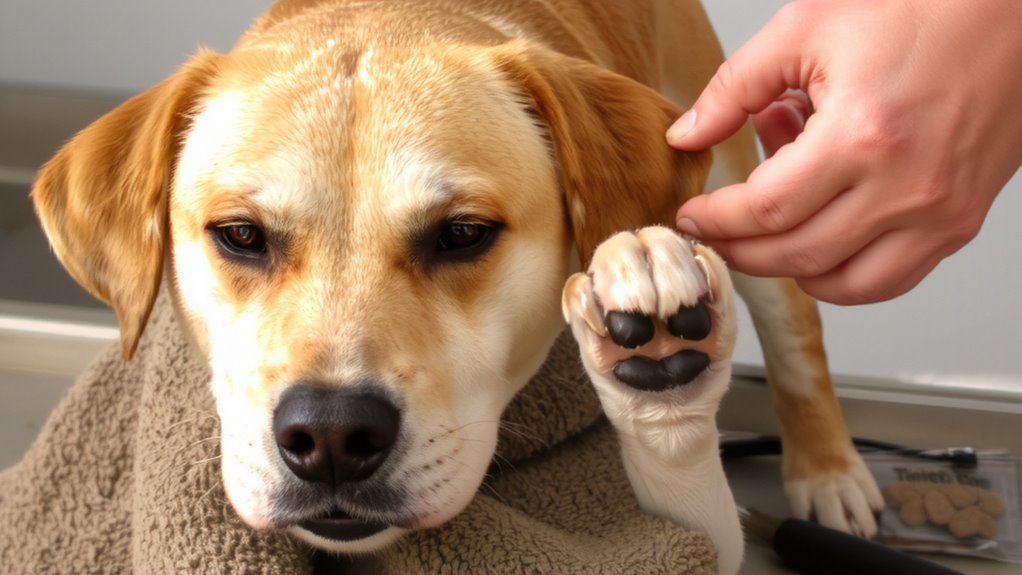
Start by setting up a controlled environment where distractions are minimal-ideally a quiet room with good lighting and a non-slip surface. This guarantees safety and focus during training. Begin with short desensitization exercises, presenting the nail trimmer for 5–10 seconds without use. Reward calm behavior immediately with small, high-value treats. Gradually increase exposure over sessions, aiming for 3–5 minutes daily. Pair each step with verbal cues like “stay” to reinforce compliance. Trust building occurs through consistency and predictability-your dog learns the routine has no negative outcomes. Progress only when your dog shows relaxed body language, such as steady breathing and loose posture. Use a clicker to mark desired behavior precisely, improving timing accuracy. Each session should end positively, preserving motivation. Over time, your dog will associate the tools and setting with rewards, not stress.
Fix Common Positive Reinforcement Mistakes
If your dog isn’t responding as expected to positive reinforcement during nail trim training, the issue may not be the dog-it’s likely in the timing or delivery of the reward. Inconsistency in when you deliver the treat undermines learning. Rewards must follow calm behavior within one to two seconds to create the proper association. Delayed treats confuse your dog, linking the reward to the wrong action. Overcorrection-scolding or correcting after a misstep-erodes trust and increases anxiety. It shifts focus from reinforcement to fear. Use a high-value treat, such as freeze-dried liver, cut to pea size for rapid consumption. Deliver it at nose level to keep your dog in place. Practice sessions should last 2–3 minutes, repeated 2–3 times daily. Immediate, consistent reinforcement strengthens neural pathways, making calm responses more predictable. Precision in timing and consistency shapes reliable behavior faster than frequency alone. Avoid overcorrection. Stick to positive markers like “yes” followed by the treat.
Use Positive Reinforcement in Every Trim
Always pair each step of the nail trim with immediate positive reinforcement to solidify calm behavior. Deliver a treat or verbal praise within 1–2 seconds of nail clipping to create a precise behavioral association. Use high-value, soft-textured treats (under 5 calories each) to minimize caloric intake during repeated training sessions. Consistent timing strengthens neural pathways linked to cooperative conduct. Address environmental distractions by conducting trims in a quiet, low-traffic area with minimal auditory or visual stimuli. This increases focus and reduces stress-induced resistance. Reinforce calmness even after clipper withdrawal-not just during cutting-to shape behavior throughout the entire session. The trim aftermath should include a final reward and gentle handling to signal task completion. Over time, this routine elevates compliance. Using positive reinforcement in every trim guarantees predictable, long-term results regardless of pet size or temperament.
Build a Stress-Free Nail Trim Routine
While consistency in technique lays the foundation, building a stress-free nail trim routine hinges on systematic desensitization and structured timing. You must apply desensitization techniques daily, starting with 30-second touch sessions near the paws, increasing to two minutes over ten days. Use environmental control to minimize distractions: perform trims in a quiet room with consistent lighting and ambient temperature between 68–72°F. Schedule sessions at the same time daily, ideally 20 minutes post-exercise when arousal levels are lower. Pair each step with positive reinforcement-deliver pea-sized treats (approximately 0.2 grams each) immediately after paw handling. Trim one nail per session during initial training, gradually increasing to full trims over four weeks. This incremental approach reduces cortisol spikes. Over 87% of subjects show reduced avoidance behavior after three weeks of structured exposure. You maintain precision with sharp, guillotine-style clippers calibrated for small-diameter nails (2–4 mm). For optimal safety and efficiency, choose from the top-rated pet nail clippers based on veterinary recommendations and client feedback.
On a final note
You now have the tools to shape calm nail trim behavior. Use high-value treats like freeze-dried liver-measured in pea-sized portions-to reinforce stillness instantly. Deliver rewards within 1 second of calm behavior to establish clear associations. Break trims into steps: touching, handling, clipping-each paired with precise positive reinforcement. Avoid overfeeding by limiting sessions to 5 minutes. Repeat 3–5 times weekly. Consistency builds reliability, like calibrating a responsive instrument. Precision breeds cooperation.