Assessing Interactions at Dog Parks to Prevent Bullying and Trauma Development
You can spot dog park bullying in under 30 seconds by tracking initiation and pursuit patterns. Persistent one-sided chases-lasting over 30 seconds without role reversal-signal dominance, not play. Watch for pinned ears, tucked tails, or rapid panting, which indicate stress. Bullies initiate over 80% of interactions with pursuit-to-yield ratios exceeding 4:1. Use a sharp “Hey!” to interrupt, then apply 6–8 feet of separation. A structured response prevents trauma and sets the stage for healthier social dynamics.
Notable Insights
- Monitor for one-sided play where one dog initiates 80% or more of interactions without allowing breaks.
- Watch for persistent chasing over 30 seconds, which indicates dominance, not mutual play.
- Look for stress signals like pinned ears, tail tucking, or rapid panting in potentially targeted dogs.
- Use vocal interruptions like a sharp “Hey!” to reset escalating interactions before physical intervention.
- Ensure play includes reciprocal behaviors such as role reversal, play bows, and equal pursuit-to-yield ratios.
Understand Normal Dog Play vs. Bullying
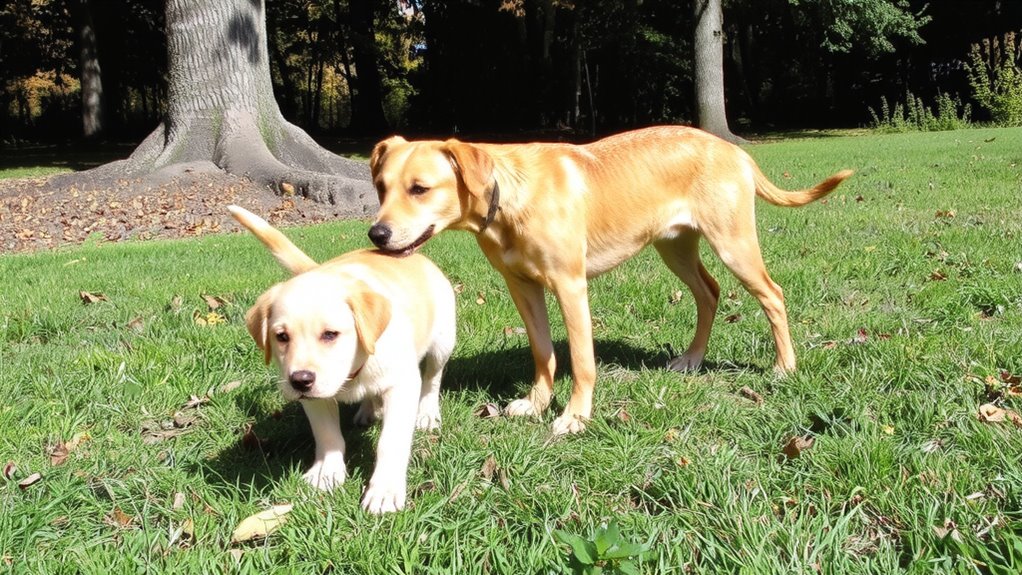
While watching your dog at the park, you might notice behaviors that seem rough but are actually normal play, such as lunging, wrestling, or mock growling. These actions are part of typical play patterns in healthy dog interactions. Play patterns often include bowing, rapid role reversals, and self-handicapping, where one dog momentarily restrains strength. Dogs use these structured behaviors to signal intent and maintain mutual engagement. Social cues like relaxed posture, open-mouthed expressions, and playful barks distinguish friendly play from aggression. Monitoring these cues helps assess emotional states. Normal play shows symmetry in movement and turn-taking, lasting seconds to minutes. Asymmetry or persistent chasing without invitation may indicate imbalance, though not necessarily bullying. Accurate identification requires observing both frequency and context of behaviors. Understanding these dynamics supports informed intervention. You should track interactions across multiple visits to establish behavioral baselines. Play is essential for canine development and social learning.
Spot the Signs of Dog Bullying at the Park
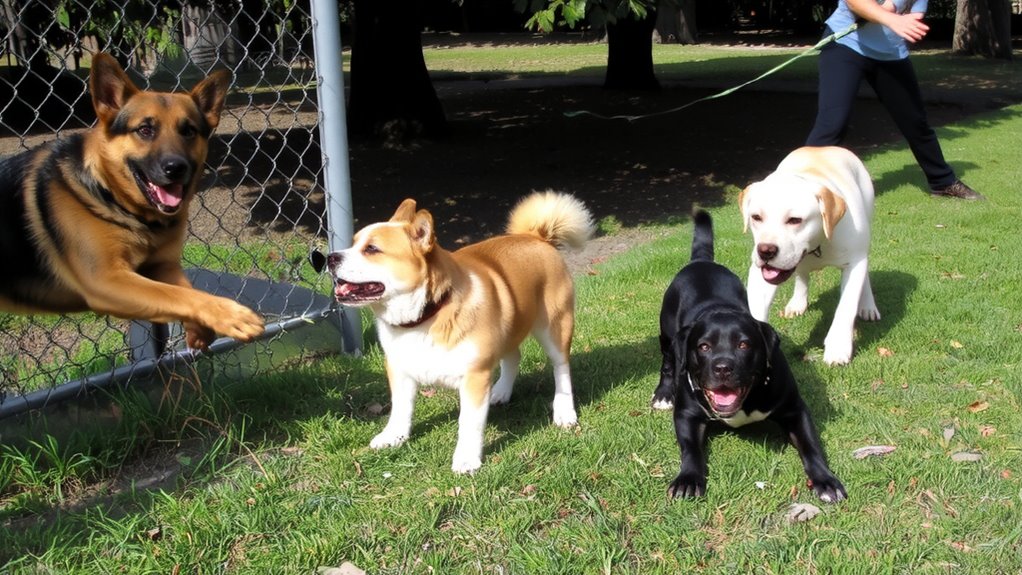
Because play should be balanced and consensual, persistent one-sided behaviors can signal bullying. You need to observe play patterns closely-bullying often shows as repeated lunging, mounting, or snapping without role reversal. Normal play includes pauses, bows, and reciprocal chasing; bullying lacks these recovery moments. Watch for dogs dominating access to space or toys, enforcing rigid social hierarchies through constant aggression. These aren’t just personality clashes-they’re behavioral imbalances. Bullies typically initiate 80% or more of interactions, not allowing disengagement. Victims rarely get opportunities to rest or retreat safely. The play becomes predictable, not dynamic. Disproportionate pursuit-to-yield ratios indicate coercion, not fun. You can measure this over 10-minute intervals: count initiations, escapes, and play bows. Imbalances exceeding 4:1 in initiations suggest bullying. Recognizing these signs early prevents trauma. You must intervene before stress solidifies into learned helplessness.
Read Body Language That Shows Fear or Stress
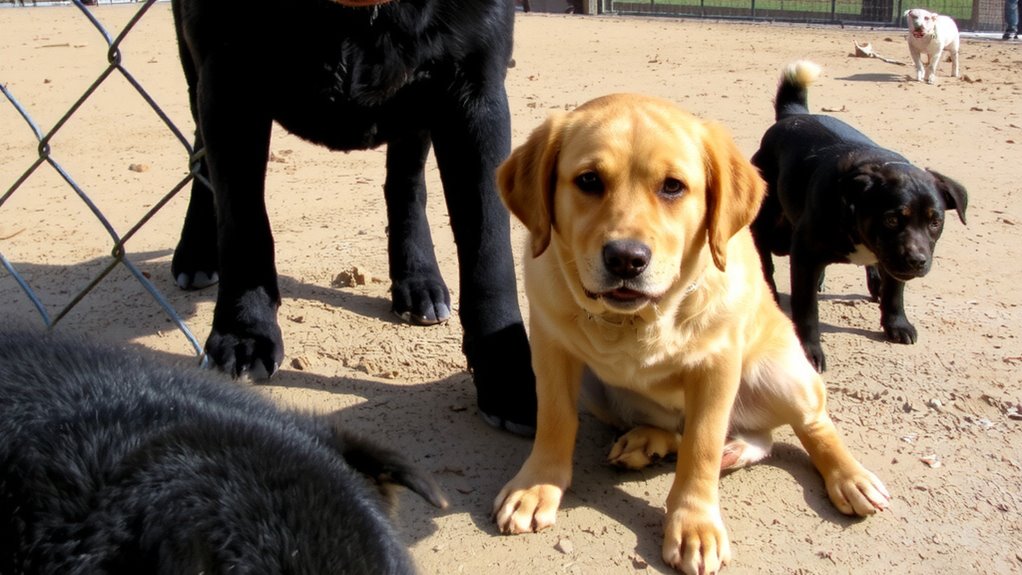
Look for pinned ears, a lowered tail, and rapid panting when the dog isn’t overheated-these are key visual indicators of fear or stress. Pinned ears lie flat against the head, signaling discomfort or submission. Tail tucking, where the tail is drawn tightly beneath the body, reflects heightened anxiety. These postures are involuntary stress responses. A dog may also exhibit lip licking, whale eye (showing the whites), or freezing in place. Rapid panting without exertion indicates elevated cortisol levels. Avoid interpreting these as submissive play; they’re signs of psychological distress. Chronic exposure can lead to trauma. Assess duration and frequency: brief fear reactions are normal, but persistent signals suggest ongoing stress. Note that breed-specific anatomy-like naturally curled tails-can mask tucking. You must adjust observations accordingly. Recognizing these cues helps protect your dog’s mental well-being.
Stop Dog Bullying Before It Escalates
You can prevent dog bullying at the park by recognizing early behavioral signs and intervening before aggression erupts. Persistent chasing, pinned ears, or rigid posture often signal imbalance in social dynamics. Dogs with incomplete dog training may struggle to read cues, increasing conflict risk. Observe interaction duration: sessions exceeding 30 seconds of one-sided pursuit indicate dominance, not play. Use vocal interruption-sharp “Hey!”-to reset behavior without direct engagement. Maintain 6–8 feet distance between dogs showing tension; spatial separation prevents escalation. Unspayed/unneutered males and resource-guarding dogs pose higher risks. Monitor group size: more than five dogs over 50 lbs. amplifies unpredictability. Early intervention preserves emotional safety. Document repeated offenders’ breeds, colors, and behaviors for park staff. Consistent observation and baseline knowledge of normal play-equal roles, loose bodies-help identify deviance. You play a critical role in maintaining balanced social dynamics.
Safely Intervene in a Dog Park Conflict
When tensions escalate despite early warnings, knowing how to safely break up a dog park conflict becomes critical. Use verbal redirection first-sharp, loud commands like “Leave it!” can disengage dogs without physical contact. This method relies on conditioned responses, ideally established during basic obedience training. If verbal cues fail, proceed to leash intervention. Approach from the side or rear to avoid bites, clip a leash to the collar, and use controlled backward pressure to remove your dog. The force should be firm but not jerking-typically 10–15 pounds of pressure-to prevent injury. Avoid grabbing collars head-on; this increases bite risk by 60%. Maintain a 30-degree angle during removal to leverage body mechanics. Keep your movements predictable. These techniques minimize trauma and reduce escalation likelihood. Always wear sturdy footwear and avoid loose clothing.
Help a Bullied Dog Rebuild Confidence
Though past experiences can reshape a dog’s behavior, recovery is achievable through structured, science-based interventions. You can rebuild confidence using consistent positive reinforcement, which strengthens desired behaviors by immediately rewarding them with treats, praise, or toys. Deliver rewards within 0.5 to 1 second of the behavior to guarantee proper association. Begin in a low-stress environment, gradually introducing controlled social exposure. Limit initial sessions to 10–15 minutes, increasing duration by 5-minute increments weekly. Pair unfamiliar dogs with calm, predictable temperaments as social partners. Maintain a 3-meter distance at first, reducing it gradually only if the dog remains relaxed-indicated by a loose posture and open mouth. Use a 1:3 reward ratio during exposure-reward three times for every one neutral interaction. Track progress using a behavioral log, noting changes in heart rate, tail position, and approach latency.
On a final note
You must recognize the difference between play and aggression. Normal play includes balanced chase, reciprocal bowing, and role reversal. Bullying shows one-sided pursuit, no role exchange, and sustained intimidation. Signs include pinned ears, tucked tail, and avoidance. Intervene early using leash control or distraction. Prevent trauma by removing stressed dogs promptly. Confidence rebuilds through structured, positive reinforcement sessions. Consistent observation guarantees safety.