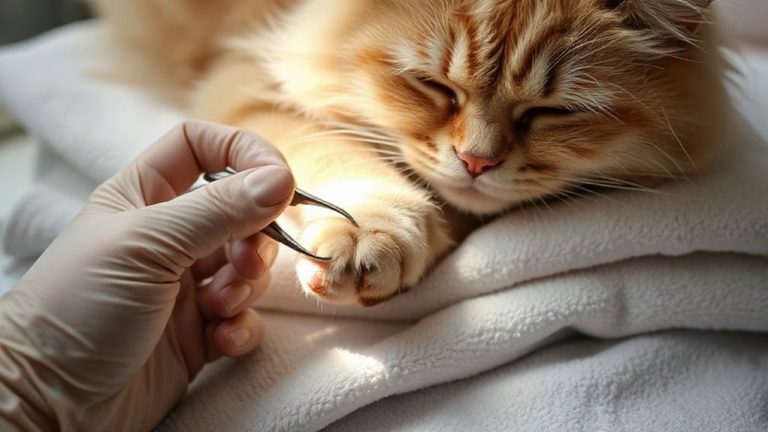
Addressing Litter Box Avoidance Due to Texture or Scent Sensitivities
Avoid scented litters-they contain VOCs that can irritate your cat’s sensitive respiratory system, especially in breeds like Persians. Cats have 200 million scent receptors, so unscented, low-dust litters are essential. Choose clay or silica with 1–2 mm granules to mimic natural sand, reducing paw discomfort. Scoop daily, clean the box monthly, and guarantee it’s 1.5 times your cat’s length. If avoidance persists, consider medical causes like UTIs or arthritis. A proper setup and gradual litter change improve acceptance and long-term use.
Notable Insights
- Avoid heavily perfumed litters, as artificial fragrances can overwhelm cats’ sensitive scent receptors and deter box use.
- Choose unscented, low-dust litters with a 1–2 mm grain size to mimic natural sand and reduce respiratory irritation.
- Transition to a new litter gradually over 7–10 days by mixing increasing amounts of the new with the old.
- Maintain clean, spacious litter boxes without scented liners, scooped daily and fully changed weekly.
- Rule out medical issues like urinary infections or arthritis, which can mimic texture- or scent-related litter box avoidance.
Avoid Scented Litters That Repel Cats
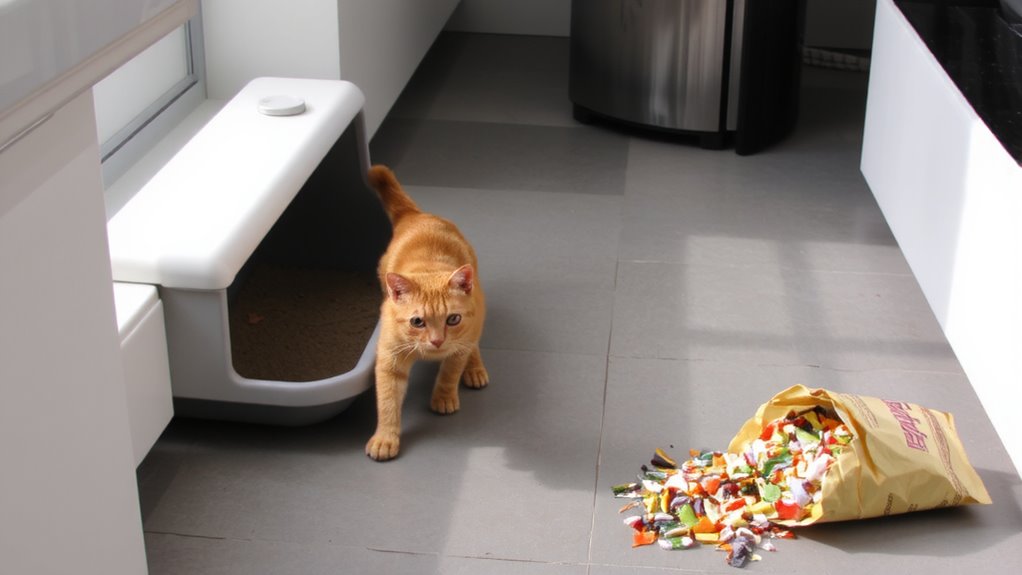
A heavily perfumed litter might seem like a good way to mask odors, but it often backfires by repelling cats from their box. You should avoid scented litters because they contain chemical irritants that can trigger adverse reactions. These additives release volatile organic compounds (VOCs), which cats inhale during use. Prolonged exposure increases the risk of respiratory issues, especially in breeds with shortened airways like Persians. Cats have 200 million scent receptors-far more than humans-making them highly sensitive to artificial fragrances. Unscented, low-dust clay or silica-based litters reduce inhalation risks and minimize irritation. Particles smaller than 10 microns can penetrate deep into lung tissue, worsening inflammation. Choose litters labeled “fragrance-free” and “low-residue” to reduce airborne particulates. Opt for products meeting ASTM safety standards for pet use. Your cat’s respiratory health and litter box consistency depend on eliminating unnecessary chemical irritants from their environment.
Watch for Litter Box Red Flags
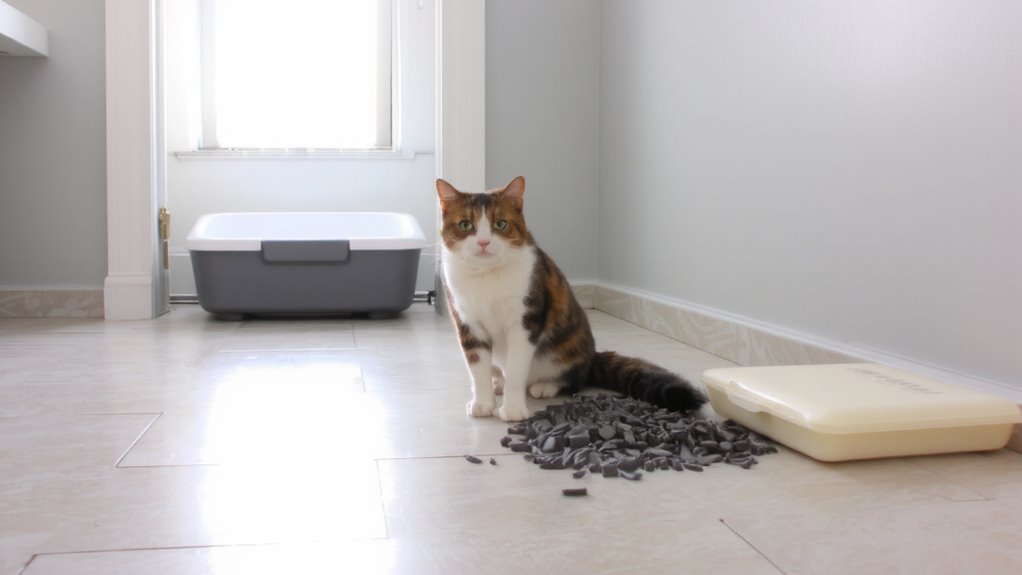
When your cat starts avoiding the litter box, subtle behavioral or physical changes may signal underlying issues that go beyond simple preference. A too-small litter box size can deter use; the box should be 1.5 times your cat’s length for comfortable turning and digging. Insufficient cleaning frequency is a leading cause of avoidance-scoop daily and replace litter entirely every 7–10 days to reduce odor buildup. Ammonia accumulation from waste alters scent and pH, repelling sensitive cats. Observe for signs like scratching outside the box, crouching hesitantly, or eliminating nearby. These indicate discomfort with current conditions. Use non-porous liners and wash the box monthly with mild soap to avoid chemical residue. Guarantee at least one box per cat, placed in quiet, accessible areas. Adjustments in size and cleaning frequency often resolve issues without medical intervention. Monitor consistently for lasting improvement.
Rule Out Pain or Illness First
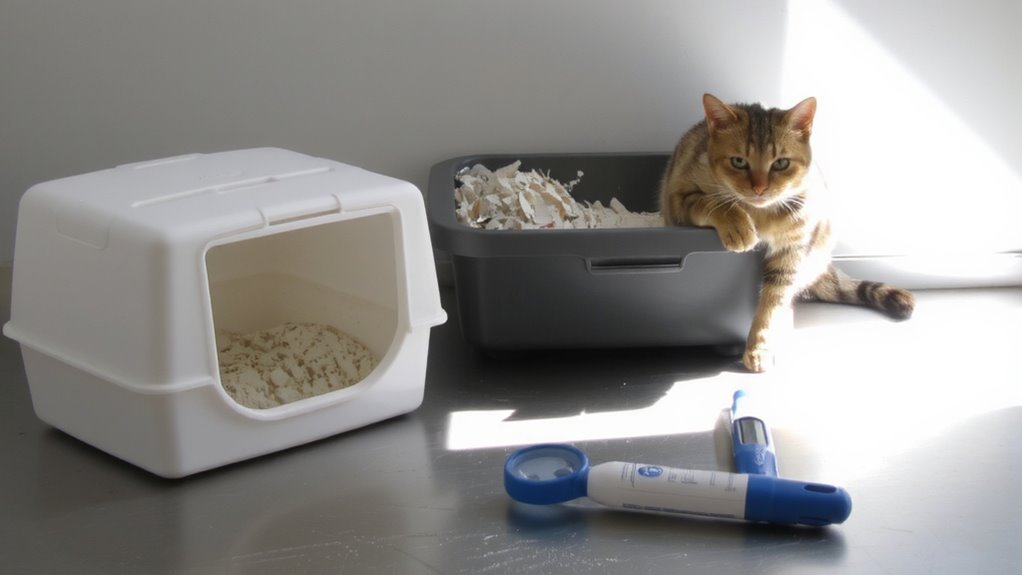
Because medical issues can mimic behavioral problems, you shouldn’t assume your cat is avoiding the litter box out of defiance or preference. A prompt veterinary consultation is critical to identify underlying conditions such as urinary tract infections, bladder stones, or arthritis. These disorders can cause pain during elimination, leading to litter box aversion. During the exam, your veterinarian may recommend medical testing, including urinalysis, blood work, and radiography, to detect infections, kidney disease, or structural abnormalities. For instance, elevated serum creatinine levels above 2.1 mg/dL may indicate renal impairment. Conditions like feline interstitial cystitis often present with frequent small urine volumes and can be confirmed through clinical signs and exclusion of pathogens. Pain from osteoarthritis, especially in senior cats, can limit mobility, making box entry difficult. Diagnosing these issues early improves treatment outcomes and prevents permanent behavioral changes.
Pick Unscented Litters That Mimic Sand
Texture matters most when choosing a litter your cat will consistently use. Unscented litters that mimic natural sand offer the ideal solution for sensitive cats. Opt for a grain size between 1–2 mm, closely resembling loose beach sand, which most cats prefer for digging and covering waste. Larger granules can feel abrasive, while finer particles may compact too tightly. Low dust levels are essential-select litters with less than 3% airborne particulate to reduce respiratory irritation and keep the air cleaner. Clay and silica-based options often produce more dust; plant-based litters like corn or walnut frequently offer finer control. These materials also maintain a soft texture without added perfumes. Unscented formulas prevent olfactory overload, which can deter usage. By prioritizing natural sand-like feel, precise grain size, and minimal dust, you create a welcoming, functional environment that encourages reliable litter box use. For budget-conscious pet owners, best affordable cat litter options are available that meet these sensory and performance standards without sacrificing quality.
Match Texture to Your Cat’s Paws
Your cat’s paw sensitivity plays a direct role in litter acceptance, building on the importance of selecting a sand-like texture free of artificial scents. Cats have thousands of nerve endings in their paws, making substrate preference critical for litter box use. A fine-grain, clumping clay litter measuring 1–2 mm in particle size closely mimics natural sand, aligning with most cats’ tactile expectations. Course or irregularly shaped litters cause discomfort, especially in cats with sensitive paw pads or age-related changes. Silica crystals, though effective at odor control, often feel unnatural and are frequently rejected. Opt for unscented, low-dust litters with soft, uniform particles. Studies show 85% of cats display stronger substrate preference for fine granules over heavy or angular alternatives. Matching texture to your cat’s paw sensitivity reduces avoidance behaviors and supports consistent box use without requiring behavioral correction later. For cats weighing around 15 lbs, choosing a litter that balances texture and clumping performance is essential, and best 15 lb cat litter options are formulated to meet these specific needs.
Switch Litter Gradually Without Stress
Most cats resist abrupt changes in litter type, so changing gradually is essential to prevent avoidance. A successful litter change requires mixing the old and new litter over 7–10 days. Start with 90% old litter and 10% new, adjusting daily to shift the ratio. This allows sensory adaptation, minimizing stress from unfamiliar texture or scent. By day 7, use a 50/50 blend; by day 10, switch to 100% new litter if the cat shows no avoidance. Use identical box placement and scoop daily to maintain consistency. Clumping litters with particle sizes between 2–3 mm closely mimic natural substrates, improving acceptance. Avoid scented additives during change, as they can overwhelm sensitive olfactory systems. Monitor urination and defecation patterns closely-any disruption indicates delayed adaptation. This phased method supports neurological habituation, aligning with feline behavioral physiology. For those using automated systems, choosing a compatible best clumping cat litter can further enhance acceptance and performance.
On a final note
You must prioritize unscented, fine-grained silica or clumping clay litters to address aversion. These materials mimic natural sand, with particle sizes between 0.5–2 mm, matching feline paw sensitivity. Gradually blend old and new litter over 7–10 days, replacing 10% daily to minimize stress. Always confirm medical causes are ruled out via veterinary exam, including urinalysis and abdominal palpation. Proper box maintenance-scooping twice daily, full changes weekly-ensures consistent texture and hygiene, critical for long-term acceptance.