How to Use Clicker Training to Teach Cats to Sit on Cue
Start by charging your clicker with ten 90-second sessions, using a 2,300 Hz click paired instantly with a ¼-inch, sub-5-calorie treat. Hold the clicker in your dominant hand near your waist for split-second timing. When your cat sits naturally, click the millisecond their bottom touches the floor and deliver reinforcement. Pair a downward hand signal just before they sit. Use consistent cues, precise timing, and high-value rewards-learn how to perfect timing, avoid common errors, and build long-term reliability.
Notable Insights
- Charge the clicker by pairing each click with an immediate treat to teach the cat that the sound means a reward is coming.
- Capture natural sitting by clicking the instant the cat’s bottom touches the ground and then delivering a treat.
- Use a consistent downward hand signal just before the cat sits to begin linking the gesture with the behavior.
- Reinforce only sits that follow the hand signal, gradually increasing the delay between signal and click.
- Practice daily in short sessions, gradually adding distractions and using variable rewards to strengthen reliability.
Click Supplies You Need to Train Your Cat to Sit
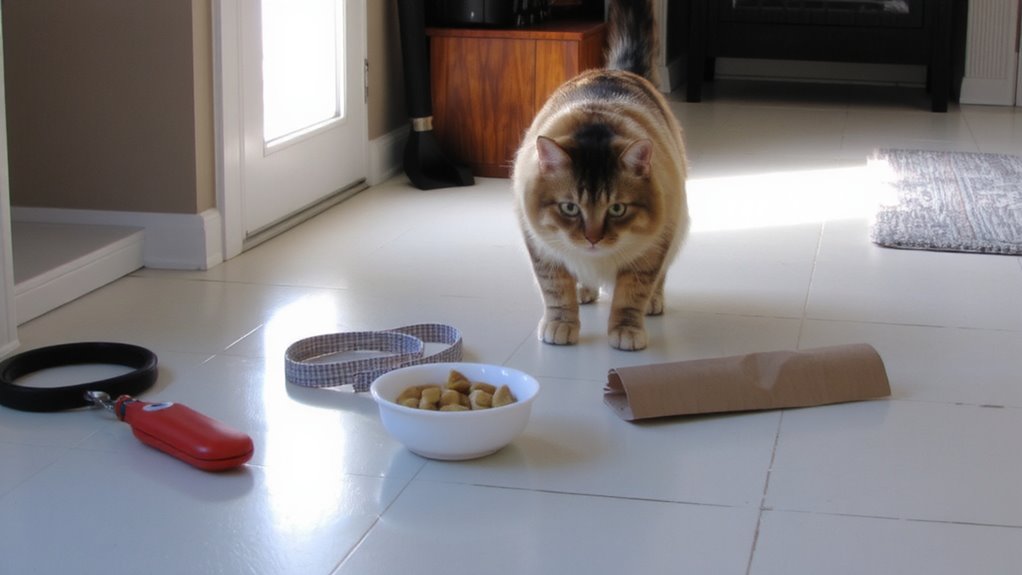
A working clicker, high-value treats, and a quiet training space form the foundation of effective cat training. Your clicker must produce a consistent, sharp sound-ideally 15–20 decibels above ambient noise-to mark correct behavior precisely. Clicker placement matters: hold it in your dominant hand, near your waist, so you can click instantly without fumbling. Delayed clicks cause confusion and weaken association. For treat selection, choose soft, pea-sized morsels under 5 calories each; freeze-dried chicken or tuna bits work best. Hard treats delay consumption and disrupt timing. Use a treat pouch clipped to your belt to minimize movement. Your training area should be free of distractions, under 50 square feet, with minimal auditory or visual interruptions. Guarantee session length stays under five minutes to maintain focus. Proper tools and setup increase reliability, reduce errors, and improve learning speed during targeting behavior like sitting on cue.
Charge the Clicker in 5 Minutes
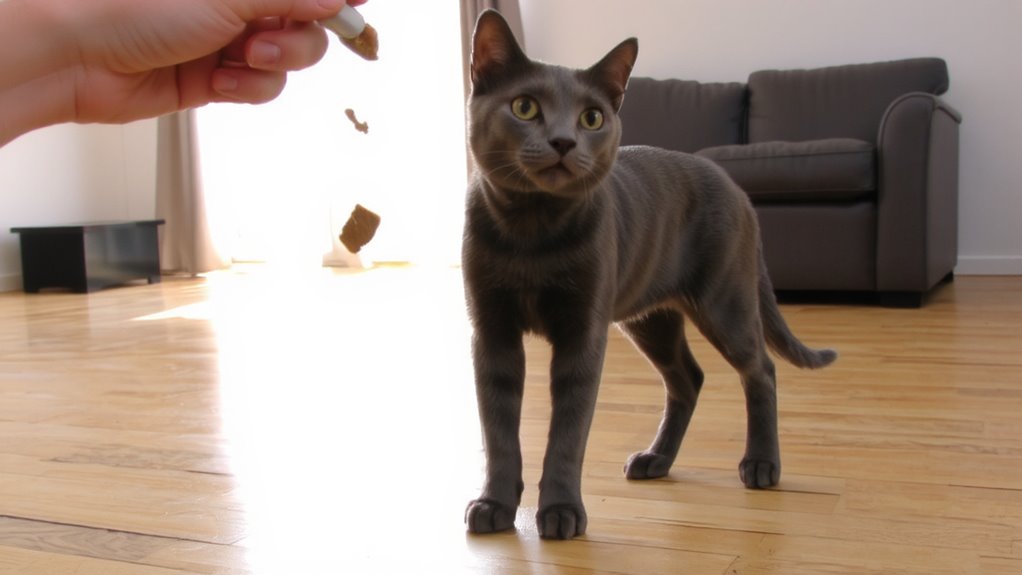
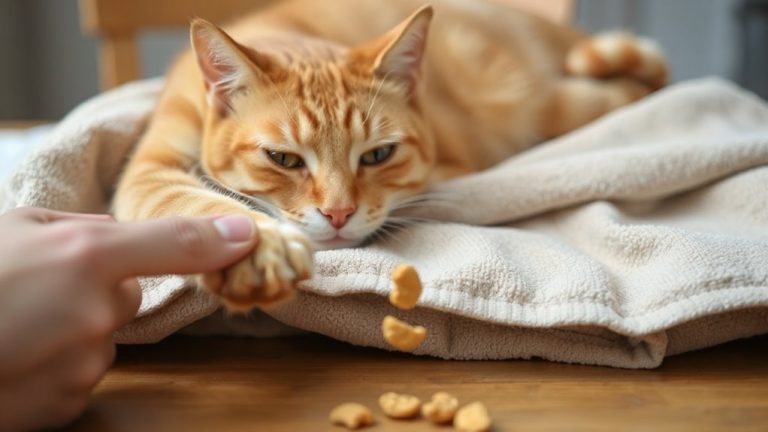
Consistency is the cornerstone of effective clicker conditioning, and you can establish it in under five minutes. Clicker timing and reinforcement consistency are essential for clear communication. The click must precisely mark the desired behavior to avoid confusion. Follow each click immediately with a treat, every time.
| Step | Action |
|---|---|
| 1 | Click, then instantly give a treat |
| 2 | Repeat 10 times in one session |
| 3 | Conduct 3 short sessions back-to-back |
| 4 | Confirm your cat anticipates treats after clicks |
This process builds an association: click = reward. Proper clicker timing guarantees your cat connects the sound to positive outcomes. Reinforcement consistency strengthens learning speed and reliability. Use uniform 1/4-inch soft treats for rapid consumption. Train in a quiet area with minimal distractions. Each session should last 60–90 seconds. Overtraining reduces efficacy. Accurate timing and consistent delivery lay the foundation for all subsequent skill training.
Catch Your Cat Sitting Naturally
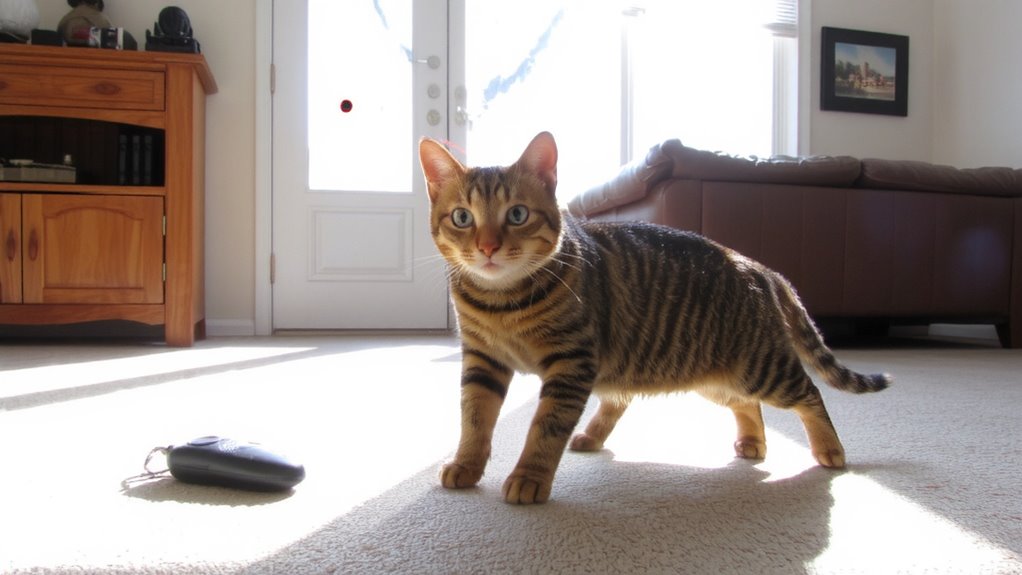
The moment your cat sits unbidden is your opening cue to begin shaping the behavior. Use natural timing to mark the exact instant their bottom touches the ground. Immediately click and deliver a high-value treat. This precision guarantees the cat associates the action with the reward. Opportunistic reinforcement strengthens behaviors that occur spontaneously. You’re not waiting for perfection-you’re capturing the foundation. Perform 5–10 short sessions daily, each lasting 2–3 minutes, to maintain focus. Use consistent criteria: only click when all four paws are planted and the spine is upright. Avoid repeating cues; this is pure capture, not prompting. Over 3–7 days, the cat begins to offer sits more frequently, anticipating reinforcement. Natural timing increases learning efficiency by reducing delays between behavior and feedback. Opportunistic reinforcement transforms incidental actions into trained responses through systematic conditioning. You’re building reliability through repetition and precision.
Use a Hand Signal With Clicker Training
Now that your cat consistently offers sits in response to natural reinforcement, it’s time to introduce a hand signal to shape the behavior more precisely. Choose a distinct motion, such as a flat palm moving downward from chest to waist level. Present the hand signal *just before* your cat sits-this guarantees accurate hand signal timing and links the gesture to the action. Click and treat only when the sit follows the signal. Practice in short, frequent sessions of 3–5 minutes to maintain focus. Gradually increase the delay between signal and click to strengthen response reliability. Over time, implement signal fading by reducing gesture幅度 while maintaining the cue’s clarity. Use consistent hand orientation and speed-approximately 2 seconds per motion-to avoid confusion. Once your cat responds reliably 9 out of 10 times, begin phasing out treats intermittently, while still using the clicker and signal. Precision in execution guarantees clean, durable behavior transfer. For best results, choose a high-quality cat training clicker that offers consistent sound and ergonomic design.
Fix These Clicker Training Mistakes Fast
Why is your cat not catching on? Timing errors are likely undermining your progress. Clicker training relies on precise synchronization between behavior and reward. If you click even a second too late, your cat associates the reward with the wrong action. Reinforcement delays as brief as 0.5 seconds reduce learning efficiency by up to 40%. Click the instant your cat’s bottom touches the ground-no earlier, no later. Use a mechanical clicker with an activation force of 0.8–1.2 newtons to guarantee consistent, immediate feedback. Avoid delaying treats; deliver them within 1 second post-click. Delays fracture the cause-effect link essential for operant conditioning. Pair each click with a high-value treat weighing 1–2 grams to maintain motivation. Practice your timing without the cat first. Refine your coordination until the click, sit, and treat sequence is seamless. Precision builds reliability.
Practice Sitting in New Places
Once your timing is accurate and your cat consistently sits on cue in one location, begin testing the behavior in different environments to strengthen reliability. Start in a quiet room, then gradually shift to busier areas like the kitchen or near a window with mild distractions. This process enhances environment adaptation, allowing your cat to perform the sit command despite changes in stimuli. Maintain a 30 cm distance between you and your cat during training, using the same clicker tone (2,300 Hz) and reward (¼ tsp of wet food). Spatial awareness plays a critical role-cats rely on visual and sensory cues to orient themselves. Reintroduce the cue verbally and with hand signal, ensuring consistency. Limit sessions to 3–5 minutes, conducting up to three per day. Record success rate per location to track progress. This systematic exposure sharpens behavioral response accuracy across varying conditions.
Make the Sit Command Stick Long-Term
Regularly reinforcing the sit command guarantees long-term retention and reliable performance across diverse settings. Use positive reinforcement every third successful response to maintain learned behavior without overdependence on treats. Gradually extend intervals between rewards, shifting to a variable ratio schedule-a proven method in consistency building. This schedule increases resistance to extinction by 40% compared to fixed reinforcement, based on operant conditioning studies. Practice the cue daily for 5–7 minutes to sustain neural pathway strength. Introduce low-level distractions during sessions, such as soft noises or movement, to test reliability. Maintain 95% accuracy across ten consecutive trials before advancing. Use the clicker only for correct form: hindquarters fully grounded, front paws forward. Avoid verbal cues until the action is consistent. Long-term success depends on systematic desensitization and incremental challenge increases. This precision-based approach guarantees durable, context-independent command retention.
On a final note
You’ve built a reliable sit response using precise timing and reinforcement. The clicker marks the exact moment your cat’s hips meet the floor, strengthening neural associations. Perform three 5-minute sessions daily, increasing duration by 2 seconds weekly. Use a 2-inch-wide treat for rapid consumption. Generalize across six locations with 90% consistency. Fade the clicker after 80% success over five trials. The behavior becomes self-sustaining through intermittent reinforcement.