Negative Punishment Effects on Pet Birds: Using Consequences Wisely to Promote Good Conduct
You can use negative punishment to reduce unwanted behaviors like screaming by removing attention within one to two seconds. This method removes a positive stimulus-your presence-right after the behavior occurs. Delaying weakens the link and may confuse your bird. Ignore for at least 10 seconds to guarantee no accidental reinforcement. Pair this with rewarding quiet behavior immediately. Consistency across all household members is critical for success. Timing and precision shape effective learning-there’s more to discover about trust-based training that strengthens cooperation without fear.
Notable Insights
- Negative punishment reduces unwanted bird behavior by promptly removing a desirable stimulus, like attention.
- Immediate timing-within one to two seconds-strengthens the link between behavior and consequence.
- Consistent application by all household members prevents confusion and enhances effectiveness.
- Strategic ignoring stops attention-seeking screams without using fear or physical punishment.
- Pairing ignored misbehavior with rewards for quiet conduct promotes long-term, positive change.
What Is Negative Punishment for Pet Birds?
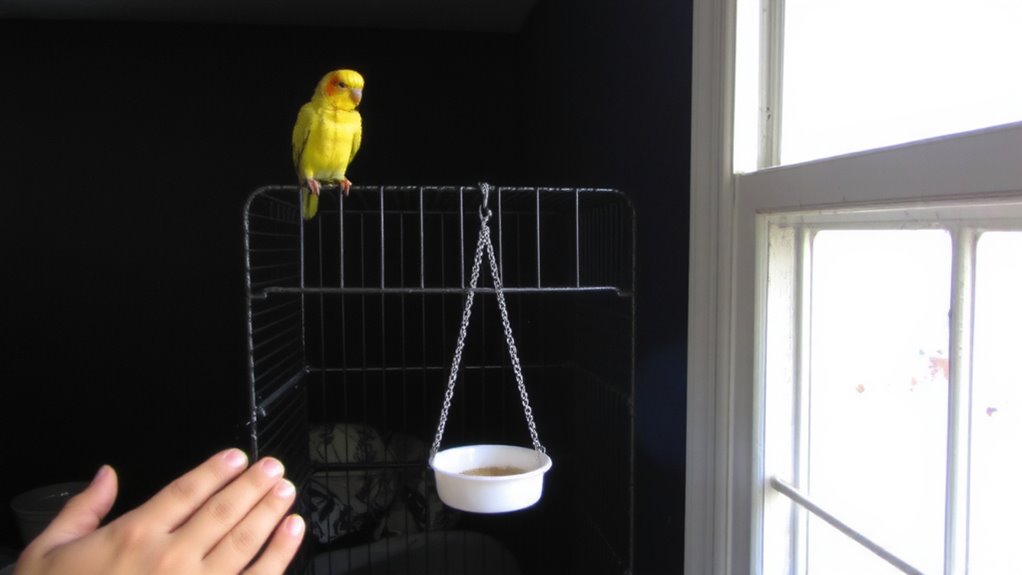
Behavior modification in pet birds often relies on clear, consistent consequences, and negative punishment is one such technique. You remove a desirable stimulus to decrease an unwanted behavior. For example, when your bird screams for attention, you turn away or leave the room. This withdrawal of attention acts as the consequence. In avian psychology, this method aligns with operant conditioning principles. Negative punishment does not involve pain or fear; it’s the absence of something positive. It works best when timed precisely-within one to two seconds of the behavior. Consistency across all household members is critical, or the bird will not associate the action with the consequence. Effective behavior modification requires tracking responses: note frequency, duration, and triggers. Use negative punishment sparingly, alongside positive reinforcement, for balanced training. It’s most effective in species with high social motivation, like cockatoos or African greys.
How Birds Learn: Reinforcement vs. Consequences
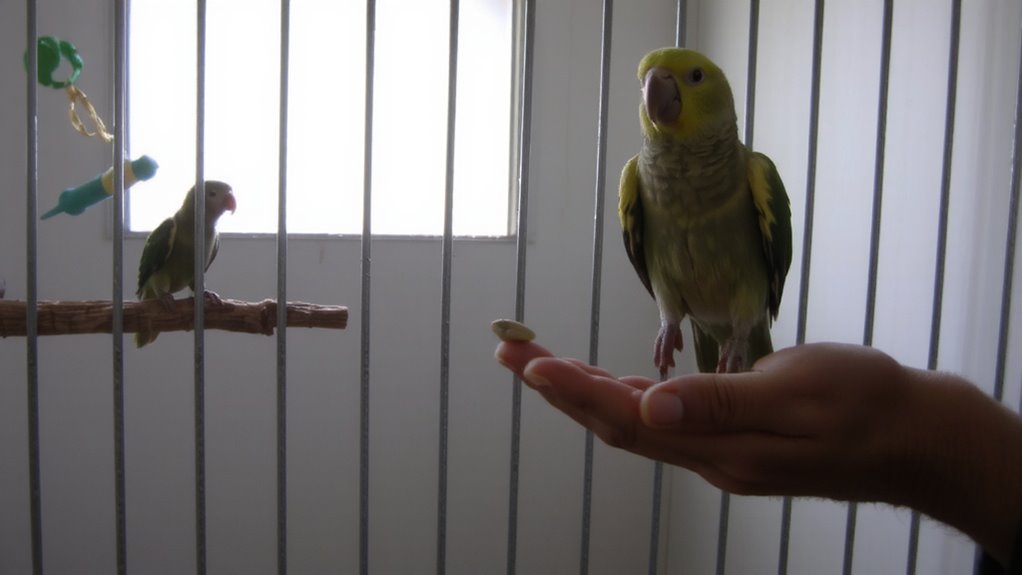
A bird’s learning process hinges on how consequences shape future actions, and understanding the difference between reinforcement and punishment is key to effective training. You can guide behavior through consequences, but only reinforcement strengthens desired actions. Positive reinforcement delivers a reward after a desired behavior, increasing its frequency. Use treats or praise immediately after the act for best results.
| Type | Effect on Behavior | Example |
|---|---|---|
| Positive Reinforcement | Increases | Giving a treat for stepping onto a perch |
| Negative Punishment | Decreases | Removing attention after screaming |
| Behavior Modeling | Encourages imitation | Owner calmly whistling to prompt copying |
Behavior modeling works best when paired with positive reinforcement. Immediate, consistent responses guarantee clarity. Unlike punishment, reinforcement builds trust and motivates repetition. You shape long-term conduct not by removing things, but by rewarding what you want to see again.
Why Walking Away Too Late Backfires
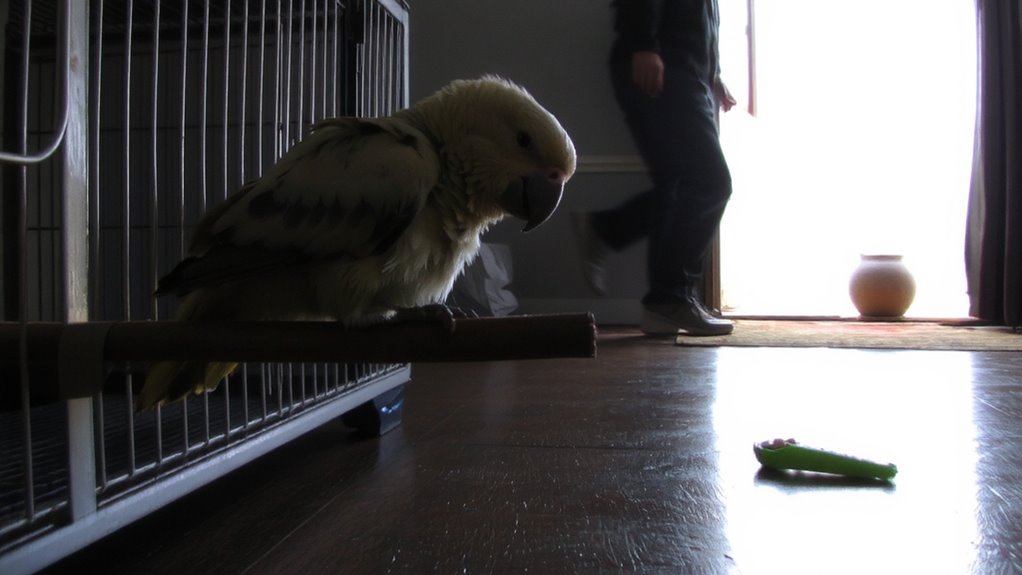
If you wait too long to walk away after a bird screams, the intended consequence loses its effect because the timing disrupts the cause-and-effect connection. Misaligned timing prevents the bird from associating the behavior with the outcome. The ideal delay for negative punishment is less than two seconds. Beyond that, efficacy drops sharply. Immediate withdrawal reinforces the link between scream and consequence. Delayed action creates emotional confusion, leaving the bird uncertain about which behavior triggered the response. Birds rely on temporal proximity to learn. A lagged reaction may unintentionally punish unrelated actions, such as quiet perching or preening. This undermines behavioral clarity. Consistency and precision are critical. Treat the response like a reflex-fast and automatic. Just as a circuit breaker cuts power instantly to prevent damage, your reaction must be prompt to prevent learning errors. Misaligned timing weakens training integrity and impedes long-term compliance.
When Ignoring Your Bird Actually Helps
You walk away immediately after the scream-just as timing demands-and in that silence, you’re already using one of the most effective tools in behavior modification: strategic ignoring. This negative punishment removes attention, a primary reinforcer for socially bonded birds. Parrots rely heavily on social bonding; they seek interaction through vocal mimicry, often repeating sounds that previously earned responses. If screaming produces attention, even reprimands, it’s likely to recur. By withholding reinforcement instantly and consistently, you reduce the behavior’s frequency. The key is precision: ignore within 0.5 seconds of the scream and maintain silence for at least 10 seconds. Do not look, speak, or gesture. Over time, the bird learns screaming fails to trigger interaction. This method works best when alternative behaviors-like quiet vocalizations-are later rewarded.
Gentler Ways to Fix Behavior Problems
While removing attention can curb unwanted screams, shaping better behavior often requires more nuanced methods that don’t rely solely on withdrawal. You can use positive reinforcement by immediately rewarding desired actions with treats, praise, or toys. Deliver a high-value reinforcer-like a sunflower seed or favored nut-within one second of the behavior to strengthen the association. Pair this with environmental enrichment to reduce boredom, a common cause of misconduct. Rotate toys weekly and offer foraging opportunities using puzzle feeders or shredded paper logs. Install perches at varying heights and textures-natural wood, rope, or concrete-to promote foot health and activity. These changes engage your bird’s cognition and mimic wild stimuli. Consistency matters: reinforce behaviors daily in 10- to 15-minute sessions. Combine enrichment with precise positive reinforcement to shift conduct long-term. Avoid reliance on absence-based techniques. These structured, proactive strategies yield measurable improvements in conduct within weeks. Choosing the right species for your lifestyle is key, so consider your commitment level when selecting a best house pet bird.
How to Set Boundaries Without Damaging Trust
Though birds rely on social interaction, setting limits doesn’t require sacrificing their trust. Use consistent signals and calm corrections to guide behavior without fear. Birds interpret tone and timing precisely, so immediate, quiet responses are more effective than loud reactions. Reinforce boundaries with predictable outcomes, allowing the bird to learn through repetition and context.
| Action | Outcome |
|---|---|
| Turn away silently | Reduces attention for biting |
| Return to cage calmly | Ends play for excessive screaming |
| Use “no” in low tone | Signals disapproval clearly |
| Pause interaction | Teaches gentle handling |
| Resume after calm | Reinforces positive pause behavior |
Calm corrections prevent escalation, while consistent signals create a stable environment. Trust grows when your bird understands expectations and experiences fair, repeatable responses. Avoid sudden movements or emotional outbursts. Instead, rely on structured feedback. The goal isn’t obedience through fear, but cooperation through clarity. You shape behavior by controlling access to rewards, not through punishment.
On a final note
You must apply negative punishment precisely to reduce unwanted bird behavior. This technique removes a reinforcing stimulus immediately after the behavior occurs. Timing is critical; delays beyond one second weaken learning. Use it only for specific actions like biting or screaming. Pair it with positive reinforcement for alternative behaviors. Consistency guarantees effectiveness. Overuse or mistimed application causes confusion, stress, or mistrust. Proper execution supports behavioral modification without harm.