Creating a Social Play Schedule for Puppies in a Multi-Dog Household
You should assess each puppy’s temperament and energy level before starting play sessions. Begin with 5–10 minute supervised intervals, monitoring body language like stiffness or relaxed wags. Rotate pairs every 15 minutes based on energy, using a 2:1 play-to-rest ratio. Schedule quiet breaks with crate time and one-on-one bonding. Adjust duration and frequency as they grow-puppies under 16 weeks need 3–5 sessions daily. Keep records to track progress and refine pairings over time. You’ll find ideal group dynamics emerge when timing and temperament align.
Notable Insights
- Match puppies by energy level and play style to prevent overstimulation and promote positive social interactions.
- Begin with 5–10 minute supervised play sessions, ending before conflicts arise to reinforce calm disengagement.
- Rotate playgroups every 15 minutes to maintain focus and balance energy across multiple dogs.
- Schedule regular quiet breaks with crate rest and one-on-one time to support neural recovery and bonding.
- Adjust schedule weekly based on age, development stage, and behavior logs to ensure healthy socialization.
Assess Temperaments and Energy Levels First
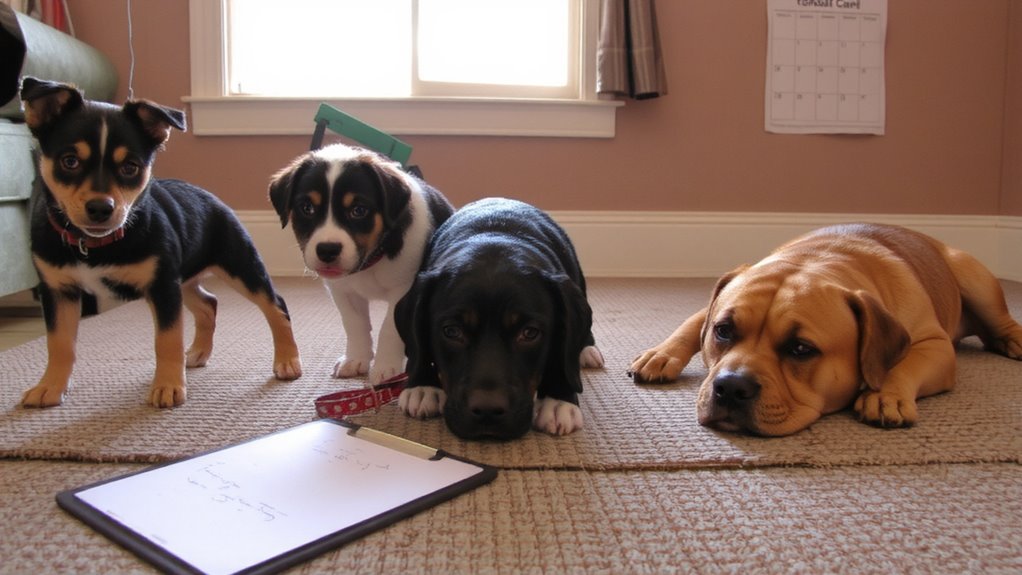
Why do some puppies thrive in group play while others become overwhelmed? You must assess temperaments and energy levels before introducing play sessions. Each puppy has a distinct play style-some are assertive, others passive. These behaviors reflect their social development and neurological maturity. Observe body language: stiff postures suggest stress; loose, wagging movement indicates comfort. Matching play style improves group cohesion. You must also evaluate individual needs, including breed predispositions, age, and stamina. A high-energy Border Collie pup may require more intense activity than a Bulldog, whose respiratory structure limits endurance. Misalignment in energy levels can lead to overstimulation or injury. Use timed observations-record interactions in 5-minute intervals to identify fatigue or agitation. Adjust pairings based on data, not assumptions. Proper assessment guarantees safe, effective socialization tailored to each puppy’s physiological and behavioral profile.
Start With Short, Supervised Play Sessions
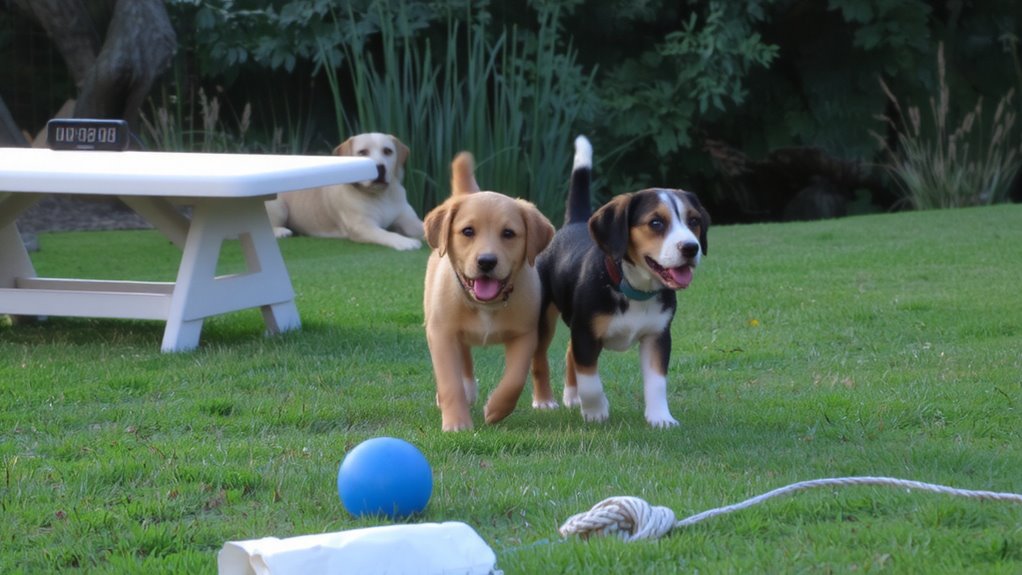
When introducing puppies to group play, begin with brief, closely monitored interactions to guarantee safety and positive social development. Establishing play boundaries early prevents escalation and supports appropriate behavior. Use active supervision techniques such as standing within arm’s reach and scanning body language for tension. Limit sessions to 5–10 minutes initially to avoid overstimulation.
| Duration | Observation Focus |
|---|---|
| 0–2 min | Entry behavior, posture |
| 2–4 min | Play reciprocity |
| 4–6 min | Energy shifts, vocalization |
| 6–8 min | Resource guarding signs |
| 8–10 min | Disengagement cues |
End sessions before conflicts occur. Reinforce calm exits with treats. Gradually increase time as puppies demonstrate consistent responses to verbal cues and respect mutual play boundaries. Supervision techniques must remain consistent across all caregivers to assure uniform learning. Accurate timing and observation are critical for shaping long-term social competence.
Rotate Dogs to Balance Energy and Focus
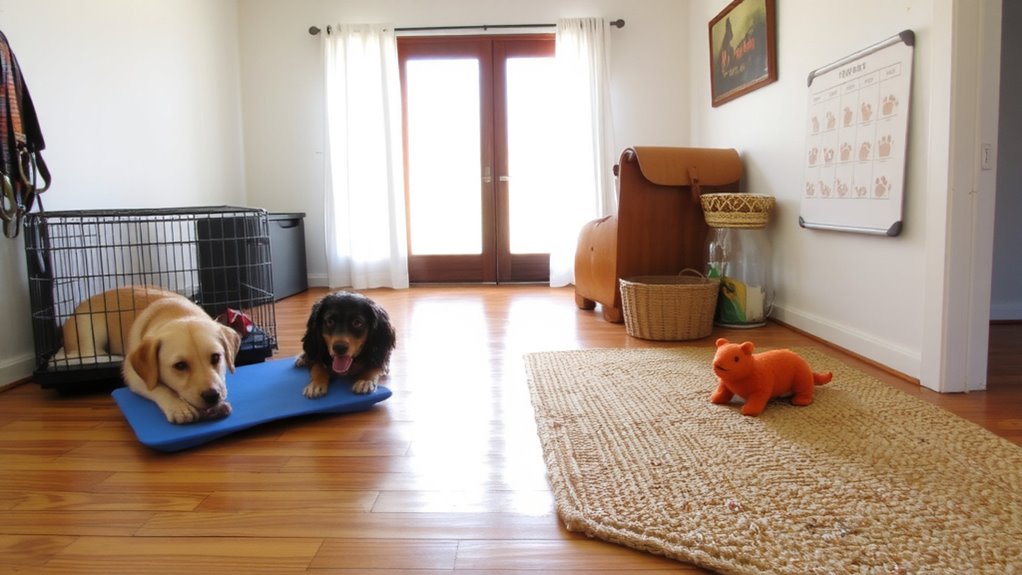
Keep play sessions productive by rotating puppies on a timed schedule to maintain balanced energy and sustained focus. Use a play rotation system with 15-minute intervals to prevent overstimulation. Energy matching guarantees compatible playmates: pair high-energy puppies with active partners and calm ones together. Mismatched energy levels cause fatigue or overarousal, increasing conflict risk. Monitor body language-panting, pinned ears, or stiffness signal the need for rotation. A 2:1 play-to-rest ratio optimizes engagement. For example, 10 minutes of play followed by 5 minutes of downtime supports neural recovery. Rotate dogs every 15 minutes using a timer. This structured turnover sustains attention and reduces hyperactive rebound. Implement consistent cues-like a verbal command or hand signal-to signal rotation changes. Rotate all puppies through solo, paired, and group configurations. This method enhances social adaptability while minimizing resource guarding and attention-seeking. Play rotation with energy matching promotes balanced development.
Schedule Quiet Breaks and One-on-One Time
Often, successful puppy development hinges on deliberate downtime. Quiet breaks prevent sensory overload and support neural processing in young dogs. You must balance social play with scheduled pauses to reinforce calm behavior. Provide individual attention daily to strengthen trust and reduce dependency on littermates. Quiet bonding sessions enhance attachment and decrease anxiety during separation. Use a consistent routine to signal downtime, such as low lighting and soft bedding.
| Activity | Duration | Purpose |
|---|---|---|
| Crate Rest | 30 min | Promotes self-soothing |
| Lap Time | 15 min | Encourages quiet bonding |
| Gentle Petting | 10 min | Reduces cortisol levels |
| Solo Exploration | 20 min | Builds confidence |
| Leash Drills | 15 min | Offers individual attention |
Each session must occur in a low-stimulus area. Isolate distractions using baby gates or closed doors. Monitor heart rate variability to assess stress recovery. These intervals are non-negotiable for balanced neurodevelopment.
Follow a Daily Social Play Schedule
While structured downtime supports neurological maturation, scheduled social play drives essential behavioral and cognitive milestones in puppies. You must maintain playtime consistency to reinforce learning and emotional regulation. Begin sessions at the same times daily-ideally after rest periods-to align with circadian rhythms and peak arousal states. Each session should last 15 to 20 minutes, allowing sufficient time for engagement without overstimulation. Use designated play zones free of distractions and hazards, measuring at least 6 x 6 feet per dog to enable safe movement. Rotate interactive toys-rubber chewables, fleece tug ropes-every 48 hours to sustain interest. Facilitate parallel play initially, then progress to controlled wrestling. Supervise closely to guarantee mutual participation and prevent dominance. Positive reinforcement strengthens social bonding. Avoid forced interactions. Let puppies initiate contact to build trust and communication skills through natural cues.
Adjust for Your Puppy’s Growth Stages
As your puppy progresses through distinct developmental phases, you’ll need to modify play duration, intensity, and social exposure to match their evolving physical and neurological capacity. Early socialization windows close around 16 weeks, so prioritize positive interactions before this milestone. Puppies between 8–16 weeks require brief, frequent play sessions-three to five sessions daily, limited to 5–10 minutes-to prevent overstimulation. During teething phases, typically 12–24 weeks, provide appropriate chew toys and reduce rough play to discourage biting. Monitor developmental milestones: by 20 weeks, most puppies exhibit improved impulse control and social awareness. Adjust group play to match size and temperament, avoiding overexertion. After 6 months, gradually extend play to 15–20 minutes, twice daily. Rotate playmates weekly to broaden social skills while minimizing disease transmission. Track progress monthly using a behavior log.
On a final note
You establish a stable social play schedule by matching temperaments and energy levels. Begin with 10- to 15-minute supervised sessions, gradually increasing to 30 minutes as social skills improve. Rotate participants every 20 minutes to prevent overstimulation. Schedule 30- to 60-minute quiet breaks between sessions. Include daily one-on-one time, 15 minutes per puppy, to reinforce individual training. Adjust intervals and groupings monthly based on developmental stage.