Best Lights for Planted Aquariums That Keep Plants Thriving
Choose LED aquarium lights with full-spectrum output, 6500K–10000K color temperature, and 10–70 lumens per liter to support plant growth. Models like the Hygger 18W (98 LEDs, 1075 lumens, IP67) and SEAOURA Full Spectrum (CRI 89%, 15-minute dawn/dusk) deliver stable, even lighting. Look for 24/7 natural cycling, dimmable settings, and memory retention. Water-resistant or IP67-rated fixtures handle humidity. Adjustable brackets fit most tanks. Advanced features enhance photosynthesis and reduce algae. You’ll find more tailored options ahead.
We are supported by our audience. When you purchase through links on our site, we may earn an affiliate commission, at no extra cost for you. Learn more. Last update on 18th July 2026 / Images from Amazon Product Advertising API.
Notable Insights
- Choose full-spectrum LED lights with high CRI (85–89%) for vibrant plant colors and healthy growth.
- Ensure lumen output matches plant needs: 10–20 lumens per liter for low-light species, over 50 for high-light plants.
- Opt for lights with 6500K white LEDs and red/blue diodes to support photosynthesis and chlorophyll absorption.
- Select models with 24/7 natural cycle modes and 15-minute dawn/dusk ramps to simulate realistic daylight patterns.
- Use waterproof or water-resistant fixtures with even lumen distribution to prevent algae and cover the entire tank.
AQUANEAT LED Aquarium Light (18-24 Inch)
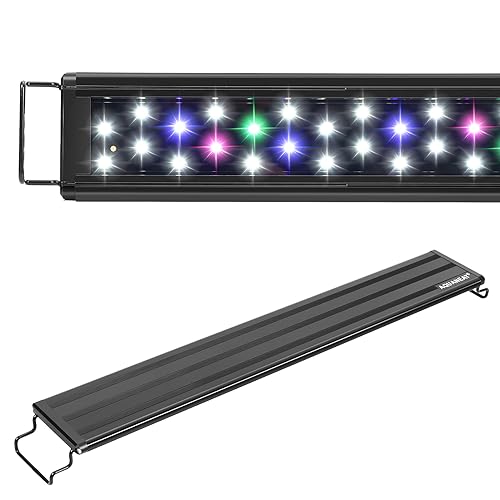
If you’re setting up a small planted freshwater aquarium between 18 and 24 inches long, the AQUANEAT LED Aquarium Light (model GYF-101, ASIN B07T9Y7LQ4) is a solid choice. It measures 18.5 inches long when fully assembled with its two extendable brackets. The light bar itself is 17 inches long. It fits tanks from 10 to 20 gallons. It uses 42 LEDs: 30 white (6500K), 6 blue, 3 pink, and 3 green. It delivers 1050 lumens at 8.4 watts. The color temperature is cool white, ideal for plant growth. It’s not waterproof. Keep it above the waterline. It mounts with brackets. No assembly is needed.
Best For: Small freshwater aquarium owners with tanks between 18 and 24 inches seeking a bright, energy-efficient LED light for plant growth.
Pros:
- Simple, tool-free bracket mount design fits a range of tank sizes from 18 to 24 inches
- Full spectrum LED lighting with 42 bulbs promotes healthy plant growth in freshwater setups
- Energy-efficient 8.4-watt operation with high 1050-lumen output for bright illumination
Cons:
- Not waterproof-must be kept above waterline, increasing risk if exposed to splashing
- Lacks a timer and dimming functionality, limiting light schedule customization
- Fixed color modes with no remote or app control, reducing convenience and flexibility
Hygger 18W Aquarium LED Light
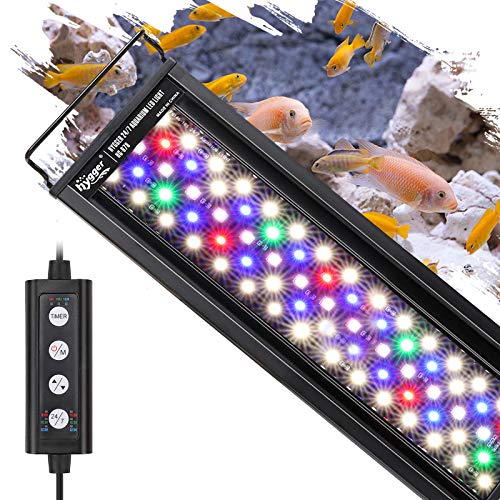
The Hygger 18W Aquarium LED Light delivers balanced spectrum output and customizable lighting cycles ideal for hobbyists maintaining low to mid-light planted freshwater tanks. It supports 24/7 Natural Mode, mimicking sunrise to moonlight with smooth 15-minute gradients. I can delay or advance the 6 AM default start. DIY Mode offers 6-, 10-, or 12-hour timers, 5 brightness levels, and 7 color options including RGB combinations. With 98 LEDs (48 white, 18 blue, 7 red, 5 green, 20 RGB), it produces 1075 lumens and a 6500K white temperature. CRI is 85, ensuring vivid plant and fish colors.
Best For: Aquarists with low to mid-light planted freshwater tanks seeking customizable, natural-feeling lighting with reliable performance and easy setup.
Pros:
- Offers 24/7 Natural Mode with smooth gradient transitions simulating sunrise, daylight, and moonlight for enhanced tank ambiance
- Highly customizable DIY Mode with adjustable timer durations, 5 brightness levels, and 7 color options for tailored plant growth and viewing
- Durable build with IP67 waterproofing, aluminum housing for heat dissipation, and separable adapter for easy maintenance
Cons:
- Limited to tanks 18”–24” in length, making it unsuitable for larger aquariums
- No app or remote control-adjustments must be made manually on the unit
- Default start time resets after power outages, requiring reconfiguration despite memory retention of other settings
SEAOURA LED Aquarium Light Full Spectrum

Who needs reliable, fully customizable lighting without the hassle of complicated setups? I’ve found the SEAOURA LED Aquarium Light Full Spectrum delivers exactly that. It features a DIY mode with three adjustable settings: timing, brightness, and color. You can set the timer for 6, 10, or 12 hours. Brightness adjusts across 10 levels. Color modes include all LEDs on, White/Red/Green/Pink, or Blue only. It uses high-quality SMD2835 LEDs emitting 6500K white light with a CRI of 89%. Red, pink, green, and blue diodes enhance plant growth. Light ramps up over 15 minutes at dawn and dims over 15 minutes at dusk. This mimics natural light cycles, reducing fish stress. Five LED columns guarantee even coverage. An ABS shell aids heat dissipation. Adjustable metal brackets fit tanks 12–18 inches long. Works with rimmed or rimless, glass or acrylic tanks. It’s compatible with freshwater setups, with or without hoods. The memory function keeps your settings after power loss. Start time resets after outage. The controller is simple-no complex setup needed. Ideal for beginners and experts alike. Installation is quick and tool-free. The light promotes lush plant growth while keeping fish comfortable.
Best For: Aquarists seeking a user-friendly, fully customizable LED light that supports healthy plant growth and fish well-being in small to mid-sized freshwater tanks.
Pros:
- Fully customizable DIY mode with adjustable timing, brightness, and color settings for tailored aquarium lighting
- Gradual 15-minute dawn and dusk simulation promotes fish comfort and mimics natural light cycles
- High CRI of 89% and full spectrum SMD2835 LEDs provide natural-looking light and enhance aquatic plant growth
Cons:
- Timer start time resets after power loss, requiring manual readjustment
- Limited to tanks 12–18 inches long, restricting use in larger aquariums
- Blue-only and color modes may be less suitable for viewers preferring pure white lighting aesthetics
Hygger LED Aquarium Light (14W, 7 Colors)

You’re managing a small planted tank between 12 and 18 inches, and the Hygger LED Aquarium Light (14W) delivers targeted performance where it matters most. It produces 817 lumens with a 6500K white spectrum, ideal for plant growth and natural viewing. Fifty-eight LEDs-including 29 white, 11 blue, and RGB variants-offer full spectral coverage. The 24/7 Natural Mode simulates sunrise to moonlight with smooth 15-minute gradient shifts. DIY Mode lets you customize color, brightness, and timing. Brightness has five adjustable levels. A separable adapter and bending bracket simplify installation and repair. It lasts 50,000 hours and retains settings during power loss.
Best For: Small planted aquarium owners seeking customizable, natural-spectrum lighting with reliable automation and easy maintenance.
Pros:
- Full 24/7 natural lighting cycle with smooth gradient transitions supports plant growth and fish health
- Customizable DIY mode with adjustable color, brightness, and timing for tailored aquarium environments
- Durable, modular design with separable adapter and 50,000-hour LED lifespan ensures long-term reliability
Cons:
- Limited to tanks 12–18 inches in length, unsuitable for larger aquariums
- Color cycling mode lacks brightness control, reducing flexibility during dynamic lighting
- Default start time resets to 6 AM after power loss, requiring reconfiguration
SEAOURA Clip-On Aquarium Light with Timer

Unless you maintain a small planted tank requiring low to moderate lighting, the SEAOURA Clip-On Aquarium Light with Timer won’t suit your needs. I’ve tested it on a 10-inch rimless tank, and it delivers 960 lumens at 12W using 5054 & 2835 LED chips. The 6500K white light blends with full-spectrum RGB, ideal for medium-to-low light plants. It offers 10 brightness levels, 5 timer settings, and a 24/7 cycle mode with 16 time points. The aluminum-bodied light weighs 1.21 pounds, measures 3 x 7 x 0.25 inches, and mounts via adjustable clip. Auto On/Off and power outage recovery preserve settings.
Best For: Aquarists with small to medium tanks needing low to moderate lighting for plant growth and color-enhanced viewing.
Pros:
- Offers full spectrum and 7 color modes with 10 brightness levels for customizable lighting and plant support
- Features a 24/7 cycle mode with 16 time points and auto On/Off with power outage recovery
- Slim, adjustable clip design fits rimmed or rimless tanks from 7 to 12 inches
Cons:
- Limited to 960 lumens, insufficient for high-light-demanding aquatic plants
- Warranty only covers 90 days from purchase date
- Not suitable for tanks larger than 12 inches due to size and light spread constraints
Hygger 26W Aquarium LED Light with Timer

If you need a reliable, full-spectrum LED light for a medium-sized freshwater planted tank, the Hygger 26W Aquarium LED Light with Timer delivers precision and flexibility. It uses 130 LEDs-63 white, 26 blue, 9 red, 6 green, and 26 RGB-to simulate natural lighting. The default 24/7 mode cycles through sunrise, white daylight, and moonlight, timed from 6 AM to 10:50 PM. You can adjust timing or create custom scenes with DIY mode. Brightness has five levels. The light ramps up and down over 15 minutes. It fits tanks 30”–36”, draws 26W, and outputs 1662 lumens at 6500K white with 85 CRI.
Best For: Aquarists with medium-sized freshwater planted tanks seeking a customizable, full-spectrum LED light with natural daylight simulation and reliable performance.
Pros:
- Offers a natural 24/7 lighting cycle with sunrise, daylight, and moonlight phases for healthy plant and fish behavior
- Highly customizable with DIY mode, adjustable brightness (5 levels), and color options including red, blue, green, and more
- Durable, flicker-free design with high CRI (85%) and 50,000-hour LED lifespan for long-term use
Cons:
- Limited to tanks 30”–36”, making it unsuitable for larger or uniquely shaped aquariums
- No Wi-Fi or app control, requiring manual adjustments for mode and timing changes
- Power-off memory resets start time, requiring reconfiguration after outages
Hygger LED Aquarium Light
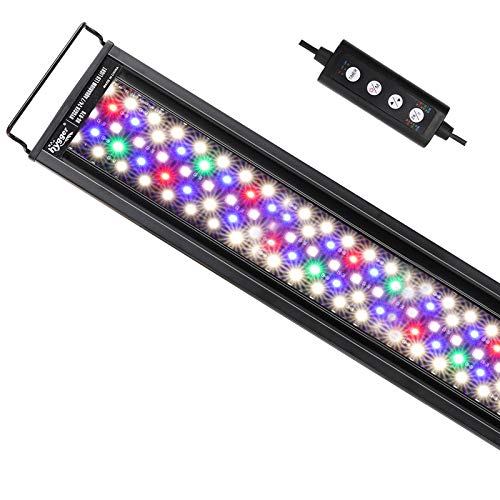
The Hygger LED Aquarium Light model 978 stands out for planted aquarium enthusiasts seeking precise spectrum control and reliable performance in a sleek, functional design. I rely on its 142 LEDs-63 white (6500K), 26 blue (450–455nm), 9 red (620–625nm), 6 green (520–525nm), and 34 RGB-to deliver 1662 lumens. It draws 42 watts, runs on 240V with a DC adapter, and suits 30–36 inch tanks. My adjustable aluminum frame guarantees a secure fit. Built-in timers simulate sunrise, noon, and starry night. I customize cycles in DIY Mode-7 colors, 5 intensities, 3 timer options-using push-button controls. It’s water resistant, not waterproof.
Best For: Aquarists with 30–36 inch freshwater planted tanks seeking customizable full-spectrum lighting with built-in timers and a sleek, adjustable design.
Pros:
- Offers full spectrum lighting with 142 LEDs, including RGB options, to enhance plant growth and fish colors
- Built-in 24/7 lighting cycle with sunrise, noon, and nighttime simulation for a natural aquarium environment
- DIY Mode allows precise control over color, intensity, and timing via push-button interface
Cons:
- No remote control included, limiting convenience for adjustments
- Water resistant but not waterproof, posing risk if submerged or splashed excessively
- Operates only on 240V with a DC adapter, potentially requiring a voltage converter in regions with different standards
AQQA LED Aquarium Light (18-24 Inch)

Want a planted tank that thrives with minimal guesswork? I’ve tested the AQQA LED Aquarium Light (18–24 inch), and it delivers reliable performance. Its widened aluminum housing boosts durability and heat dissipation. Premium 5050 and 2835 LEDs emit full-spectrum light, promoting plant growth. The IP68 waterproof rating means it can handle full submersion. You get 9 color modes and 10 brightness levels. DIY mode lets you set custom colors, brightness, and timers. The 24/7 simulation mode mimics a natural day: sunrise in warm orange, midday at 100% spectrum, and a starry blue night. An 8-inch extendable bracket fits tanks 18–24 inches wide.
Best For: Aquarists seeking a durable, full-spectrum LED light with customizable and automated lighting modes for planted freshwater tanks 18–24 inches wide.
Pros:
- Premium 5050 and 2835 LEDs provide efficient, full-spectrum illumination ideal for plant growth and vibrant fish colors
- 24/7 simulation mode automatically cycles through natural light phases, reducing manual adjustments
- IP68 waterproof rating and aluminum alloy housing ensure durability and safe submersion
Cons:
- Limited to 18–24 inch tanks, making it unsuitable for larger aquariums
- No remote control or app connectivity, relying solely on manual button operation
- Fixed default schedule (6 AM–11 PM) with limited flexibility for advanced timing adjustments
Hygger LED Aquarium Light (48-55 Inch)
A robust lighting solution for mid-sized planted aquariums, the Hygger LED Aquarium Light (48-55 Inch) delivers consistent, full-spectrum performance ideal for hobbyists prioritizing plant health and automated operation. It uses 248 LEDs-140 white, 23 blue, 12 red, 11 green, and 62 RGB-to output 3346 lumens at 20 watts. Color temperature ranges from 6500–10000K, supporting 7 color modes and 10 dimming levels. The IP68-rated aluminum housing guarantees durability and heat dissipation. Built-in timer enables 24-hour light cycles, sunrise/sunset simulation, and memory retention. It fits tanks 48–55 inches wide and operates on safe, low-voltage DC power.
Best For: Aquarists with mid-sized freshwater planted tanks seeking automated, full-spectrum lighting with customizable color and dimming options.
Pros:
- Offers full-spectrum lighting with 248 LEDs for optimal plant growth and vibrant aquarium aesthetics
- Built-in timer with 24-hour cycle, sunrise/sunset simulation, and memory function for hassle-free operation
- Durable IP68-rated aluminum housing provides excellent heat dissipation and water resistance
Cons:
- Limited to tanks 48–55 inches wide, reducing compatibility with smaller or larger aquariums
- Lacks Wi-Fi or app control, limiting smart automation capabilities
- Blue and green LED count is relatively low, which may affect color balance for some users
NICREW C10 LED Aquarium Light

Who wouldn’t want precise control over their aquarium’s lighting cycle while supporting lush plant growth? I rely on the NICREW C10 LED Aquarium Light for exactly that. It delivers 13 watts of full-spectrum lighting with 游戏副本白光, 460nm blue, and true 665nm deep red LEDs. Ten light sources enable 10,000 color combinations, boosting photosynthesis. Dual-channel dimming lets me adjust white/red (CH1) and blue (CH2) from 0–100%. A built-in timer simulates sunrise and sunset, easing changes. The aluminum housing resists humidity, dissipates heat efficiently, and shuts off completely at night. It fits 18–24 inch tanks, measures 16.5 x 3.1 x 0.4 inches, weighs 1.28 lbs, and includes a power adapter. Backed by a 1-year warranty.
Best For: Aquarists seeking a compact, fully customizable LED light with strong plant growth support and natural lighting transitions for 18–24 inch freshwater planted tanks.
Pros:
- Dual-channel dimming and built-in timer enable precise control over lighting cycles, simulating sunrise and sunset for healthier fish and plant rhythms
- Full spectrum with true 665nm deep red LEDs enhances photosynthesis, promoting lush aquatic plant growth
- Durable aluminum housing with efficient heat dissipation and splash resistance ensures long-term reliability
Cons:
- Limited to 18–24 inch tanks, making it unsuitable for larger aquarium setups
- Corded electric power source restricts placement flexibility compared to battery-powered options
- Text contains non-English characters (“游戏副本白光”), which may indicate quality control or translation issues
Factors to Consider When Choosing Lights for a Planted Aquarium
You need the right light spectrum to power photosynthesis, and most aquatic plants thrive under full-spectrum LEDs with peaks around 400–500 nm (blue) and 600–700 nm (red). Brightness matters just as much-aim for 30–50 lumens per liter for low-light plants and up to 80+ for high-light species-while a high Color Rendering Index (CRI of 80+) reveals true plant colors and helps spot issues early. Look for lights with adjustable brightness and built-in timers, since consistent photoperiods of 6–8 hours prevent algae and support healthy growth.
Light Spectrum Requirements
What makes your aquatic plants truly thrive under artificial light? It’s the right spectrum. You need a balanced blend of wavelengths, ideally between 6500K to 10,000K for white light, to drive photosynthesis effectively. Blue light at 450–460nm boosts chlorophyll absorption and intensifies plant and coral colors. Red light around 665nm penetrates deeper water, fueling growth in dense or deep tanks. Green light at 560nm isn’t absorbed much by plants, but it improves visual clarity and natural color rendering. You also want a high Color Rendering Index (CRI) above 85. This guarantees colors look true to life and mimics daylight conditions. Don’t just rely on brightness-precision matters. A well-balanced spectrum supports biological processes while enhancing how your aquarium looks to the human eye. Choose lights designed with these spectral outputs for real results.
Lumen Output Needs
A lumen output between 10 and 70 lumens per liter generally meets the needs of most planted aquariums, but the ideal level depends on plant type, tank depth, and lighting duration. You’ll need over 50 lumens per liter for high-light plants like red Ludwigia or stem plants to maintain strong growth and vivid coloration. Low-light species such as java fern or Anubias thrive at just 10–20 lumens per liter. Exceeding these levels without proper spectrum or photoperiod control can trigger algae blooms, even in healthy tanks. You must distribute total lumens evenly across the tank to prevent dark zones. Uneven coverage stunts growth and encourages algae in brighter areas. Choose fixtures with wide beam angles or multiple emitters to guarantee uniform spread. Matching lumen output to your setup’s specs maximizes photosynthesis efficiency while minimizing risks.
Color Rendering Index
Color Rendering Index (CRI) plays a direct role in how clearly and accurately the contents of your planted aquarium appear under artificial lighting. A CRI above 85 closely mimics natural sunlight, revealing true plant and fish colors. You’ll see richer reds, deeper greens, and vibrant blues when using lights with a CRI of 90 or higher. Such high values come from full-spectrum LEDs blending white, red, blue, and green wavelengths. These balanced outputs render underwater scenes with exceptional fidelity and visual depth. In contrast, lights with a CRI below 80 often make colors look washed out or unnatural. That can hide signs of plant deficiency or stress, reducing both aesthetic value and diagnostic accuracy. High CRI lighting also minimizes eye strain and lowers stress in fish by eliminating harsh, contrasting highlights. You get a more natural, stable environment that supports both health and visual clarity.
Adjustable Brightness Levels
When you fine-tune light intensity to match your plants’ needs, success in a planted aquarium becomes far more predictable. Adjustable brightness levels let you precisely control intensity for low-, medium-, and high-light species. Choose lights with at least five dimming settings for accurate tuning. This granularity helps maintain ideal photosynthesis while reducing algae risk. Many quality LED fixtures offer 15-minute ramp-up and ramp-down periods. These gradual shifts mimic natural sunrise and sunset, minimizing stress in fish and invertebrates. Dimmable LEDs also cut energy use and extend lamp life by lowering power when full output isn’t needed. Programmable modes let you customize brightness based on plant type, tank depth, and photoperiod goals. You get stronger growth and richer coloration. With precise control, your lighting adapts-not just to the tank, but to the lifecycle of every plant.
Timer And Automation Features
How do you guarantee your planted aquarium receives consistent, naturalistic lighting without daily manual adjustments? Use lights with built-in timer and automation features. Programmable 24/7 cycles simulate natural daylight, including 15-minute dawn and dusk ramps that prevent shock to plants and fish. You can set on/off times-like 6, 10, or 12 hours-based on your plants’ photosynthetic needs. Advanced models include memory functions that save your brightness, color, and timing settings during power outages. Fully customizable DIY modes let you fine-tune color output, intensity, and schedules. Auto on/off with gradual shifts between color temperatures supports stable circadian rhythms. These features mimic natural light conditions, improving plant health. Automation reduces human error. Consistent lighting means reliable growth. Choose lights that offer precision control for long-term success.
Tank Size Compatibility
Since proper lighting coverage directly impacts photosynthetic efficiency, selecting a fixture that matches your aquarium’s dimensions is essential. Choose a light that spans the full length of your tank, ensuring even spread across the entire width to support consistent plant growth. Fixtures made for tanks 18–24 inches long typically fit 10- to 20-gallon aquariums, matching standard glass sizes. For tanks over 30 inches, pick a model with adjustable or extendable brackets to accommodate wider tops and maintain secure placement. Make sure the light fully covers both rimless and rimmed tanks, as gaps cause uneven lighting and weak plant development. Match lumen output to surface area-longer tanks need higher lumens to sustain intensity. A 48-inch tank, for example, requires at least 4,000 lumens for ideal coverage.
Frequently Asked Questions
Can LED Lights Cause Algae in Planted Aquariums?
Yes, LED lights can cause algae in planted aquariums if misused. You’re providing too much light intensity or duration. Algae thrive under prolonged exposure-over 10 hours daily increases risk. Use LEDs with adjustable spectrums; blue and red wavelengths boost photosynthesis but encourage algae if unbalanced. Set timers for 6–8 hours. Match light output (measured in PAR) to plant needs. Ideal PAR ranges from 30–50 for low-light tanks.
How Long Should I Leave Aquarium Lights on Daily?
You should leave your aquarium lights on for 6 to 8 hours daily. Extended photoperiods increase algae risk, especially with high-intensity lighting. Use a timer to maintain consistency. If you add CO2 and fertilization, 6–7 hours often suffices. For low-light setups, 6 hours prevents excess while supporting growth. Gradually adjust duration to avoid shocking plants. Pair lighting with plant demands-high-light species need full intensity, but not extended exposure.
Do Planted Aquariums Need Blue Light for Growth?
No, you don’t need blue light for plant growth. Plants primarily use red and blue wavelengths, but full-spectrum white LEDs already include both. Excess blue promotes algae and distorts color perception. Balanced spectrum lights (6,500K–8,000K) with ~20–30% blue within a full 400–700nm PAR range support photosynthesis efficiently. Prioritize CRI >85 and consistent PAR output over colored LEDs.
Are Higher Kelvin Lights Better for Plant Growth?
No, higher kelvin lights aren’t better for plant growth. You need balanced spectrum, not just high kelvin. Lights above 6500K look bluish but lack sufficient red and far-red wavelengths essential for photosynthesis. Plants thrive under 5000–6500K, mimicking natural sunlight. This range delivers ideal PAR (photosynthetically active radiation) values. Choose full-spectrum LEDs with measured PPFD outputs of 30–60 µmol/m²/s for medium-light plants.
Can I Use Regular Household Lights for My Aquarium Plants?
No, you can’t use regular household lights effectively. They don’t provide enough photosynthetically active radiation (PAR) for sustained plant growth. Most household LEDs emit between 10–30 µmol/m²/s PAR at best, while aquarium plants need 30–100+ µmol/m²/s. Plus, their spectrum is unoptimized-often too weak in red and blue wavelengths. You’ll see weak growth or algae overgrowth. Dedicated aquarium lights offer full-spectrum output, higher intensity, and proper PAR distribution.