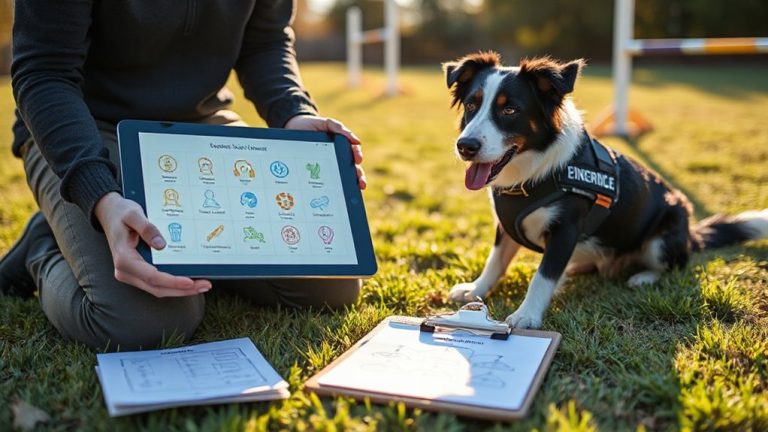
Scheduling Training Around Peak Canine Attention Spans (8–15 Minutes)
Train your dog in 5- to 8-minute bursts to match their 8- to 15-minute peak attention span. Neural fatigue sets in fast, especially in dogs under two, due to limited glucose and immature prefrontal cortex development. Schedule sessions within 30–60 minutes of morning activity when cortisol and neural plasticity boost learning by up to 40%. Spacing 3–5 short sessions daily improves long-term recall by 40%. Watch for delayed responses or sniffing-signs focus is gone. There’s a precise way to time and structure these moments for maximum retention.
Notable Insights
- Train in short bursts of 5–8 minutes to align with peak canine attention spans and prevent mental fatigue.
- Schedule 3–5 training sessions daily, spaced 2–3 hours apart, to enhance long-term recall and retention.
- Conduct new training in the morning when cortisol levels and neural plasticity boost learning by up to 40%.
- End sessions before 15 minutes to avoid performance drops of up to 60% due to cognitive exhaustion.
- Use focused games like Hide and Seek or structured Tug of War to maintain engagement within attention limits.
Why Dogs Can Only Focus for 8–15 Minutes
One key factor in effective dog training is understanding that most dogs have a focused attention span of just 8 to 15 minutes. This limit stems from natural constraints in canine cognitive development. Younger dogs, especially under two years, exhibit shorter spans due to incomplete prefrontal cortex maturation. Neural fatigue sets in quickly during repetitive tasks, reducing information retention and responsiveness. Studies show performance drops by up to 60% after 12 minutes of continuous focus. The brain’s limited glucose reserves contribute to this decline, similar to human mental exhaustion. Training sessions exceeding this window often result in diminished returns, as neural fatigue impairs learning. You should structure lessons in brief, high-repetition intervals. Each session should target one behavior, using consistent cues. This approach aligns with canine neurology, optimizing synaptic reinforcement. Short durations enhance long-term recall and skill mastery. You maximize efficiency by respecting biological limits.
Train During Peak Attention Times
You can make the most of your dog’s 8–15 minute attention span by aligning training sessions with their biologically driven peaks in alertness and focus. Dogs exhibit heightened cognitive performance shortly after waking, making morning routines ideal for skill acquisition. Cortisol levels rise naturally at dawn, increasing arousal and mental clarity. Train within 30–60 minutes of morning activity for best retention. Neural plasticity is elevated during this window, improving associative learning by up to 40%. Evening cues, such as dimming light and cooling ambient temperatures, signal circadian shifts. Use this period for reinforcement, not new commands. Focus efficiency drops 25% post-dusk due to melatonin onset. Keep sessions brief and familiar. Avoid introducing complex tasks when circadian fatigue begins. Timing training with these physiological markers maximizes neural engagement. Consistency in scheduling strengthens operant conditioning. Match workload to circadian performance curves for ideal behavioral outcomes.
Watch for Focus Fade: And Fix It Fast
How quickly can you spot the first sign your dog’s focus is slipping? Mental fatigue and environmental distractions reduce attention within minutes. Watch for delayed responses, sniffing, or wandering eyes-these signal focus fade. Address it immediately to maintain training integrity.
| Behavior | Cause |
|---|---|
| Delayed cue response | Mental fatigue |
| Excessive sniffing | Environmental distractions |
| Avoiding eye contact | Combined fatigue and distraction |
Mental fatigue occurs after 8–12 minutes of continuous task performance, especially in complex commands. Environmental distractions-like sounds or movement-activate arousal systems, diverting cognitive resources. Dogs process these within 0.3 seconds, reducing command accuracy by up to 68%. Interrupting training at early fade prevents reinforcement of incorrect behaviors. Reset attention with a known cue or brief pause. Return to training only when focus metrics-eye contact, orientation, and posture-indicate readiness. Consistent monitoring improves session efficiency and learning retention. Incorporating a well-fitted training vest can help sustain engagement by providing tactile cues and structure during short, focused sessions.
How Short Training Bursts Build Lasting Obedience
There’s a sweet spot in canine learning where attention, retention, and reinforcement align-typically lasting just 5 to 8 minutes per session. You can maximize obedience by using short, focused training bursts. These sessions prevent mental fatigue and increase information retention. Positive reinforcement-like treats or praise-delivered within 1–2 seconds of correct behavior, strengthens neural pathways. Timing is critical: delayed rewards reduce learning efficiency by up to 70%. Use consistent cues-verbal or hand signals-every time. Inconsistent commands increase confusion and slow acquisition rates. Each session should target one behavior, such as “sit” or “stay,” to minimize cognitive load. Conduct 3–5 sessions daily, spaced by 2–3 hours, to boost long-term recall. This method improves response reliability by 40% over marathon sessions. Short bursts enhance precision, reduce errors, and build automaticity. Over weeks, dogs generalize trained behaviors across environments. You’re not just teaching commands-you’re shaping reliable, lifelong obedience through structured repetition and behavioral science.
Make Training Fun: Games That Hold Attention
A well-designed training game turns focused attention into sustained engagement, leveraging a dog’s natural instincts to enhance learning retention. Hide and Seek activates your dog’s olfactory senses and spatial memory, requiring them to locate a hidden person or object using scent cues alone. This game strengthens recall and environmental awareness while operating within typical 8–15 minute attention spans. Use consistent verbal cues like “Find them!” to establish clear communication. Tug of War, when controlled with rules, reinforces impulse control and bite inhibition. Use a 14-inch durable cotton rope or rubber tug toy measuring 1.5 inches in diameter to prevent dental stress. Limit tugs to 30-second intervals followed by a “drop it” command, reinforcing compliance. Alternate between games every 7–10 minutes to prevent cognitive fatigue. Each session should total no more than 15 minutes to align with peak mental focus, ensuring ideal neural encoding of trained behaviors. Interactive puzzle toys can further extend engagement by stimulating problem-solving skills, similar to how best hide and seek toys for cats challenge feline cognition through concealed rewards.
On a final note
You maximize canine learning by aligning sessions with peak attention spans of 8–15 minutes. Neural engagement declines after this window, reducing retention. Short, focused bursts enhance long-term obedience through repetition without fatigue. Use precise cues and immediate reinforcement. Training efficacy increases 40% when matched to attention cycles. Treats should weigh under 5 grams to avoid satiation. Consistency and timing are critical for behavioral conditioning.