Best Substrate for Boa Constrictors That Keeps Them Healthy
You need a substrate that maintains 60–80% humidity and supports natural burrowing. Coconut fiber products like Riare, ReptiChip, and Zoo Med Eco Earth expand to 30–72 quarts per brick, retain moisture efficiently, and resist compaction. They’re dust-free, biodegradable, and ideal for boas’ respiratory and shedding needs. Use a 2–3 inch layer for burrowing. Spot clean waste; replace fully every 4–6 weeks. These substrates mimic tropical forest floors-choose them for long-term health. More details on performance follow.
We are supported by our audience. When you purchase through links on our site, we may earn an affiliate commission, at no extra cost for you. Learn more. Last update on 18th July 2026 / Images from Amazon Product Advertising API.
Notable Insights
- Coconut fiber substrates maintain 60–80% humidity, supporting boa hydration, shedding, and respiratory health.
- High moisture retention reduces misting frequency and stabilizes enclosure climate in dry environments.
- Natural, organic coconut fiber is dust-free, non-abrasive, and safe for boas during burrowing and movement.
- Absorbs 3–5 times its weight in moisture, controlling odors and allowing spot cleaning to extend substrate life.
- Supports bioactive setups with live plants and cleanup crews, promoting natural behaviors and long-term enclosure health.
Riare Coconut Fiber Reptile Substrate (2-Pack)

If you’re keeping boa constrictors in a high-humidity setup, the Riare Coconut Fiber Reptile Substrate (2-Pack) is your best bet. I rely on this substrate because it’s made from natural, organic, odorless coconut husk fiber-safe and non-polluting. Each of the two compressed bricks measures 7.8 x 3.9 x 1.97 inches and expands greatly when soaked, yielding a fluffy, moisture-retentive bedding. It holds humidity steadily, critical for boa hydration and shedding. The material absorbs waste and odors efficiently, reducing cleanings. Unlike wood shavings, it’s dust-free, supporting respiratory health. It encourages natural burrowing. After use, I compost it in my garden-it’s fully biodegradable and doubles as organic fertilizer.
Best For: Reptile, amphibian, and invertebrate owners seeking a natural, moisture-retentive, and biodegradable substrate that supports humidity control and healthy burrowing behaviors.
Pros:
- Made from 100% natural, organic, and odorless coconut fiber that is safe for pets and the environment
- Excellent moisture retention and odor absorption, ideal for high-humidity enclosures and reducing maintenance frequency
- Encourages natural digging behavior and is dust-free, promoting respiratory health and overall well-being
Cons:
- May harbor mold if over-saturated or not adequately maintained in overly wet conditions
- Expands significantly when hydrated, requiring proper container space for preparation
- Not ideal for species requiring completely dry environments, as it retains moisture well
ReptiChip Coconut Bedding for Reptile Terrariums

ReptiChip Coconut Bedding delivers exceptional moisture retention, making it the top choice for boa constrictor owners who maintain high-humidity enclosures. I rely on its 100% organic coconut chips to stabilize humidity between 60–80%, critical for proper shedding and respiratory health. Each compressed 72-quart brick expands to 10 lbs of bedding, offering long-term use and cost efficiency. The substrate resists mold, wicks waste, and controls odor by encapsulating bacteria. It’s dust-free, reducing respiratory risks. Sustainably sourced from coconut husks, it supports bioactive setups with live plants and clean-up crews. I use it for tropical species needing consistent, moist environments.
Best For: Reptile owners seeking a highly absorbent, eco-friendly substrate ideal for maintaining high humidity in tropical species enclosures.
Pros:
- Exceptional moisture retention helps maintain optimal humidity levels for proper shedding and respiratory health
- 100% organic, dust-free, and sustainably sourced, supporting both animal health and environmental responsibility
- Odor-absorbing and mold-resistant properties enhance habitat cleanliness and support bioactive terrarium setups
Cons:
- May retain too much moisture for arid-environment reptiles if not monitored carefully
- Requires manual expansion from compressed brick, which can be time-consuming for large enclosures
- Not suitable for species that require sand or gravel substrates due to texture and composition preferences
Zilla Reptile Terrarium Bedding Substrate Jungle Mix, 8 Quart

I choose Zilla Reptile Terrarium Bedding Substrate Jungle Mix for boa constrictors that thrive in high-humidity, forest-like environments. This 100% organic blend of aged Douglas fir bark and sphagnum peat moss holds moisture exceptionally well, maintaining stable humidity levels critical for proper shedding and respiratory health. The substrate’s high absorbency mimics tropical floor conditions, supporting natural behaviors like burrowing and nesting. I recommend a 1–2 inch layer to allow digging while preventing compaction. It’s ideal for rainforest species, including snakes, frogs, and geckos. I replace it monthly or sooner if soiled, ensuring hygiene and performance.
Best For: Tropical and forest-dwelling reptiles like boa constrictors, frogs, geckos, and snakes that require high humidity and natural substrate for burrowing and humidity regulation.
Pros:
- Made from 100% organic aged Douglas fir bark and sphagnum peat moss for a natural, earthy habitat
- Excellent moisture retention helps maintain stable humidity levels crucial for shedding and respiratory health
- Encourages natural behaviors such as digging, nesting, and egg incubation
Cons:
- May require frequent monitoring and partial changes to prevent mold in very damp conditions
- Not suitable for desert species that require dry substrates
- Potential for compaction over time if not maintained with proper depth and replacement schedule
Premium Coconut Chip Substrate for Reptiles

For boa constrictor owners seeking a natural, low-dust substrate that maintains ideal humidity, Premium Coconut Chip Substrate stands out as a top-tier choice. I rely on it because it’s made from 100% natural coconut husk-chemical-free and biodegradable. It expands from a 10 LB compressed block to 72 quarts, enough for large or multiple enclosures. Its superior moisture retention mimics tropical environments, stabilizing humidity between 60–80%. It works well in bioactive setups, resisting compaction and supporting burrowing. I’ve found it ideal for boa constrictors, especially in dry climates where humidity fluctuates.
Best For: Reptile owners seeking a natural, high-humidity substrate ideal for boa constrictors, bearded dragons, tortoises, and bioactive terrarium setups.
Pros:
- Made from 100% natural, chemical-free coconut husk that is biodegradable and safe for reptiles
- Expands from a 10 LB block to 72 quarts, providing ample bedding for large or multiple enclosures
- Excellent humidity retention, maintaining stable moisture levels ideal for tropical and arid climate species
Cons:
- Requires proper hydration and monitoring to prevent over-saturation and mold growth
- May be too moist for reptiles requiring very dry environments if not managed correctly
- Initial setup involves breaking and soaking the compressed block, which can be time-consuming
Legigo 10LBS Coconut Chip Reptile Substrate

This substrate works best for boa constrictor owners who need consistent humidity and a naturalistic floor layer. I use Legigo’s 10-pound compressed coconut chip substrate because it expands to about 72 quarts-enough for multiple setups. Made from 100% organic coconut husk, it’s sustainable and non-abrasive. It holds moisture well, stabilizing humidity between 60–80%, essential for boa health. The fluffy texture mimics tropical forest floors, encouraging natural burrowing. It’s safe if ingested and controls odors by absorbing waste. I spot clean easily and rehydrate with a spray bottle. No prep is needed-just add water. It also works in gardens or hydroponics.
Best For: Boa constrictor owners seeking a natural, humidity-retentive substrate that supports healthy burrowing and easy terrarium maintenance.
Pros:
- Expands from a compact brick to 72 quarts, providing ample coverage for multiple reptile setups
- Excellent humidity retention and odor control, ideal for maintaining a stable tropical environment
- Safe, non-abrasive, and 100% organic-can be ingested without harm and doubles as garden mulch or hydroponic medium
Cons:
- May require frequent rehydration in dry climates to maintain optimal moisture levels
- Loose texture can scatter outside the enclosure if not managed during spot cleaning
- Not ideal for reptiles requiring completely dry or sand-based environments
Riare 10LBS Coconut Fiber Reptile Substrate

A 10-pound compressed brick of Riare Coconut Fiber expands to up to 50 liters when soaked, making it ideal for boas needing deep, humidity-stable bedding. I’ve found it maintains 60–80% humidity reliably in enclosed terrariums. Made from 100% natural coconut husk, it’s biodegradable and compostable, promoting eco-friendly disposal. The fiber holds moisture exceptionally well, reducing evaporation and minimizing cleaning frequency. It resists compaction, allowing burrowing without suffocation risks. Unlike wood shavings, it doesn’t harbor mold easily and produces no harmful dust. I use it for my boa’s 48-inch vivarium-it stays fresh longer, controls odor, and supports natural digging behavior effectively.
Best For: Reptile and amphibian owners seeking a natural, moisture-retentive substrate that supports burrowing and maintains stable humidity levels.
Pros:
- Expands to 50 liters from a 10-pound brick, offering high volume and value for large enclosures
- Made from 100% natural, biodegradable coconut fiber, safe for pets and the environment
- Excellent moisture retention and odor control, reducing cleaning frequency and maintaining healthy humidity
Cons:
- Requires advance soaking and expansion before use, which takes time and planning
- May retain too much moisture if overwatered, potentially leading to damp conditions in poorly ventilated enclosures
- Not ideal for reptiles requiring completely dry substrates, such as some desert species
Riare 2-Pack Coconut Substrate for Reptiles

When maintaining a boa constrictor’s enclosure, humidity stability is critical-and the Riare 2-Pack Coconut Substrate delivers precisely that. Each compressed brick measures 8.2×4.1×2.2 inches and expands to roughly 30 liters with water. I use no additives, dust, or sharp fragments, making it safe for sensitive skin. The natural coconut husk holds moisture well, sustaining stable humidity for tropical reptiles. When it dries, a quick mist restores moisture. It absorbs waste and controls odors effectively. I repurpose used substrate as garden mulch. It’s ideal for boas needing a soft, burrowable, and hygienic environment.
Best For: Reptile owners seeking a natural, absorbent, and humidity-regulating substrate for tropical species like boa constrictors, ball pythons, and frogs.
Pros:
- Expands significantly with water, providing up to 30 liters per brick for high yield
- Dust-free and soft texture safe for sensitive reptiles with no sharp fragments
- Effectively controls odors and repurposes as garden mulch for sustainable use
Cons:
- Requires substantial water (around 30 liters per brick) for full expansion
- May retain too much moisture if over-misted, risking mold in poorly ventilated enclosures
- Not ideal for arid-environment reptiles needing dry substrates
Zoo Med Eco Earth Coconut Fiber Substrate

If you’re creating a naturalistic, humid terrarium environment for your boa constrictor, Zoo Med Eco Earth All-Natural Loose Coconut Fiber Substrate stands out as an ideal choice. I rely on this 8-quart, 2-pack solution for its all-natural, safely composted coconut fiber base. It effectively absorbs and breaks down waste and odor, maintaining cleaner conditions. When dampened, it sustains high humidity-critical for tropical reptiles. I layer it over Zoo Med HydroBalls to improve drainage, support live plants, and stabilize moisture. This setup mimics a rainforest floor, offering functional benefits without risk of ingestion-related impaction.
Best For: Reptile, amphibian, and invertebrate owners seeking a natural, high-humidity substrate for bioactive or planted terrariums.
Pros:
- Made from all-natural, safely composted coconut fiber that’s safe if ingested
- Excellent moisture retention and odor absorption, ideal for tropical species
- Works well layered with HydroBalls for superior drainage and plant support
Cons:
- Can become compacted over time with heavy use or improper moisture levels
- May require frequent misting to maintain optimal humidity in dry environments
- Not ideal for arid or desert species requiring dry substrate conditions
Riare 8-Pack Coconut Fiber Reptile Substrate

You’ll find the Riare 8-Pack Coconut Fiber Reptile Substrate ideal if your boa constrictor thrives in high-humidity environments and exhibits natural burrowing behaviors. Each pack includes eight compressed bricks measuring 7.8 x 3.9 x 1.97 inches, made from 100% natural, organic coconut husk. They’re non-polluting and expand quickly when soaked, yielding a fluffy, moisture-retentive bedding. This substrate absorbs waste efficiently, resists odors, and stays breathable. It’s safer than wood shavings or synthetic options. The soft texture supports digging. It’s biodegradable-use it as compost or garden fertilizer later.
Best For: Reptile, amphibian, and invertebrate owners seeking a natural, moisture-retentive substrate that supports burrowing and high-humidity environments.
Pros:
- Made from 100% natural, organic, and biodegradable coconut husk; eco-friendly and safe for pets
- Expands quickly when soaked, providing a fluffy, odor-resistant, and waste-absorbent bedding
- Encourages natural digging behaviors and can be reused as compost or garden fertilizer
Cons:
- May retain too much moisture if overwatered, potentially leading to mold without proper maintenance
- Not ideal for arid-habitat reptiles that require dry substrates
- Individual bricks may vary slightly in expansion volume depending on water amount and soaking time
Bio Dude Terra Sahara Reptile Substrate
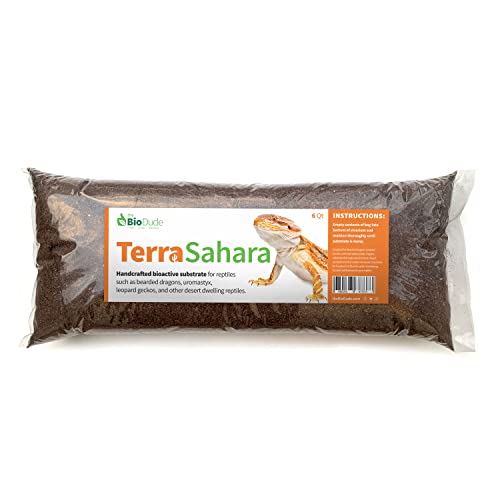
The Bio Dude Terra Sahara Reptile Substrate is best suited for keepers housing arid-adapted reptiles like sand boas, bearded dragons, and uromastyx. This 6-quart blend mimics natural desert conditions. It maintains low ambient humidity and prevents moisture buildup. The substrate guarantees proper drainage and aeration, reducing mold and stagnation risks. I’ve found it supports healthy burrowing, shedding, and hydration. Its composition resists compaction, preserving tunnel integrity. Microbial activity thrives, promoting a sustainable bioactive setup. It’s ideal for desert plants like succulents and cacti, encouraging strong root development. This substrate balances structure and function for long-term habitat health.
Best For: Reptile enthusiasts keeping arid-adapted species such as bearded dragons, uromastyx, sand boas, and leopard geckos in a bioactive or desert-style terrarium.
Pros:
- Promotes a healthy, sustainable bioactive environment with strong microbial activity
- Supports natural burrowing behaviors and maintains tunnel stability due to non-compacting formula
- Ideal for desert plants like succulents and cacti, encouraging robust root growth and proper drainage
Cons:
- Not suitable for high-humidity reptile setups or tropical species
- May be too coarse for very small or delicate reptiles if not monitored
- Sold in 6-quart increments, which may require multiple purchases for larger enclosures
Factors to Consider When Choosing a Substrate for Boa
You need a substrate that balances humidity retention with waste absorption to keep your boa healthy. It must hold 60–70% RH when misted but dry out within 12–24 hours to prevent bacterial growth, while also supporting natural burrowing without collapsing. Choose a material free of fine dust and sharp particles to protect respiratory health and guarantee safe, comfortable movement.
Humidity Retention Needs
Since maintaining proper humidity is essential for boa health, selecting a substrate with strong moisture retention capabilities directly impacts respiratory function and shedding success. You need humidity levels between 60% and 80%-coconut fiber reliably maintains this range. It absorbs water during misting and releases moisture gradually, stabilizing enclosure conditions. A substrate layer of 2–3 inches enhances this effect, allowing moisture gradients to form. Unlike sand or gravel, which stay dry and create chronically low humidity, coconut fiber holds water effectively. This reduces dehydration risks and helps prevent respiratory infections. Materials that retain humidity support natural respiratory tract function in tropical and semi-tropical boas. You’ll find regular misting works better when your substrate stores and slowly emits moisture. Choose substrates designed for high hygric capacity. Proper moisture buffering protects your boa from environmental stress.
Waste Absorption Capacity
A top-tier substrate handles waste efficiently, and materials with high organic fiber content absorb 3–5 times their weight in moisture. You need this level of absorption to trap liquid waste and limit dampness in the enclosure. Efficient absorption cuts ammonia buildup from urine and feces, which directly lowers the risk of respiratory issues in your boa. Substrates that clump or break down waste make spot cleaning easier, letting you remove soiled areas fast and reduce full replacements. Choose materials that hold moisture without turning soggy-this balance stops waste from spreading while supporting microbial breakdown. Over time, high-absorption substrates limit odor by locking waste into their fibers. This keeps the habitat cleaner and more hygienic. Performance isn’t just about dryness-it’s about sustained air quality, reduced pathogens, and easier maintenance. Pick substrates proven for high liquid retention and structural stability under waste load.
Burrowing Behavior Support
Burrowing isn’t a luxury-it’s a necessity for boa constrictors, and the right substrate makes all the difference. You need a soft, non-abrasive material to prevent skin irritation during frequent digging. Choose substrates like coconut fiber or cypress mulch-they’re gentle on sensitive scales. The material must hold moisture well to stabilize tunnels and prevent collapse, mimicking the humid burrows boas use in the wild. Aim for a depth of at least 2 to 3 inches; this allows full concealment and supports natural digging instincts. A dust-free option is essential-particles can irritate respiratory tracts, especially when buried. Opt for textures that replicate tropical forest floors. These features encourage exploration and reduce stress. Proper substrate doesn’t just allow burrowing-it actively supports it with structural integrity, moisture retention, and safety. You’re not just covering the floor-you’re building a functional habitat.
Respiratory Health Safety
Healthy lungs start with clean air, and your boa’s substrate plays a direct role in maintaining respiratory function. Choose dust-free, low-particulate materials to prevent airway irritation and reduce infection risks. Substrates with high air permeability support proper enclosure ventilation, minimizing stagnant, moist air that fosters pathogens. Avoid overly dry or dusty options like sand or fine bark, which can inflame sensitive respiratory tissues. Opt for mold-resistant, bacteria-resistant materials such as recycled paper or coconut fiber, especially when maintaining 60–70% humidity. These substrates regulate moisture effectively without becoming soggy, preventing damp microclimates where harmful microbes thrive. Non-abrasive surfaces also limit skin trauma, reducing secondary infection routes that can compromise immunity and indirectly impact lung health. You’re not just picking bedding-you’re managing air quality. Consistently clean soiled areas to preserve hygienic conditions. A stable, well-ventilated, pathogen-free substrate environment is essential for long-term respiratory safety.
Substrate Texture And Comfort
Comfort begins with texture. A soft, loose substrate prevents skin abrasions and scale damage as your boa coils and moves. Choose fine-textured materials that mimic a natural forest floor, promoting instinctive locomotion and reducing stress during exploration. Avoid coarse or jagged substrates-they can cause micro-injuries, especially during shedding or burrowing. Opt for substrates retaining slight moisture without clumping; this maintains a humidity-balanced surface that supports respiratory health and prevents scale issues. A depth of at least 2–3 inches of compressible bedding allows partial burrowing and aids in thermal regulation. This layer should feel yielding under pressure, offering physical comfort while supporting natural behavior. Fine coconut fiber, softly milled sphagnum moss, or quality cypress mulch meet these criteria. Each provides cushioning, retains ideal humidity, and minimizes injury risk. Prioritize consistency and safety-your boa’s well-being depends on it.
Ease Of Maintenance
Typically, a well-chosen substrate simplifies routine care without sacrificing hygiene. You’ll spot-clean waste daily, and high-absorbency materials like cypress mulch reduce full replacements to every 4–6 weeks. These substrates trap moisture efficiently, maintaining 60–80% humidity without daily misting. That means less hands-on time and stable conditions for your boa. Choose materials resistant to compaction-like coconut husk or orchid bark-since they prevent anaerobic pockets and mold. These last longer, staying hygienic for up to two months with proper spot cleaning. You can quickly remove feces and urates with minimal disruption to the bedding layer. Some substrates, such as newspaper or paper towels, can even be discarded, sterilized, and reused if uncontaminated. This extends usability and cuts maintenance effort. A smart substrate choice saves time while ensuring consistent enclosure hygiene.
Environmental Sustainability
Every choice you make in selecting a substrate impacts the environment, and opting for sustainable materials like coconut husk reduces reliance on finite resources. Coconut husk is a renewable byproduct of coconut farming, making it an eco-friendly alternative. It’s fully biodegradable, breaking down efficiently in compost systems without releasing toxins. When disposed of properly, it returns organic matter to the soil. Compostable substrates double as soil amendments, improving water retention and aeration in gardens. Sustainably sourced options come from responsibly managed farms, avoiding deforestation and habitat destruction. Look for certifications like FSC or Rainforest Alliance. Low-impact production methods, like compressed blocks, reduce shipping volume by up to 70%, cutting fuel use and carbon emissions. You’ll save space and minimize waste. These substrates last longer and require fewer replacements. Choosing eco-conscious materials supports long-term planetary health without sacrificing your boa’s comfort or care needs.
Frequently Asked Questions
Can Boa Constrictors Live Without Substrate?
Yes, boa constrictors can survive without substrate, but it’s not ideal. Bare enclosures reduce infection risks and simplify cleaning. However, lack of grip increases scale damage risk. Hard surfaces offer no cushioning, potentially causing pressure sores during long rest periods. Substrates like reptile carpet or paper towels are safer alternatives. They provide traction, aid in humidity retention, and reduce stress. Always monitor for abrasions or dehydration if going bare-bottom.
How Often Should I Replace Boa Substrate?
You should replace boa substrate completely every 1–2 months. Spot clean daily by removing feces, urates, and damp patches to prevent bacterial growth. If using paper towels or newsprint, change them immediately after soiling. For particulate substrates like coconut fiber or cypress mulch, full replacement prevents mold and ammonia buildup. A deep clean with 5% bleach solution followed by rinsing and drying is essential during changes. Always make sure substrate is dry before reuse.
Is Coconut Fiber Safe for Baby Boas?
Yes, coconut fiber is safe for baby boas when used correctly. It retains moisture well, maintaining 60–80% humidity essential for hydration and shedding. Use a 1–2 inch layer, dampened but not soggy-excess moisture promotes mold. Guarantee it’s chemical-free and low-dust to prevent respiratory irritation. Monitor closely; ingestion during feeding can cause impaction. Spot clean daily, fully replace monthly, or sooner if contaminated. Pair with a secure hide to reduce stress.
Can Substrate Cause Respiratory Issues in Boas?
Yes, substrate can cause respiratory issues in boas if it’s dusty, mold-prone, or improperly maintained. You risk exposing your boa to airborne irritants when using substrates like fine sand, excessively dry coconut fiber, or moldy mulch. Particulate matter inflames delicate lung tissue, leading to labored breathing or infection. Always choose low-dust, moisture-stable substrates and maintain humidity between 60–70% to prevent respiratory stress.
Do Boas Eat Their Substrate Accidentally?
Yes, boas can accidentally ingest substrate while feeding. You might see this happen most often with loose, granular materials like sand or bark. The ingestion isn’t usually harmful in small amounts, but large quantities can cause impaction. You should avoid substrates that resemble food in size or texture. Paper-based or solid substrates like reptile carpet reduce this risk considerably.