Best Saltwater Fish Tanks for a Stunning Ocean Vibe
You want a tank that brings the ocean’s beauty to life with stability and style. The Fluval Evo XII offers 13.5 gallons in a compact, reef-ready design with 1,383-lumen LED lighting and three-stage filtration. Larger setups like the 32.5-gallon Fluval Flex provide enhanced water stability and app-controlled RGB lighting. For maximum impact, the 25-gallon Innovations Marine Lagoon features low-iron glass, dual return pumps, and a built-in overflow. Each model guarantees ideal water quality, precise lighting control, and sleek aesthetics. Choosing the right system shapes your underwater world-what fits your space and goals matters most.
We are supported by our audience. When you purchase through links on our site, we may earn an affiliate commission, at no extra cost for you. Learn more. Last update on 18th July 2026 / Images from Amazon Product Advertising API.
Notable Insights
- Fluval Evo XII offers a sleek 13.5-gallon reef-capable design with honeycomb rear concealment and app-controlled LED lighting for a stunning ocean aesthetic.
- Coralife BioCube 32-Gallon combines compact footprint with adjustable flow and sunrise/sunset LED programming to enhance marine visuals.
- Fluval Flex 32.5 features curved front glass, hidden filtration, and RGB LED lighting via app control for immersive ocean ambiance.
- Coralland Compact System uses ultra-clear low-iron glass and a space-saving 8-gallon design for vibrant, desktop-sized ocean displays.
- Innovations Marine 25 Gallon Lagoon includes dual pumps, built-in overflow, and frameless low-iron glass for a stable, crystal-clear marine view.
Fluval Evo XII Saltwater Aquarium Kit

If you’re setting up a compact saltwater aquarium that doesn’t sacrifice performance, the Fluval Evo XII Saltwater Aquarium Kit is an excellent choice for beginner to intermediate hobbyists. It holds 13.5 gallons (52 L) and measures 22 x 11.5 x 15 inches. The honeycomb-designed rear conceals the filter compartment and hides the waterline. A sleek aluminum canopy houses a 16 W LED light producing 1,383 lumens with touch-activated day/night modes. Its 3-stage filtration uses oversized mechanical, chemical, and biological media. All components integrate seamlessly, ensuring reliable, reef-capable performance in a space-efficient design.
Best For: Beginner to intermediate saltwater aquarium hobbyists seeking a compact, reef-capable 13.5-gallon system with integrated, space-saving design.
Pros:
- Sleek honeycomb design hides filter compartment and waterline for a clean, modern look
- Integrated 16 W LED lighting with touch-activated day/night modes and high 1,383 lumen output
- Efficient 3-stage filtration with oversized mechanical, chemical, and biological media for reliable water quality
Cons:
- Limited capacity may restrict stocking options for larger or more active fish
- Integrated design reduces flexibility for custom equipment upgrades or modifications
- Saltwater setup requires additional purchases like salt mix, protein skimmer, and test kits not included in kit
Coralife BioCube 32-Gallon Aquarium Kit

The Coralife BioCube 32-Gallon Aquarium Kit stands out as a precision-engineered solution for saltwater enthusiasts who demand an all-in-one system that balances space efficiency with advanced life-support features. It houses a 32-gallon tank with a compact footprint, ideal for small spaces. Integrated filtration, a submersible pump, dual intakes, and an adjustable return nozzle guarantee stable water flow. The low-profile hood encloses vibrant LEDs-white, blue, and color-enhancing channels-that support coral and plant health. A built-in 24-hour timer mimics natural cycles with sunrise/sunset and moonrise/moonset modes. I rely on its seamless design and trusted Coralife performance for hassle-free, reliable operation.
Best For: Saltwater and freshwater enthusiasts seeking a compact, all-in-one aquarium system with advanced LED lighting and integrated filtration for easy maintenance.
Pros:
- All-in-one design with integrated filtration, pump, and adjustable flow for reliable, space-saving performance
- Advanced LED lighting with programmable channels and natural cycle simulation supports coral and plant health
- Sleek, modern build with a compact footprint and compatibility with existing BioCube accessories
Cons:
- Substrate, fish, corals, and décor sold separately, increasing initial setup cost
- Limited to 32 gallons, which may restrict aquascaping or stocking options for larger displays
- Replacement parts or specialized maintenance may be required over time due to integrated system design
Instant Ocean Sea Salt 50 Gallons, For Marine Aquariums, Fast Dissolving
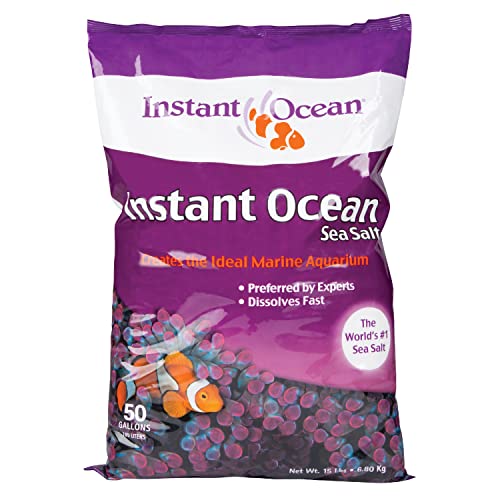
I rely on Instant Ocean Sea Salt for my 50-gallon marine aquarium because it delivers consistent, laboratory-formulated salinity that supports sensitive reef and fish-only systems. It contains every major, minor, and trace element marine life needs, with zero nitrates or phosphates. Advanced testing confirms its balance promotes long-term health. The salt dissolves quickly-no cloudiness or residue-so water is ready in minutes. pH stabilizes fast, matching natural seawater at around 8.2. Each batch is rigorously tested for quality. I’ve used it for years without issues. No extra additives are needed. The packaging prevents clumping, even after shipping. It’s reliable, precise, and trusted across the hobby for over four decades.
Best For: Marine aquarium enthusiasts seeking a reliable, high-quality salt mix that ensures optimal water conditions for both reef and fish-only systems.
Pros:
- Contains all essential major, minor, and trace elements with no nitrates or phosphates
- Fast-dissolving formula produces clear water quickly, with no residue or cloudiness
- pH stabilizes rapidly to natural seawater levels and requires no additional additives
Cons:
- Priced higher than some competing salt mixes
- Limited availability in certain regional markets
- Packaging, while durable, is not eco-friendly or recyclable
Fluval Flex 32.5 Marine Aquarium Kit

You’ll find the Fluval Flex 32.5 Marine Aquarium Kit best suits hobbyists seeking a mid-sized, all-in-one saltwater system that combines advanced filtration with modern aesthetics. It holds 123 liters (32.5 gallons) in a sleek black finish, measuring 32.5″ x 15.75″ x 15.35″. The curved front and honeycomb wrap hide the waterline and filter sides cleanly. Its LED system mixes 7500K white and RGB LEDs, adjustable via the FluvalSmart App. A 3-stage filtration uses oversized mechanical, chemical, and biological media. Dual multi-directional outlets allow precise flow control. An easy-feed top opening simplifies maintenance. Fluval engineered this system for reliable, sustainable aquatic performance.
Best For: Advanced and beginner hobbyists seeking a stylish, mid-sized marine aquarium with integrated smart lighting and superior filtration for a saltwater setup.
Pros:
- Sleek, contemporary design with a curved front and honeycomb wrap that hides the waterline and filter components
- Customizable LED lighting with 7500K white and RGB LEDs controllable via the FluvalSmart App for optimal plant growth and ambiance
- Integrated 3-stage filtration with oversized media and dual multi-directional outlets for excellent water quality and flow control
Cons:
- Limited to 32.5 gallons, which may restrict stocking options for larger or more diverse marine species
- Dependence on the FluvalSmart App may be inconvenient for users preferring manual controls or lacking smart device access
- Black finish, while stylish, may show scratches or scuffs over time, affecting aesthetic appeal
Coralland 8-Gallon Saltwater Aquarium

Compact yet thoughtfully engineered, this 8-gallon saltwater aquarium suits hobbyists with limited space who still want a fully functional marine or reef system. It holds 5.5 gallons in the display and 2.5 gallons in the rear sump-ideal for small ecosystems. I use premium low-iron, ultra-clear glass, eliminating the greenish tint and offering crystal-clear visibility. My 45° angled joints and reinforced corners provide structural strength and a sleek profile. I’m built for saltwater-perfect for marine fish, live rock, and delicate corals, though I also support freshwater. Setup and cleaning are simple, but I don’t include accessories. I require a 5/8-inch (16 mm) water flow nozzle with compatible tubing.
Best For: Space-conscious hobbyists seeking a compact, durable saltwater aquarium ideal for small marine, reef, or desktop setups.
Pros:
- Premium low-iron, ultra-clear glass provides crystal-clear viewing without the greenish tint
- 45° angled joints and reinforced corners ensure durability and a modern aesthetic
- Integrated rear sump design supports efficient water circulation and easy maintenance
Cons:
- No accessories included, requiring additional purchases for full setup
- Limited 8-gallon capacity restricts stocking options for larger or more complex systems
- Water flow nozzle requires specific 5/8-inch (16 mm) tubing, limiting component flexibility
10-Gallon Saltwater Aquarium Kit (Black)

A 10-gallon rimless curved corner aquarium serves as an efficient and visually striking entry point for beginners venturing into saltwater systems. I use low iron ultra-clear glass, which transmits 97% of visible light-far clearer than standard glass at 80%. My dimensions are 20 x 12 x 10 inches, with an 8.5-gallon front viewing area and a 1.5-gallon rear filtration compartment. I include an aluminum LED light with three color modes, five brightness levels, and an auto-off timer. I also integrate a quiet power pump, a premium protein skimmer, two biochemical sponges, ceramic rings, and a lid. My double bullnose corner design strengthens structure while enhancing visual flow. I support saltwater, reef, and coral setups with minimal maintenance.
Best For: Beginners looking for a compact, all-in-one saltwater, reef, or coral aquarium setup with high clarity and integrated filtration.
Pros:
- Premium low iron ultra clear glass provides 97% light transmittance for superior brightness and visibility
- Integrated 1.5-gallon back filtration system with protein skimmer, sponges, and ceramic rings ensures easy water maintenance
- LED light with 3 color modes, 5-level dimming, and auto-off timer supports coral growth and enhances visual appeal
Cons:
- Limited to 10-gallon capacity, restricting stocking options and limiting scalability for larger marine life
- Rimless curved glass, while aesthetically pleasing, may be more prone to chipping if not handled carefully
- Back filtration compartment reduces total water volume to 8.5 gallons, slightly limiting system stability
PAIZOO LED Fish Tank Thermometer ±0.9°F

The PAIZOO LED Fish Tank Thermometer ±0.9°F stands out as a top choice for saltwater aquarium keepers who demand accurate, maintenance-free temperature monitoring without compromising tank aesthetics or safety. It features a bright HD LED screen with a wide viewing angle, making readings clear in any light. I simply touch it to activate-display shuts off after 5 seconds to save power. The cordless, stick-on design mounts externally; no wires touch the water. A precision probe senses temperature through the glass, delivering readings from 0–140°F with ±0.9°F accuracy in under 5 seconds. It works on saltwater, freshwater, and even seawater tanks. Its compact size fits small or large aquariums seamlessly. Powered by a long-lasting 3V button battery, it includes a 12-month warranty and 24/7 support.
Best For: Aquarists seeking a safe, accurate, and wire-free temperature monitor for saltwater, freshwater, or seawater tanks.
Pros:
- Bright HD LED display with wide viewing angle for easy reading in any lighting
- Cordless, stick-on design with external probe ensures no wires in the water
- Fast, accurate readings from 0–140°F with ±0.9°F precision and 5-second refresh rate
Cons:
- Requires manual touch activation to view temperature, which may be inconvenient for frequent checks
- Battery is built-in and not user-replaceable, limiting long-term usability
- Accuracy may be affected by thick or heavily tinted aquarium glass
Coralife BioCube Nano Aquarium Kit (16 Gal)
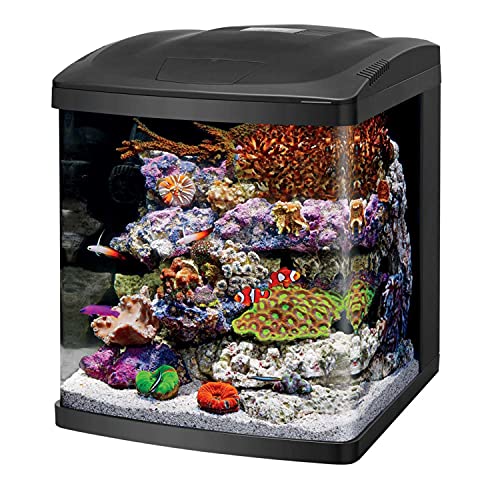
You’ll want the Coralife BioCube Nano Aquarium Kit (16 Gal) if you’re serious about maintaining a stable, visually striking saltwater tank without compromising on space or performance. It’s a fully integrated 16-gallon system designed for both saltwater and freshwater use. The rear filtration chamber simplifies maintenance and optimizes water flow. Its low-profile hood houses a customizable LED array with white, blue, and color-enhancing diodes across three independent channels. A 24-hour timer controls output. The system simulates natural lighting with 30-minute sunrise/sunset and 60-minute moonrise/moonset cycles. A quiet submersible pump drives dual intakes and an adjustable return nozzle. It’s compatible with all BioCube accessories. Coralife excludes substrate, fish, corals, and décor. This isn’t a starter kit-it’s an advanced ecosystem in compact form.
Best For: Advanced hobbyists seeking a compact, high-performance saltwater or freshwater aquarium with integrated lighting and filtration.
Pros:
- Fully integrated 16-gallon system with customizable LED lighting and natural lighting cycle simulation
- Built-in rear filtration chamber and quiet submersible pump for efficient, low-maintenance operation
- Compatible with all BioCube accessories, allowing for seamless expansion and customization
Cons:
- Does not include substrate, fish, corals, or décor, requiring additional purchases
- Higher price point makes it less suitable for beginners or budget-conscious buyers
- Limited to 16 gallons, which may restrict stocking options for larger aquatic setups
Innovative Marine Starter Kit Aquariums (25 Gallon Lagoon)

When setting up a compact yet fully functional saltwater aquarium, serious beginners and intermediate hobbyists who demand precision engineering will find the Innovative Marine 25 Gallon Lagoon Starter Kit delivers unmatched value. The tank holds 25 gallons and measures 23.6” L × 19.7” W × 11.8” H, weighing 62 lbs empty. It uses 8mm low-iron glass for superior clarity and a frameless design with beveled, polished edges. Black silicone seals guarantee durability. The built-in overflow includes dual 200-micron filter socks and an emergency drain. Two 130 GPH DC return pumps run on 5W/24V power. Flexible hoses, a return elbow, and a flow nozzle optimize water movement. A pre-installed rubber mat prevents shifting and protects surfaces.
Best For: Serious beginners and intermediate saltwater aquarium hobbyists who prioritize precision engineering, compact design, and built-in filtration in a high-clarity 25-gallon setup.
Pros:
- Features 8mm low-iron glass with beveled edges and black silicone seals for exceptional clarity and sleek, durable construction
- Includes dual 130 GPH DC return pumps and dual 200-micron filter socks for customizable, efficient filtration and water flow
- All-in-one design with pre-installed leveling mat and essential flow components for quick, tool-free setup
Cons:
- Limited tank height (11.8”) may restrict aquascaping options for tall reef builds or deep-water species
- 24V DC pumps require a specific power adapter, adding potential cost or complexity if replacements are needed
- Frameless design, while elegant, may raise concerns about long-term structural support on uneven surfaces
Innovative Marine Starter Kit Aquariums (20 Gallon Long)

One standout choice for hobbyists stepping into medium-sized saltwater systems is the Innovative Marine Starter Kit Aquarium (20 Gallon Long), especially those prioritizing integrated filtration and space-efficient design. It uses low-iron glass with beveled edges for clarity and sleek appearance. The 6mm walls measure 23.6” L × 15” W × 13” H, weighing 48 lbs. An acrylic overflow wall includes emergency backup and two 200-micron filter socks. Dual 130 GPH DC return pumps (5W/24V) offer adjustable flow. It comes with hose, elbow, and flow nozzle. A rubber leveling mat is pre-installed underneath.
Best For: Saltwater aquarium hobbyists seeking a compact, all-in-one 20-gallon long system with integrated filtration and premium build quality.
Pros:
- Features low-iron glass with beveled edges for enhanced clarity and a sleek, modern appearance
- Includes built-in acrylic overflow with emergency backup and dual 130 GPH DC return pumps for reliable, adjustable flow
- Comes with essential plumbing components and a pre-installed rubber leveling mat for easy setup
Cons:
- Limited to 20-gallon capacity, which may restrict stocking options for larger or more complex ecosystems
- Uses filter socks instead of a sump, requiring more frequent maintenance and limiting filtration customization
- Dual pump setup, while redundant, may be overkill for simpler setups and increases initial cost
Factors to Consider When Choosing a Saltwater Fish Tank
You need to pick the right tank size because larger volumes stabilize water conditions-aim for at least 30 gallons to reduce parameter swings. Proper lighting matters for coral health; use full-spectrum LEDs with a 6,500K to 20,000K range and 3–5 watts per gallon for reef tanks. Your filtration system should combine mechanical, chemical, and biological methods, and place the tank away from direct sunlight and high-traffic areas to maintain stable water quality.
Tank Size Selection
Though smaller aquariums may seem convenient, selecting the right tank size is critical for long-term success in saltwater setups. You need a minimum of 10 gallons to stabilize water conditions during cycling and early stocking. Larger tanks-over 30 gallons-offer superior stability, diluting waste and minimizing swings in temperature and salinity. A broad footprint matters as much as volume; it guarantees enough swimming space for active fish and supports complex aquascaping. Compact systems under 10 gallons demand constant monitoring due to rapid parameter shifts and poor thermal inertia. Opt for models with built-in sumps or filtration compartments. These increase total water volume and boost system stability without expanding the tank’s external size. Always match tank dimensions to your intended species’ behavioral needs. Bigger tanks forgive mistakes; small ones don’t. Your choice directly impacts livestock health, maintenance frequency, and overall viability.
Water Quality Management
Stable water quality separates thriving saltwater tanks from struggling ones, building directly on the foundation set by proper tank size. You must maintain pH between 8.1 and 8.4 to support healthy biological processes and marine life. Salinity should stay within 1.023–1.025 specific gravity to mimic natural seawater conditions. Test levels regularly-you can’t afford guesswork. Keep ammonia and nitrite at 0 ppm; even trace amounts stress fish and damage gills. Nitrate should stay below 10 ppm to prevent algae overgrowth and coral decline. Use a protein skimmer to remove organic waste before it breaks down into harmful compounds. It pulls toxins from the water column efficiently. Always mix saltwater with high-purity salt blends to guarantee correct calcium, magnesium, and trace element levels. Contaminants disrupt stability and harm sensitive invertebrates. Consistent testing and equipment use keep your system balanced.
Lighting Requirements
When selecting lighting for your saltwater tank, matching output to your inhabitants’ needs guarantees biological success. You’ll need 50–100 PAR at the tank bottom for photosynthetic corals-reef tanks demand this intensity. Use full-spectrum LEDs with white light (5000K–10000K) and actinic blue (420nm–460nm) to support coral symbionts and enhance fish colors. Adjustable systems let you program sunrise, sunset, and lunar cycles, mimicking natural rhythms and reducing stress. Run main lights 6–10 hours daily; add 2–4 hours of moonlight to maintain circadian balance. Avoid exceeding these durations-too much light fuels algae. Position fixtures to guarantee full coverage, eliminating shaded zones that stunt coral growth. Poor placement creates microenvironments, just like uneven heat on a stove. Uniform spread promotes consistent photosynthesis. Choose quality LEDs with reliable drivers and cooling. Proper lighting isn’t just visibility-it’s essential.
Filtration System Options
Since clean water is critical for marine life, setting up an effective filtration system starts with combining three key stages: mechanical, chemical, and biological. You need mechanical filtration to trap debris-use an overflow system with removable filter socks to capture large particulates and improve clarity. Pair this with chemical filtration, like activated carbon, to remove discoloration and toxins. For biological filtration, porous ceramic rings and live rock provide ample surface area for beneficial bacteria to convert ammonia into less harmful nitrates. You can’t skip protein skimmers; they remove organic waste before it breaks down, cutting down algae growth and maintaining water quality. Install dual return pumps with adjustable flow rates to guarantee strong, customizable water circulation that mimics ocean currents. Proper flow keeps detritus suspended for easier removal and supports coral respiration-critical for a thriving saltwater ecosystem.
Aquarium Placement Tips
You’ve designed a high-performing filtration system, but even the best setup can’t compensate for poor aquarium placement. Position your tank away from direct sunlight to prevent algae blooms and temperature swings. Sunlight exposure raises water temps by up to 5°F during peak hours, destabilizing the ecosystem. Place the aquarium on a level, load-rated surface-minimum 10 lbs per gallon-to avoid structural failure. A 100-gallon tank requires a surface supporting at least 1,000 lbs. Avoid high-traffic zones; footfalls and door slams generate vibrations that stress fish. Locate near grounded electrical outlets to power pumps and heaters safely. Guarantee easy access to a water source for efficient 10–20% weekly changes. Maintain room temperatures between 68°F and 78°F to reduce heater workload. Stability is critical-thermal fluctuations over 2°F in 24 hours compromise immune health. Choose wisely: placement directly impacts long-term tank performance.
Marine Life Compatibility
Choosing the right marine life for your saltwater tank demands careful planning, as incompatible species can destabilize the ecosystem. Match tank size to adult fish dimensions and activity levels-small tanks overstock quickly, increasing stress and ammonia spikes. You’ll need at least 30 gallons for larger or schooling species to guarantee adequate swimming space. Research dietary needs; some fish require live prey or fortified brine shrimp fed three times daily. Combine species by temperament: aggressive fish like lionfish may attack peaceful cardinals, while semi-aggressive damsels can dominate shy tankmates. Verify reef safety-angels and some puffers graze on soft corals, risking colony loss. Each fish adds bioload; a 6-inch angelfish produces roughly 1.5 times the waste of a 3-inch clownfish. Pair high-bioload species with filtration rated for 1.5 times your tank’s volume to maintain nitrate below 20 ppm.
Setup And Maintenance
While aesthetics matter, functionality should drive your saltwater tank selection-starting with a built-in overflow system that uses dual 200-micron filter socks to trap debris efficiently and reduce maintenance time. You’ll appreciate how integrated return pumps deliver up to 130 GPH with adjustable flow, allowing precise control for sensitive corals and fish. These pumps guarantee consistent circulation without overwhelming your ecosystem. Pre-installed leveling mats stabilize the tank on uneven surfaces, minimizing glass stress and preventing leaks. Rear filtration compartments stay hidden within the design, streamlining access during routine cleaning while reducing visible hardware clutter. Your maintenance workload drops further thanks to low-iron glass, which boosts clarity and resists algae growth better than standard glass. This material doesn’t just improve viewing-it cuts down scrubbing time. You get reliable performance, smart engineering, and long-term durability in one functional system built for real aquarium demands.
Frequently Asked Questions
How Often Should I Change the Saltwater in My Tank?
You should change 10–20% of your saltwater every two weeks. This routine maintains stable salinity, pH, and alkalinity levels critical for coral and fish health. Use a calibrated hydrometer or refractometer to confirm salinity stays between 1.023 and 1.025 SG. Always premix new saltwater to match tank temperature and pH. Frequent small changes reduce nitrate buildup more effectively than infrequent large changes.
What Lighting Is Best for Coral Growth in Saltwater Tanks?
You need full-spectrum LED lighting with intense PAR values for coral growth. Aim for 100–200 PAR at the tank’s bottom. Use LEDs emitting 20,000–30,000 Kelvin, balancing blue and white channels. SPS corals demand higher intensity-run lights 8–10 hours daily with gradual ramping. Fixtures like the AquaIllumination Hydra 52 or Maxspect Razor 270R deliver stable, customizable spectrums. Proper photoperiods and intensity prevent algae while boosting zooxanthellae photosynthesis.
Can I Keep Freshwater Fish in a Saltwater Aquarium Setup?
No, you can’t keep freshwater fish in a saltwater aquarium setup. Freshwater fish lack the physiological adaptations to excrete excess salt. Their kidneys and gills aren’t designed for osmoregulation in saline environments. Exposure to saltwater causes rapid dehydration and stress. Osmotic pressure forces water out of their cells, leading to organ failure. Even brackish-tolerant species can’t survive full marine salinity. Always match species to water parameters-salinity must be 1.023–1.025 specific gravity for marine tanks.
How Do I Cycle a New Saltwater Fish Tank Properly?
You cycle a new saltwater tank by establishing beneficial bacteria to process waste. Start with adding live rock or a bacterial starter. Introduce a source of ammonia-like fish food or pure ammonia. Monitor levels: aim for 2–5 ppm initially. Test weekly with a liquid saltwater test kit. Wait until ammonia and nitrite read 0 ppm, and nitrate appears. That process takes 4–8 weeks. Don’t skip patience-rushing causes crashes.
Are Saltwater Tanks Harder to Maintain Than Freshwater Tanks?
Yes, saltwater tanks are harder to maintain than freshwater tanks. You manage more complex water chemistry, including salinity, calcium, and alkalinity levels. You must test parameters weekly and keep salinity between 1.023 and 1.025. Protein skimmers, refugiums, and calcium reactors often become necessary. Corals demand intense lighting and pristine conditions. Even minor fluctuations stress livestock. Your maintenance routine is longer and more precise.