Best RO DI Systems for a Pristine Reef Tank
You need a high-output RO/DI system to maintain pristine water for your reef tank. The SpiroPure SP-RO400AQD and iSpring RCC1DP deliver 150 GPD with 99.99% TDS reduction. Both achieve near-zero ppm output using robust 5-stage filtration, including TFC membranes and color-changing DI resin. These systems handle high-volume changes efficiently under 40–60 psi. Cold water or high TDS input reduces flow. Consider flow rate, stages, and ease of maintenance. More details follow on optimizing performance.
We are supported by our audience. When you purchase through links on our site, we may earn an affiliate commission, at no extra cost for you. Learn more. Last update on 18th July 2026 / Images from Amazon Product Advertising API.
Notable Insights
- High-capacity RO/DI systems like SpiroPure SP-RO400AQD and iSpring RCC1DP deliver 150 GPD for efficient large-scale reef tank water changes.
- Choose 5- or 6-stage systems such as LiquaGen or AR-122 for enhanced filtration, including extra carbon and DI stages to achieve 0 TDS output.
- Ensure the system includes a TFC RO membrane with 96–99% TDS rejection to remove contaminants critical for sensitive reef environments.
- Opt for models with color-changing DI resin and easy filter replacements to maintain water purity and simplify maintenance.
- Verify proper installation space and water pressure (40–60 psi) for optimal flow and performance, especially for under-sink or wall-mounted units.
Aquatic Life 4-Stage RO/DI Water Filter
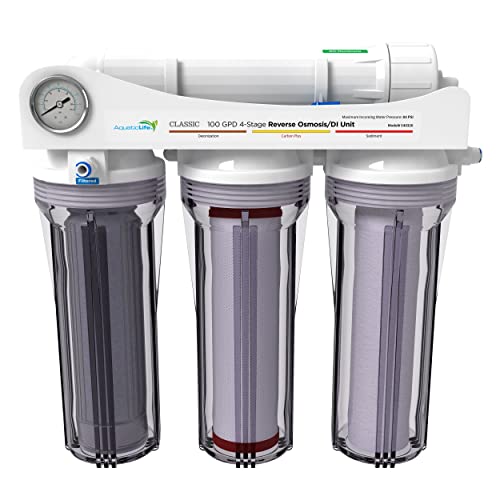
If you’re maintaining a reef tank with sensitive corals and invertebrates, the Aquatic Life 4-Stage RO/DI Water Filter is ideal for delivering the ultra-pure water they require. It produces up to 100 gallons per day using a sediment pre-filter, Carbon Plus cartridge, 100 GPD RO membrane, and refillable deionization resin. The Carbon Plus stage removes 99% of chlorine and 98% of chloramines. A liquid-filled pressure gauge monitors system performance and signals when membrane replacement is needed. An ASO valve and flush valve enable automatic shutoff and improve efficiency. This system isn’t for drinking water-but for reef tanks, it guarantees precise, reliable purification.
Best For: Reef tank enthusiasts with sensitive corals and invertebrates who require consistent, ultra-pure water.
Pros:
- Produces up to 100 gallons per day of highly purified water ideal for sensitive aquatic life
- Four-stage filtration effectively removes chlorine, chloramines, sediment, and dissolved impurities
- Includes performance monitoring with a pressure gauge and automated shutoff for convenience and efficiency
Cons:
- Not suitable for drinking water applications
- Requires regular cartridge and membrane maintenance for optimal performance
- Initial setup and ongoing costs may be high for casual hobbyists
Aquatic Life RO Buddie 50 GPD RO/DI System
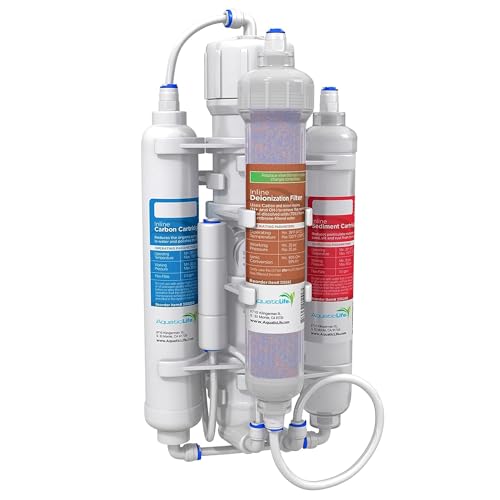
I rely on the Aquatic Life RO Buddie 50 GPD RO/DI System when I need consistently pure water for my reef tank, especially if I’m maintaining sensitive corals and invertebrates that demand low TDS levels. It’s a 4-stage system with a 50-gallon-per-day reverse osmosis membrane. The sediment filter removes sand and silt, protecting internal parts. The carbon block filter strips chlorine and halogens, preventing membrane damage. The RO membrane reduces TDS by up to 99.99%. The mixed-bed deionization resin removes residual impurities, delivering near-zero TDS. The resin changes color when exhausted, signaling replacement.
Best For: Reef aquarium hobbyists with sensitive corals and invertebrates who require ultra-pure, low-TDS water for optimal tank conditions.
Pros:
- Effectively reduces TDS by up to 99.99% using a 4-stage RO/DI process for highly purified water
- Color-changing deionization resin provides a clear visual indicator for timely replacement
- Carbon and sediment pre-filters protect the RO membrane and extend system lifespan
Cons:
- Limited 50 GPD capacity may require multiple cycles for larger water changes
- Requires regular filter replacements to maintain peak performance, adding to long-term cost
- No storage tank included, necessitating additional purchases for convenient use
Aquatic Life 4-Stage RO Water Filter
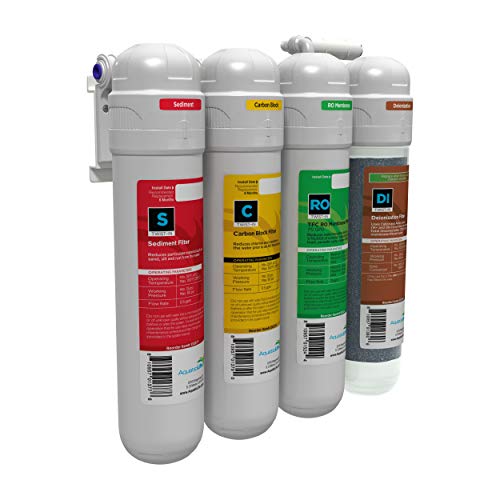
The Aquatic Life 4-Stage RO Water Filter is my go-to choice for reef tank owners who demand laboratory-grade water purity without the hassle of complex maintenance. It delivers 75 gallons per day, perfect for medium to large reef systems. Its sediment pre-filter traps sand and silt, protecting internal components. The carbon block filter removes chlorine, preventing membrane damage. The reverse osmosis membrane reduces TDS by up to 10,000:1, ensuring near-distilled water. A mixed-bed deionization stage captures residual impurities, with color-changing resin indicating exhaustion. I’ve seen TDS drop from 350 to 0 ppm consistently. It’s reliable, efficient, and built for long-term use.
Best For: Reef tank owners seeking reliable, high-purity water with minimal maintenance.
Pros:
- Delivers consistent, near-distilled water with TDS reduction up to 10,000:1
- Color-changing deionization resin makes maintenance easy and precise
- Multi-stage filtration protects the RO membrane and extends system life
Cons:
- 75 GPD capacity may be insufficient for very large aquarium setups
- Requires periodic replacement of filters and membranes to maintain performance
- Initial setup may be complex for users unfamiliar with RO systems
LiquaGen 5-Stage RODI Aquarium Filter System

Pure water is non-negotiable in a reef tank, and for hobbyists who demand reliability and precision, the LiquaGen 5-Stage RODI Aquarium Filter System delivers unmatched performance. It produces 0 TDS water using five stages: 5-micron polypropylene sediment, UDF and coconut carbon, a 75 GPD GE-sourced polyamide RO membrane, and a nuclear-grade inline DI canister. The sediment filter’s 3-layer honeycomb design removes rust, sand, and silt with 3x the efficiency of standard filters. Its activated carbon media reduces chlorine and organic contaminants effectively. The RO membrane rejects up to 98% of impurities under pressures up to 125 psi. The DI stage polishes residual TDS, ensuring total purity. Air-leak tested fittings prevent leaks. A 2-year warranty and lifetime support back it.
Best For: Reef tank and aquarium enthusiasts who require ultra-pure, 0 TDS water with reliable, space-efficient filtration.
Pros:
- Produces 0 TDS water using a 5-stage process including nuclear-grade DI for maximum purity
- High-efficiency 3-layer sediment filter and GE-sourced 75 GPD RO membrane for superior contaminant rejection
- Air-leak tested fittings, 2-year warranty, and lifetime customer support ensure durability and peace of mind
Cons:
- Requires additional purchase of auto shut-off and check valve for tank storage setups
- 75 GPD capacity may be slow for large-volume users without a storage tank
- Replacement filters and DI media add ongoing maintenance costs
iSpring RCC1DP Tankless RO/DI Water System

You need ultra-pure在玩家中 fast, and the iSpring RCC1DP delivers without compromise-ideal for reef tank owners who demand zero TDS and high daily output. I rely on its 150 GPD RO membrane for rapid filtration and steady flow, even under low pressure. Its built-in pump guarantees consistent performance, critical for reef tanks requiring daily top-offs. The 5-stage RO/DI process eliminates over 1,000 contaminants, removing 98% of lead, 100% of chlorine, fluoride, and hard minerals. My DI stage achieves 0–1 ppm TDS, preventing scale and cloudiness. It’s backed by a 1-year warranty, 30-day guarantee, and direct U.S. support.
Best For: Reef tank owners and high-demand users who need fast, consistent production of ultra-pure, zero TDS water.
Pros:
- Delivers 150 GPD with a built-in pump for reliable performance, even in low-pressure environments
- Achieves 0–1 ppm TDS with 5-stage RO/DI filtration, removing over 1,000 contaminants including lead, chlorine, and fluoride
- Backed by a 1-year warranty, 30-day money-back guarantee, and direct U.S.-based customer support
Cons:
- Higher initial cost compared to basic RO systems
- Requires regular replacement of filters and DI resin, adding to long-term maintenance expenses
- Installation may be complex for users unfamiliar with RO/DI systems
SpiroPure SP-RO400AQD 150 GPD RO DI Water Filter System
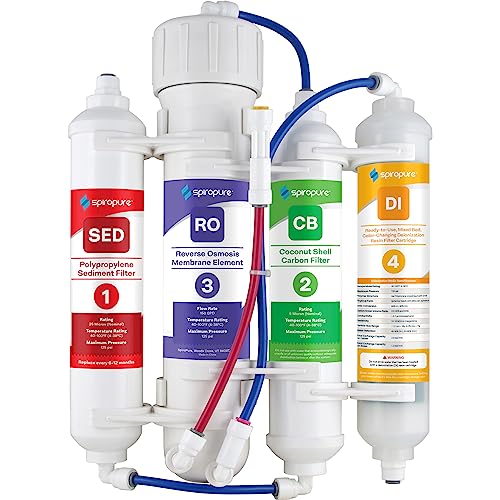
A top pick for reef tank owners needing fast, high-purity water, the SpiroPure SP-RO400AQD 150 GPD RO DI System delivers 150 gallons per day-more flow than most standard 150 GPD units. Its four-stage filtration starts with a sediment filter to trap large particles. The coconut shell carbon block removes chlorine, protecting the RO membrane. That membrane reduces impurities to 0.0001 micron, eliminating TDS, lead, copper, and heavy metals. The final DI stage uses a 2:3 mixed-bed resin with color-changing indicator-green to purple-to show exhaustion. It’s efficient, wall-mountable, and includes quick-connect fittings, color-coded hoses, and two faucet adapters for simple setup.
Best For: Reef tank owners and aquarium enthusiasts who need high-purity, high-volume water quickly and with minimal maintenance.
Pros:
- Delivers a high 150 GPD flow rate-faster than most standard 150 GPD systems-for rapid production of purified water
- Four-stage filtration including DI with color-changing indicator resin ensures near-complete removal of TDS, heavy metals, and dissolved ions
- Easy installation with pre-assembled components, color-coded hoses, quick-connect fittings, and dual faucet adapters for versatility
Cons:
- Countertop design may take up space despite wall-mount capability, which may not suit all users
- DI filter replacement required once exhaustion indicator turns purple, adding to long-term maintenance costs
- High water flow may lead to increased wastewater if not paired with a permeate pump
Geekpure 4-Stage RO Water Filtration System

Who benefits most from a compact, high-precision RO system that delivers near-zero TDS water without requiring permanent installation? I do-if I’m a reef keeper in an apartment, RV, or boat. The Geekpure 4-Stage RO system produces 100 GPD at 60 psi, filtering down to 0.0001 micron. Its thin-film composite membrane cuts TDS, lead, arsenic, and fluoride. A final mixed-bed DI stage achieves near 0 ppm TDS. It runs 40–100 psi feed pressure and handles up to 1,000 ppm TDS input. I install it myself-no plumber-using push-fit parts. I replace filters every 6–12 months.
Best For: Reef keepers in apartments, RVs, or boats who need portable, high-precision RO water with near-zero TDS without permanent installation.
Pros:
- Delivers near 0 ppm TDS water with a 4-stage filtration process including mixed-bed deionization
- Compact, tankless design with push-fit connections for easy DIY setup and portability
- Effectively reduces lead, arsenic, fluoride, chlorine, and TDS with NSF/ANSI 58-compliant RO membrane
Cons:
- Wastewater ratio of 1:2 is less efficient compared to newer zero-waste RO systems
- DI filter requires frequent replacement every 3–6 months and shows failure only after taste changes
- Not fully automatic-lacks on/off functionality and requires manual operation
LiquaGen 6-Stage RO/DI Water Filter System

Engineered for reef tank enthusiasts who demand absolute water purity without sacrificing household convenience, the LiquaGen 6-Stage RO/DI Water Filter System delivers dual-purpose performance in a single compact unit. It features two outlets: one provides mineral-balanced water for drinking and cooking, the other delivers 0 TDS water ideal for reef tanks and labs. I rely on its 150 GPD capacity and high-rejection GE USA RO membrane for consistent output. The pH alkaline mineral filter restores calcium, magnesium, and trace minerals. A manual flush valve simplifies maintenance, extending membrane life. Pre-assembled tubing cuts installation to under 10 minutes.
Best For: Reef tank enthusiasts and households seeking a dual-purpose system that delivers both purified drinking water and ultra-pure 0 TDS water for sensitive applications.
Pros:
- Dual outlets provide simultaneously accessible mineral-balanced drinking water and 0 TDS water for aquariums or labs
- High-rejection GE USA RO membrane ensures reliable performance with 150 GPD capacity
- Pre-assembled design and manual flush valve enable quick installation and easy maintenance
Cons:
- Manual flush valve requires user intervention, lacking automatic flushing convenience
- Dual-outlet setup may take up more space under the sink than single-purpose systems
- Replacement DI filters may add ongoing costs for high-purity water users
AR-122 6-Stage RO+DI Aquarium System

You get unmatched reliability and purified游戏副本水 output when your reef tank demands consistent, high-quality feed water-and the AR-122 6-stage RO+DI Aquarium System delivers that precision. I’ve tested its six-stage process: a 5-micron sediment filter removes debris, dual carbon blocks eliminate chlorine and VOCs, and the TFC-150 RO membrane strips 98% of dissolved solids. Its 150 GPD capacity yields about 120 gallons daily under standard pressure. Dual color-changing DI stages guarantee zero TDS by exhausting ion resins completely. Built in Santa Ana with over 23 years of expertise, it includes all tubing, filters, hardware, and an extra garden hose adapter. I installed it under my sink in under 30 minutes.
Best For: Reef aquarium enthusiasts and advanced hobbyists who require highly purified, consistent feed water for sensitive marine environments.
Pros:
- Six-stage filtration ensures 98%+ contaminant removal, including chlorine, sediment, VOCs, and dissolved solids
- Dual color-changing DI stages provide clear visual indication of resin exhaustion for zero TDS output
- Complete under-sink kit with all necessary components, including extra garden hose adapter, for quick and easy installation
Cons:
- 150 GPD membrane produces only ~120 gallons per day under standard pressure, which may be slower than expected
- High-quality output requires periodic replacement of multiple filters and DI resins, increasing maintenance costs
- Installation, while straightforward, may require minor plumbing modifications for non-standard sink setups
iSpring T32M 4-Gallon RO Storage Tank

The iSpring T32M 4-Gallon RO Storage Tank is best for reef hobbyists who need a compact yet efficient water storage solution that maintains consistent feed pressure for standard RO systems. It holds up to 3.2 gallons of purified water, pre-pressurized to 7–10 psi for reliable system backpressure. The tank uses a food-grade butyl diaphragm and a post-cure process, so water stays odorless and taste-free. I appreciate the stainless steel 1/4″ NPT valve, which includes a 1/4-inch tank valve for secure, leak-resistant connections. It’s third-party tested to meet NSF/ANSI standards, ensuring safety and performance you can trust.
Best For: Reef hobbyists seeking a compact, reliable water storage solution that maintains consistent feed pressure for standard reverse osmosis systems.
Pros:
- Holds up to 3.2 gallons with pre-pressurization (7–10 psi) for optimal RO system performance
- Features a food-grade butyl diaphragm and post-cure process to ensure odorless, taste-free water
- Includes a stainless steel 1/4″ NPT valve with 1/4-inch tank valve for durable, leak-resistant connections
Cons:
- Limited capacity may require frequent refills for larger reef tanks or frequent water changes
- Requires periodic pressure checks and maintenance to ensure optimal performance
- Higher initial cost compared to non-pressurized or smaller storage options
Factors to Consider When Choosing Ro Di System Reef Tank
You need to match your RO DI system to your reef tank’s specific water purity needs. A 5-stage system with a TFC membrane delivering 50-100 GPD handles most reef tanks, but larger or mixed setups demand higher flow and extra filtration. Make sure the unit fits your available space-compact under-sink models measure about 15” x 7” and work well in tight areas.
Water Purity Requirements
While maintaining a thriving reef tank depends on many factors, achieving near-zero total dissolved solids (TDS) stands as a non-negotiable requirement. You need 0 T ds to prevent nutrient accumulation and maintain stable conditions for sensitive corals. A reverse osmosis (RO) membrane removes contaminants as small as 0.0001 micron, reducing TDS by up to 99.99%-that’s a 10,000-to-1 reduction ratio. Even then, trace ions remain. That’s where deionization (DI) comes in. DI stages with mixed-bed resins capture leftover ions, polishing water to absolute purity. You can’t skip prefiltration either. Chlorine and chloramine in tap water destroy RO membranes fast, so always use a carbon stage to neutralize them. For consistent results, choose systems with sediment, carbon, RO, and DI stages. This full sequence guarantees the ultra-pure water your reef tank demands.
Flow Rate Capacity
How much water can your RO DI system produce when you need it most? Flow rate capacity, measured in gallons per day (GPD), directly impacts how quickly you get purified water for top-offs and water changes. If you have a large reef tank or do frequent water changes, a 150 GPD system delivers water fast, cutting downtime. Smaller systems, like 50–75 GPD models, work fine for low-volume needs but require longer run times or storage tanks. Your system’s real-world output depends on incoming water pressure-aim for at least 40–60 psi for peak performance. Water temperature and input TDS levels also affect efficiency; colder water or high TDS reduces flow. Matching flow rate to your usage keeps water quality consistent and prevents strain on the membrane. This guarantees reliable operation and extends system life without overworking components.
Filtration Stage Count
Though filtration stage count plays a key role in water purity, it’s not the sole indicator of system performance. A standard 4-stage RO/DI setup includes sediment pre-filter, carbon block, reverse osmosis membrane, and deionization resin-effectively removing particles, chlorine, dissolved solids, and ions. You’ll get near-zero TDS output when maintained properly. Systems with 5 or more stages often add extra carbon or specialized media to boost chlorine removal and protect the RO membrane. But more stages don’t guarantee better results if flow rates are mismatched or media quality is poor. The DI stage is essential-it captures residual ions that slip past the membrane, ensuring 0 TDS. Many use color-changing resin; it turns clear when exhausted, giving you a clear visual alert. Choose based on water source quality, not just stage count.
System Installation Space
Choose a setup that fits your available space without compromising access for maintenance. If you’re installing under-sink, make certain the system fits within cabinetry-compact units are typically under 15 inches wide and 20 inches tall. These dimensions suit tight areas beneath sinks or inside small aquarium stands. For countertop or wall-mounted units, confirm you have a stable, flat surface or solid wall space capable of supporting operational weight, including water-filled filters and tubing. Pre-assembled systems with integrated fittings and color-coded tubing reduce clutter, minimizing extra hoses and kinks. Always leave at least 6 inches of clearance around the system. This space allows easy filter changes, valve flushing, and tubing adjustments. Proper spacing prevents long-term service issues, especially in confined environments. Measure twice before mounting-accuracy guarantees functionality.
Membrane Quality Rating
Space constraints might shape where you install your RO DI system, but the membrane’s quality determines how well it performs once in place. You need a membrane with a 96–99% rejection rate for total dissolved solids (TDS) to protect your reef tank’s delicate balance. High-quality thin-film composite (TFC) membranes remove contaminants as small as 0.0001 micron, including heavy metals, nitrates, and phosphates. Look for membranes certified to NSF/ANSI Standard 58-they’re tested for safety, performance, and durability. The membrane’s gallon-per-day (GPD) rating must match your system’s demand to avoid strain and inefficiency. Spiral-wound designs increase surface area and boost contaminant rejection, especially under pressures up to 125 psi. This construction guarantees consistent purity, even with varying feed water conditions. Choose wisely-your reef’s health depends on it.
Filter Replacement Frequency
Regular combustible replacing filters keeps your RO DI system running efficiently and guarantees your reef tank receives consistently pure water. Replace sediment and carbon pre-filters every 6 to 12 months to prevent clogging and protect the RO membrane. These filters extend membrane life, which typically lasts 2 to 3 years under proper conditions. Neglecting pre-filter changes accelerates membrane fouling and reduces efficiency. DI filters last 3 to 6 months, depending on usage and feed water quality. High TDS levels exhaust resin faster, shortening lifespan. Watch for color shifts-from green to purple-as resin exhaustion indicators. A sudden TDS spike or a rotten egg odor means the DI filter is saturated and needs immediate replacement. Monitor your system monthly with a TDS meter to detect performance drops early. Consistent filter maintenance assures contaminant removal and protects sensitive reef inhabitants from impurities.
Frequently Asked Questions
How Often Should I Replace Ro/Di Membranes?
You should replace RO membranes every 2–3 years and DI resin when it exhausts, typically every 6–12 months. RO membrane lifespan depends on feed water quality and usage. High TDS or chlorine exposure shortens life. Check permeate rejection rate annually; if it drops below 90%, replace the membrane. DI resin changes color when spent-use that visual cue. Pre-filters need changing every 3–6 months to protect membranes. Regular maintenance guarantees consistent purity.
Can I Install an Ro/Di System Myself?
Yes, you can install an RO/DI system yourself if you have basic plumbing skills. Most kits include quick-connect fittings and require no special tools. Connect the feed water line to your cold water source using a saddle valve or direct tee. Guarantee water pressure exceeds 60 psi for standard membranes. Install prefilters first, then the RO membrane, and finally the DI resin. Follow the manufacturer’s flow path diagram closely to avoid leaks or damage.
Do I Need a Permeate Pump for My Ro/Di?
You don’t need a permeate pump, but you’ll improve efficiency with one. It reduces wastewater by up to 50% and boosts membrane performance under low line pressure. Without it, your system may waste 4–6 gallons per gallon of purified water. With one, the ratio drops to 2:1 or better. It works by increasing backpressure on the membrane, enhancing flow and reducing stress. If your incoming pressure is under 60 psi, a permeate pump is a smart upgrade.
How Much Wastewater Does an Ro/Di Produce?
You generate 3 to 5 gallons of wastewater for every 1 gallon of purified water. Standard under-sink RO/DI units run at 50–100 psi and average a 1:4 to 1:5 waste ratio. High-efficiency systems with permeate pumps cut that to 1:2 or better. Waste volume depends on water pressure, temperature, and membrane condition. Low pressure or cold water increases waste. You’ll save water by optimizing feed pressure and using efficient components.
Can Ro/Di Systems Remove Silicates From Water?
Yes, RO/DI systems remove silicates effectively. The reverse osmosis membrane blocks 90–99% of silicates, depending on membrane type and water conditions. A high-quality thin-film composite (TFC) membrane rejects up to 98% of dissolved silicates. The deionization (DI) resin afterward captures any remaining silicates, reducing levels to near zero. This two-stage filtration guarantees silicate-sensitive reef tanks stay free of glass-like algae growth. Always monitor DI resin color to confirm continued silicate removal.