Top-Rated Mechanical Filters for Aquariums That Keep Water Crystal Clear
You need a mechanical filter that traps debris without restricting flow. The Aquatic Experts Filter Floss uses a dual-layer 12″ x 72″ undyed polyester design-loose fibers on top capture large particles, dense bottom layer grabs micro-debris. It’s reusable, USA-made, and ideal for canister filters and sumps. For high-flow durability, the resin-bonded 12x72x0.75-inch filter pad lasts twice as long as standard pads. You’ll see how each option balances efficiency, longevity, and compatibility.
We are supported by our audience. When you purchase through links on our site, we may earn an affiliate commission, at no extra cost for you. Learn more. Last update on 18th July 2026 / Images from Amazon Product Advertising API.
Notable Insights
- Dual-layer filter floss traps large and fine debris effectively, ensuring clearer water with gradual particle capture.
- High-density 20 PPI sponge pads capture fine particulates while maintaining strong water flow and resisting deformation.
- Resin-bonded polyester filter pads last twice as long as standard pads and maintain high flow in demanding systems.
- Graded-layer mechanical media acts as a multi-stage sieve, enhancing clarity by capturing debris progressively.
- Reusable mechanical filter pads reduce waste and cost, maintaining efficiency beyond 12 months with proper rinsing.
Aquatic Experts Filter Floss for Fish Tanks

If you demand consistent water clarity and efficient mechanical filtration, the Aquatic Experts Filter Floss is your best ally. Its dual-layer design traps large debris in the open-fiber top layer while the dense bottom layer captures fine particles. I rely on this 12-inch wide, 72-inch long roll-it fits canister filters, sumps, and reef tanks. I cut it to size for turtle tanks, aquaponics, or freshwater systems. Water must enter through the looser side first, ensuring gradual particle capture. Made from undyed polyester, it’s reusable, durable, and safe for indoor or small outdoor ponds. Manufactured in the USA.
Best For: Aquarists seeking reliable, reusable, and high-efficiency mechanical filtration for freshwater, saltwater, reef, or aquaponic systems.
Pros:
- Dual-layer design effectively captures both large and fine debris for superior water clarity
- Reusable and durable undyed polyester construction extends lifespan and reduces waste
- Versatile sizing and compatibility with a wide range of filter types and aquarium setups
Cons:
- Requires proper orientation (loose side first) for optimal performance, which may be overlooked by beginners
- May need frequent rinsing in heavily stocked tanks to prevent clogging
- Not specifically designed for very large ponds, requiring separate purchase of koi pond variant
ALEGI Sponge Filter Pad (20″x20″x1″)

The ALEGI Sponge Filter Pad (20″x20″x1″) stands out for aquarists who demand customizable, high-efficiency mechanical filtration without sacrificing long-term performance. I rely on its 20PPI high-density foam to trap fine debris, uneaten food, and particulates. The premium sponge resists deformation and won’t degrade in water, maintaining structural integrity over time. Each 20″x20″x1″ pad is easily cut to fit canister filters, sumps, or DIY systems. I’ve reused these pads for months-rinsing restores flow and filtration. With 20 pieces per pack, I always have spares. It’s a cost-effective, eco-conscious upgrade.
Best For: Aquarists seeking customizable, durable, and high-efficiency mechanical filtration for freshwater or saltwater tanks.
Pros:
- High-density 20PPI sponge provides excellent mechanical filtration by capturing fine debris and particulates
- Resistant to deformation and decomposition, ensuring long-term use and structural integrity
- Easy to cut and fit into various filtration systems, with simple cleaning and reusability for cost and eco savings
Cons:
- Offers mechanical filtration only, lacking biological or chemical filtration media
- Thickness of 1 inch may require layering for enhanced filtration in larger tanks
- May need frequent rinsing in heavily stocked tanks to maintain optimal water flow
Marineland Penguin Bio-Wheel Power Filter, Multi-Stage Aquarium Filtration
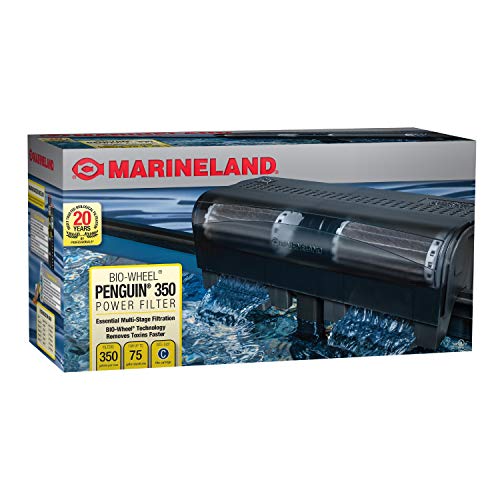
I rely on the Marineland Penguin Bio-Wheel Power Filter when I need reliable, multi-stage filtration that handles mechanical, chemical, and biological demands in both freshwater and saltwater setups. Its patented Bio-Wheel spins freely, exposing beneficial bacteria to oxygen for superior wet/dry biological filtration. This drastically reduces ammonia and nitrate levels. The filter includes a replaceable cartridge with activated carbon for chemical filtration and a foam block for mechanical trapping. I appreciate the adjustable intake and quiet dual vent covers. It’s made of durable black plastic, weighs 3.52 lbs, and fits tanks up to 70 gallons. Available in five sizes, the PF0350B model suits 50–75 gallon aquariums.
Best For: Aquarists seeking reliable, multi-stage filtration with superior biological performance in freshwater and saltwater tanks up to 75 gallons.
Pros:
- Utilizes patented Bio-Wheel technology for highly efficient wet/dry biological filtration, enhancing beneficial bacteria growth
- Offers multi-stage filtration with replaceable cartridge and foam block for chemical and mechanical cleaning
- Features adjustable intake and noise-reducing dual vent covers for customizable, quiet operation
Cons:
- Requires periodic cartridge replacement, adding to long-term maintenance costs
- Plastic construction may be less durable compared to higher-end metal or reinforced filters
- Bio-Wheel could be sensitive to power interruptions, potentially affecting bacterial efficiency if not restarted promptly
225GPH Canister Filter for 55-Gallon Aquariums

You’ll want the 225GPH Canister Filter if you own a 55-gallon freshwater aquarium and demand dependable, high-efficiency filtration. I rely on its 225-gallon-per-hour capacity to cycle my tank three times hourly. The 8W brushless copper motor runs quietly and efficiently, cutting energy costs. Anti-vibration rubber feet keep noise minimal. It includes sponges, filter balls, and an extra bulb-zero assembly needed. I set it up on my countertop; it fits in tight spaces at 10 x 8 x 14.2 inches. Made by PONDFORSE, it’s not for saltwater. Manual flow control lets me adjust output. It’s backed by a 1-year warranty.
Best For: Freshwater aquarium owners with 55-gallon tanks seeking efficient, quiet, and easy-to-use filtration with minimal setup.
Pros:
- High 225GPH flow rate effectively cycles water in up to 55-gallon tanks three times per hour
- Ultra-quiet brushless motor and anti-vibration feet ensure near-silent operation
- Comes fully assembled with comprehensive filtration media and extra bulb for immediate use
Cons:
- Not suitable for saltwater aquariums, limiting its use for marine setups
- Manual flow control may lack precision compared to automated systems
- Limited 1-year warranty compared to longer coverage offered by some competitors
NICREW Slim Aquarium Filter for 5-Gallon Tanks

A top choice for compact aquarium setups, the NICREW Slim Aquarium Filter delivers reliable mechanical filtration tailored to 5-gallon nano and pico tanks. Its slim, hang-on-back design saves space and blends seamlessly into small aquariums. I’ve found it works exceptionally well for bettas, shrimp, and other delicate species. With a 42 GPH flow rate and adjustable control, it circulates water efficiently without creating strong currents. The 3W motor runs quietly, minimizing stress. A patent-pending priming system allows automatic restart after power outages. Everything needed-sponge, cartridge, tubes-is included. Setup takes minutes, and performance stays consistent.
Best For: Aquarists with 5-gallon nano or pico tanks seeking a compact, efficient, and quiet filter ideal for bettas, shrimp, and other small, delicate aquatic species.
Pros:
- Slim, unobtrusive HOB design fits seamlessly in small aquariums without taking up internal space
- Adjustable flow rate and quiet 3W motor create a stress-free environment for sensitive fish and invertebrates
- Patent-pending priming system enables automatic restart after power outages, with all necessary components included for immediate setup
Cons:
- Limited to small tanks up to 5 gallons, making it unsuitable for larger aquariums or high-bioload setups
- Replacement cartridges may be less readily available compared to more universal filter brands
- Intake flow might be too strong for very tiny shrimp or fry, even at the lowest setting
DOMICA 100GPH Aquarium Filter with Aeration

This internal filter suits small aquarium owners needing efficient, space-saving filtration and added aeration. I rely on the DOMICA 100GPH to maintain clean, oxygen-rich water in tanks from 5 to 15 gallons. It delivers 100 gallons per hour of flow while using just 5 watts, cutting energy costs. Its submersible design saves space and operates quietly. I get both mechanical and biological filtration through a bio sponge and ceramic balls that trap debris and host beneficial bacteria. The built-in aeration boosts oxygen levels with a steady bubble stream. I mount it securely using suction cups and clean or replace the pre-installed cartridge monthly.
Best For: Small aquarium owners with 5 to 15-gallon tanks seeking efficient, space-saving filtration and reliable aeration in one quiet, energy-efficient unit.
Pros:
- Combines mechanical and biological filtration with included bio sponge and ceramic balls for optimal water clarity and tank health
- Built-in aeration increases oxygen levels, supporting fish wellness without requiring a separate air pump
- Easy to install and maintain with suction cup mounting, detachable parts, and a pre-assembled cartridge for monthly replacements
Cons:
- Limited to small tanks up to 15 gallons, making it unsuitable for larger aquariums
- Monthly cartridge replacement may increase long-term maintenance costs
- Aeration bubble stream, while functional, may be noisy for some users in quiet environments
172GPH Canister Filter for 30-Gallon Aquariums

One top-rated choice for 30-gallon aquarium owners seeking powerful, low-maintenance filtration is the 172GPH canister filter. It’s designed for tanks up to 30 gallons and delivers strong, consistent water turnover. The system uses multi-stage filtration with bio balls and sponges to trap debris and break down toxins. It removes impurities, excess nutrients, and fine particles effectively. An 8W energy-efficient motor powers the flow, moving 172 gallons per hour reliably. Flow rate is adjustable, letting you fine-tune circulation. A brushless copper motor and four rubber feet guarantee quiet operation. It’s not for saltwater.
Best For: Freshwater aquarium enthusiasts seeking a quiet, energy-efficient, and low-maintenance canister filter for tanks up to 30 gallons.
Pros:
- Powerful 172GPH flow rate with adjustable control for optimized water circulation
- Multi-stage filtration using bio balls and sponges ensures clear water and healthy biological balance
- Quiet operation thanks to a brushless copper motor and anti-vibration rubber feet
Cons:
- Not suitable for saltwater aquariums
- Replacement parts or additional media sold separately
- Initial setup may require careful priming to avoid leaks
Aquatic Experts Filter Pad 12x72in

If you run a high-flow aquarium system and demand reliable, long-lasting mechanical filtration, the Aquatic Experts Filter Pad 12x72in is your best choice. Measuring 12x72x0.75 inches, this blue and white bonded polyester pad is made in the USA. Its open fiber structure guarantees high water flow while trapping debris, waste, and particulates. Resin-bonded fibers resist clogging and last twice as long as standard pads. I cut mine to fit my sump and canister filters. It’s reusable, cost-efficient, and works in freshwater or saltwater. Pair it with carbon for even better results.
Best For: Aquarists with high-flow systems seeking durable, customizable, and cost-effective mechanical filtration for both freshwater and saltwater setups.
Pros:
- Resin-bonded polyester construction lasts twice as long as standard filter pads, reducing replacement frequency
- Open fiber design maintains high water flow while effectively trapping debris, waste, and particulates
- Can be cut to fit sumps, canister filters, and other systems, offering versatility and improved cost efficiency
Cons:
- Sold as a roll, requiring manual cutting to size, which may be less convenient for some users
- 0.75-inch thickness may not fit all filter trays without modification
- Blue pigment, while non-leaching, may raise aesthetic concerns for some hobbyists
Tetra Whisper IQ Power Filter 45

The Tetra Whisper IQ Power Filter 45 delivers reliable, high-performance filtration for medium-sized aquariums up to 45 gallons, making it an ideal choice for hobbyists who prioritize consistent water quality and quiet operation. I rely on its 215 gallons per hour (GPH) flow rate to maintain strong water turnover. The filter operates below 40 dB, thanks to a built-in sound shield-quieter than most refrigerators. Its submerged motor allows self-priming, so setup is fast and spill-free. I appreciate the Stay Clean Technology, which helps stabilize pH and reduces maintenance. I replace the cartridge monthly using large Tetra Whisper Bio-Bag cartridges-sold separately-for best results.
Best For: Aquarists with medium-sized tanks up to 45 gallons seeking quiet, reliable filtration with easy setup and stable water conditions.
Pros:
- High 215 GPH flow rate ensures effective water turnover for tanks up to 45 gallons
- Operates quietly below 40 dB with a built-in sound shield for noise reduction
- Self-priming submerged motor enables quick, spill-free startup and maintenance
Cons:
- Monthly cartridge replacement required, increasing long-term maintenance costs
- Filter cartridges sold separately, adding to initial setup expenses
- Stay Clean Technology may not eliminate the need for additional water testing and adjustments
Fluval FX6 Aquarium Filter 400 Gal

You’ll find the Fluval FX6 Aquarium Filter ideal if you own a large aquarium and demand efficient, high-volume filtration without sacrificing space. It delivers a flow rate of 925 gallons per hour, supporting tanks up to 400 gallons. At just 21 inches tall, it fits under most stands. Smart Pump technology uses a microchip to monitor performance and auto-restarts when powered on. It clears air every 12 hours to maintain efficiency. The filter includes stackable media baskets with 1.5-gallon total capacity-plenty for mechanical, chemical, and biological media. I can do water changes easily using the output hose; the pump drains and refills without heavy lifting. Setup is tool-free and includes all necessary parts for quick, reliable operation.
Best For: Large aquarium owners who need powerful, space-saving filtration with smart features and easy maintenance.
Pros:
- High 925 GPH flow rate supports tanks up to 400 gallons
- Smart Pump technology ensures automatic startup and continuous performance optimization
- Tool-free setup and easy water changes with integrated pump and output hose
Cons:
- Higher initial cost compared to standard canister filters
- Smart Pump technology may be overly complex for simple setups
- Stackable media baskets require careful arrangement to prevent channeling
Factors to Consider When Choosing a Mechanical Filter for Aquarium
You need to match the filter’s capacity to your tank size-most manufacturers rate filters by gallons per hour (GPH), and choosing one that processes your tank’s volume at least 4 times hourly guarantees clean water. Flow rate matters because too strong can stress fish, while too weak won’t trap debris effectively; adjustable pumps let you fine-tune output between 200–1000 GPH depending on stock density. Look for durable, easy-to-clean models with interchangeable media trays that accept custom sponges, floss, or foam for long-term efficiency.
Filtration Capacity Requirements
Matching your aquarium’s water volume with adequate filtration starts with understanding turnover rates-aim for at least four complete cycles per hour to maintain clear water and effective waste removal. You need a filter rated for your tank’s size, ideally matching or exceeding its volume. If you run a densely stocked tank or keep messy eaters like goldfish or cichlids, you’ll need higher-capacity filtration to handle the extra waste. Choose mechanical filters with multi-stage media trays that include coarse sponges and fine floss for graded particle removal. Canister filters typically deliver stronger mechanical performance than hang-on-back models, making them better for large or heavily stocked setups. Always verify the filter’s maximum flow rate and adjust it to prevent excessive current. An improperly matched filter can cause stress to delicate species or leave debris behind. Match capacity to bioload-accuracy guarantees lasting clarity and function.
Flow Rate Compatibility
Flow rate directly impacts how well a mechanical filter maintains water quality and supports aquatic life. You need a filter that circulates your tank’s full volume at least four times per hour. For a 30-gallon aquarium, that means a minimum flow rate of 120 gallons per hour (GPH). If the filter’s flow is too high, it creates strong currents that stress fish-especially in small or nano tanks. On the other hand, an underpowered filter won’t circulate water properly, leaving dead zones and murkiness. Adjustable flow controls let you fine-tune output for delicate species or densely planted setups. In heavily stocked or messy tanks, pushing up to six times the tank volume per hour-like using a 180 GPH filter on that same 30-gallon tank-helps keep things clean. Matching flow rate to your tank’s needs guarantees efficient filtration without harming your aquatic environment.
Media Type Options
The right mechanical filter media determines how effectively debris is removed from your aquarium water. Foam pads offer durable, coarse filtration, trapping large particles while maintaining strong water flow. Filter floss, with its fine fibers, captures microscopic debris but clogs faster, demanding more frequent changes. If you want balanced performance, use high-porosity sponges rated at 20 PPI-these trap small particles without restricting circulation. Some filters use graded-layer media, combining coarse outer layers with fine inner layers to capture debris progressively. This design mimics a multi-stage sieve, improving efficiency. Reusable media like bonded polyester pads save money over time; just rinse and reinsert them during maintenance. Each media type affects clarity differently, so match your choice to your tank’s bioload and maintenance schedule. Don’t overlook pore size and layering-they’re critical for sustained mechanical filtration.
Durability And Longevity
A well-built mechanical filter pays off over time by withstanding constant water pressure and frequent maintenance cycles without degrading. You’ll benefit from reinforced polyester filter media with resin-bonded fibers-these pads last twice as long as standard versions by resisting disintegration. Reusable pads hold up through repeated rinsing and maintain efficiency for over 12 months with proper care. Dense sponge materials prevent compaction, preserving pore structure for steady water flow and reliable particle capture. Look for thick, multi-layered media with graded zones: open-fiber sections trap large debris while fine layers capture smaller particles, delaying clogs and reducing replacement frequency. Internally, brushless motors generate less heat and wear, extending service life beyond 50,000 hours. Anti-vibration housing components minimize mechanical stress, guaranteeing stable operation even under continuous use. These design features collectively guarantee long-term performance with minimal degradation.
Ease Of Maintenance
Choose a mechanical filter that simplifies upkeep without sacrificing performance. Look for tool-free designs with quick-access compartments so you can clean or replace media in minutes. Models with reusable, washable sponges cut down on waste and recurring costs-just rinse and reinstall. Self-cleaning features like automatic air purge and self-priming pumps reduce manual adjustments and keep the system running smoothly between service intervals. Opt for modular units with removable media baskets; they let you target one filtration stage without disassembling the whole unit. Filters with smooth internal chambers and anti-clog intake tubes maintain strong flow rates and minimize debris buildup, slashing the need for deep cleaning. These design elements save you time and keep your aquarium’s water clarity consistent with minimal effort.
Noise Level Considerations
Wondering why your aquarium filter disrupts the quiet ambiance of your room? Noise levels matter more than you think. Filters with brushless motors and anti-vibration rubber feet operate below 40 dB, delivering ultra-quiet performance. Some models achieve under 30 dB using optimized water flow paths and low-turbulence housings-perfect for bedrooms or offices. Sound shield designs and vented covers reduce operational noise by dissipating sound waves before they escape. Submerged motor configurations cut cavitation noise and allow self-priming, ensuring silent startup and steady running. High-flow filters tend to be louder, but advanced internal dampening absorbs vibrations without compromising circulation. You don’t have to sacrifice power for peace. Look for technical specs listing decibel output and noise-reduction features. A well-designed filter runs so quietly, you’ll forget it’s on.
Aquarium Size Matching
Your aquarium’s size directly determines the right mechanical filter’s flow capacity and filtration efficiency. Match the filter’s flow rate to your tank’s volume, ensuring it circulates the entire water volume at least four times per hour. For tanks up to 10 gallons, use a filter with 40 to 60 gallons per hour (GPH) to maintain gentle, effective filtration. Larger tanks demand proportionally higher GPH ratings to manage waste and clarity. Oversized filters can create strong currents, stressing sensitive fish, so align flow capacity with both bioload and tank dimensions. Canister filters for tanks over 30 gallons should deliver a minimum of 150 GPH for reliable particulate removal. Choose models with adjustable flow controls-they let you fine-tune water movement to match your tank’s needs, ensuring efficient mechanical filtration without disrupting aquatic life.
Frequently Asked Questions
How Often Should I Replace Mechanical Filter Media?
You should replace mechanical filter media every 2–4 weeks. Regular replacement prevents clogs and maintains ideal water flow. Debris builds up quickly, reducing filtration efficiency. Use filter pads with pore sizes between 10–50 microns for effective particle capture. Rinse media in tank water weekly to extend life. Never replace all media at once to preserve beneficial bacteria. Replace only when visibly saturated and water flow drops noticeably.
Can I Use Multiple Mechanical Filters Together Safely?
Yes, you can safely use multiple mechanical filters together. Running dual filters increases water turnover and redundancy. Position them to avoid overlapping intake zones, guaranteeing even circulation. Match flow rates within 10% to prevent imbalance. Total turnover should not exceed 6x tank volume per hour. Use filters with sealed motors if stacking. Guarantee electrical safety with GFC I outlets. Parallel setups improve particle removal without stressing fish.
Do Mechanical Filters Remove Beneficial Bacteria?
No, mechanical filters don’t remove beneficial bacteria. You trap debris and particulate matter in filter media like sponges or foam, which have large pore sizes that let beneficial bacteria remain in your tank. Bacteria colonize surfaces, not water, so they stick to substrate, tank walls, and biological media. Your filter’s mechanical stage clears cloudiness without harming the biofilter colonies essential for ammonia control.
Are Foam Pads Better Than Filter Floss?
Yes, foam pads are better than filter floss. You get longer-lasting performance and superior mechanical filtration. Foam pads have larger pore spaces, trapping debris without clogging quickly. They’re reusable-just rinse and reinsert. Filter floss, while fine for polishing water, clogs fast and needs frequent replacement. Foam supports beneficial bacteria growth too, aiding biological filtration. You’ll save time and money with foam in the long run.
Will a Mechanical Filter Reduce Algae Growth?
Yes, a mechanical filter reduces algae growth by trapping suspended particles that feed algae. You remove organic debris before it breaks down into nitrates and phosphates. High-efficiency pads with pore sizes under 20 microns capture fine particulates effectively. Paired with regular maintenance, you limit nutrient buildup. This doesn’t eliminate algae entirely but starves it at the source. Clear water isn’t just cosmetic-it’s a sign of reduced available food for algae blooms.