Top-Rated Hang On Back Aquarium Filters for Crystal-Clear Water
You need a hang-on-back filter that combines high flow rates with multi-stage filtration for crystal-clear water. The Tetra Whisper IQ 45 delivers 215 GPH for tanks up to 45 gallons while operating below 40 dB. It features self-priming, Stay Clean Technology, and a submersible motor. Models like the Marineland Penguin Bio-Wheel use a patented wet/dry Bio-Wheel for superior biological filtration. Choose filters with mechanical, chemical, and biological stages to guarantee peak clarity and water quality-key details await.
We are supported by our audience. When you purchase through links on our site, we may earn an affiliate commission, at no extra cost for you. Learn more. Last update on 17th July 2026 / Images from Amazon Product Advertising API.
Notable Insights
- High-rated HOB filters like Marineland Penguin and Fluval C3 deliver 4–6x hourly turnover for optimal water clarity.
- Models with three-stage filtration (mechanical, chemical, biological) effectively remove debris, toxins, and ammonia.
- Bio-Wheel technology in Marineland filters enhances biological filtration by maximizing air-water bacterial contact.
- Replaceable activated carbon and sponge media in filters like Aqueon QuietFlow 10 maintain long-term water purity.
- Quiet, self-priming designs with adjustable flow, such as NICREW Slim and hygger HOB, suit small to medium tanks.
Tetra Whisper IQ Power Filter 45

If you’re maintaining a freshwater aquarium up to 45 gallons, the Tetra Whisper IQ Power Filter 45 is an ideal choice. It delivers 215 gallons per hour of flow, ensuring efficient water circulation. The submersible motor self-primes automatically, so setup is fast and hassle-free. A sound shield design keeps operation below 40 dB-quieter than a library whisper. Stay Clean Technology helps stabilize pH levels, promoting fish health and reducing maintenance. I replace the filter cartridge monthly using large Tetra Whisper Bio-Bag cartridges, sold separately. This filter combines reliable performance, smart engineering, and consistent results for clear, healthy aquarium water.
Best For: Freshwater aquarium owners with tanks up to 45 gallons seeking a quiet, efficient, and easy-to-maintain filtration system.
Pros:
- Delivers strong 215 GPH flow rate for excellent water circulation in tanks up to 45 gallons
- Operates quietly at less than 40 dB thanks to sound shield design
- Self-priming motor allows for quick, hassle-free setup and startup
Cons:
- Filter cartridges must be replaced monthly, increasing ongoing maintenance costs
- Cartridges are sold separately, requiring additional purchase
- May not be suitable for larger tanks beyond its 45-gallon capacity
Marineland Penguin Bio-Wheel Power Filter, Multi-Stage Aquarium Filtration
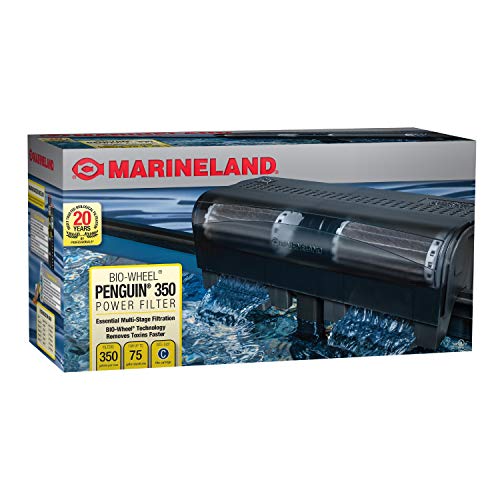
The Marineland Penguin Bio-Wheel Power Filter stands as a top-tier choice for aquarium hobbyists prioritizing reliable, multi-stage filtration in a compact hang-on-back design. Its patented Bio-Wheel rotates continuously, exposing beneficial bacteria to both air and water, boosting biological filtration efficiency. This system combines mechanical, chemical, and biological stages to trap debris, remove toxins, and convert ammonia effectively. I rely on Marineland’s Rite-Size cartridges-matched to each model-for peak performance. Five flow rates are available: 75, 100, 150, 200, and 350 GPH, scaling cleanly from 10- to 70-gallon tanks.
Best For: Aquarium hobbyists seeking reliable, multi-stage filtration with efficient biological support in a compact hang-on-back design for tanks ranging from 10 to 70 gallons.
Pros:
- Utilizes patented Bio-Wheel technology for enhanced biological filtration by maximizing beneficial bacterial growth
- Combines mechanical, chemical, and biological filtration in one system for comprehensive water cleaning
- Available in five flow rate options (75–350 GPH) to suit a wide range of tank sizes
Cons:
- Requires proprietary Marineland Rite-Size cartridges, limiting filter media alternatives
- Bio-Wheel may require periodic cleaning to maintain optimal rotation and performance
- Higher flow rate models may be too strong for small or nano aquarium setups
Marineland Penguin Bio-Wheel Filter 200 GPH
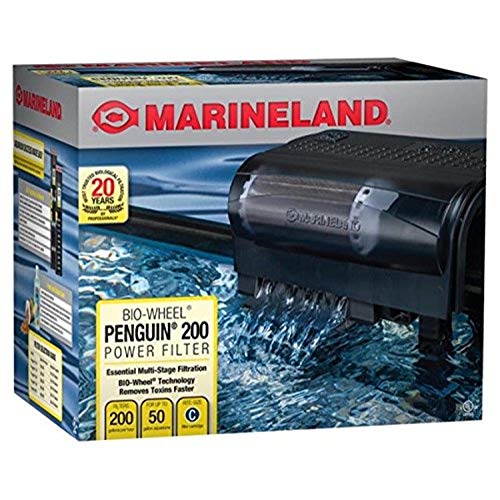
I rely on the Marineland Penguin Bio-Wheel Filter 200 GPH when I need dependable, high-performance filtration for aquariums up to 20 gallons. Its 200-gallon-per-hour flow rate guarantees rapid water turnover and consistent circulation. The patented Bio-Wheel provides superior wet/dry biological filtration by maximizing oxygen exposure to beneficial bacteria. It supports a multi-stage filtration process: mechanical, chemical, and biological. I use Marineland Rite-Size cartridges matched to this model for best results. The system runs quietly and integrates seamlessly on most standard tank setups. I trust Marineland’s engineering for long-term reliability and balanced performance in small to mid-sized aquariums.
Best For: Aquarists with small to mid-sized tanks up to 20 gallons seeking reliable, quiet, and efficient multi-stage filtration.
Pros:
- Features patented Bio-Wheel technology for superior biological filtration with enhanced oxygen exposure
- Combines mechanical, chemical, and biological filtration in a compact, easy-to-install design
- Compatible with Marineland Rite-Size cartridges and operates quietly for consistent performance
Cons:
- Flow rate may be too strong for very small or heavily planted tanks without flow adjustment
- Replacement cartridges must be model-specific, potentially limiting third-party filter media options
- Bio-Wheel performance depends on proper maintenance and may decrease if not cleaned regularly
NICREW Slim Aquarium Filter for 5 Gallon Tanks

Forget bulky filters that dominate small tanks-this slim HOB unit is built for nano and pico aquariums where space and aesthetics matter. I rely on the NICREW Slim Aquarium Filter for my 5-gallon shrimp tank because it’s compact and operates quietly. It delivers 42 GPH with just 3W power, offering efficient circulation without overwhelming delicate inhabitants. Its adjustable flow prevents stress in betta and shrimp. The patent-pending priming system automatically restarts after power outages. It includes a sponge, cartridge, intake, and extension tubes-everything needed for immediate setup. The low profile blends seamlessly, maintaining clean water and a stable environment.
Best For: Aquarists with nano or pico tanks, especially those housing shrimp or bettas who need a compact, quiet, and efficient filtration system.
Pros:
- Slim, low-profile design fits discreetly in small tanks up to 5 gallons
- Quiet operation with adjustable flow to protect delicate aquatic inhabitants
- Patent-pending automatic restart priming system after power outages
Cons:
- Limited to very small tanks, not suitable for larger aquariums
- 42 GPH may be excessive for ultra-micro tanks under 2 gallons
- Replacement cartridges may be costly over time compared to generic options
Tetra Whisper IQ Power Filter 20

A hang-on-back filter like the Tetra Whisper IQ Power Filter 20 suits aquarists managing small to medium freshwater or saltwater tanks who demand reliable, low-noise performance. I rely on its 130 GPH flow rate to maintain crystal-clear water in up to 20-gallon setups. The self-priming motor starts automatically-no manual pumping needed. Its sound shield keeps noise under 40 dB, quieter than a library whisper. Stay Clean technology reduces debris and stabilizes pH. I replace the blue Tetra Whisper Bio-Bag cartridge monthly. The bio-scrubber fosters beneficial bacteria, breaking down ammonia and nitrite efficiently.
Best For: Aquarists managing small to medium freshwater or saltwater tanks up to 20 gallons who prioritize quiet operation and reliable filtration.
Pros:
- Delivers powerful 130 GPH flow rate with self-priming motor for easy startup
- Operates quietly under 40 dB thanks to sound shield and soft barrier technology
- Supports healthy tank ecosystems with Stay Clean technology and bio-scrubber for ammonia and nitrite reduction
Cons:
- Requires monthly cartridge replacement, increasing long-term maintenance costs
- Filter cartridges must be specific (Tetra Whisper Bio-Bag, blue packaging) for optimal performance
- May be oversized for very small tanks, potentially creating excessive water movement
Hygger External Hang-On-Back Aquarium Filter (8W)

The Hygger External Hang-On-Back Aquarium Filter (8W) is a top choice for hobbyists with medium-sized freshwater tanks who need reliable, space-saving filtration. It delivers 180 GPH, ideal for 40–60 gallon tanks. The 3-stage system uses 500g ceramic balls, a black sponge, and dual 8D sponges inside a 0.6-gallon canister. Water enters through the bottom inlet and skimmer port, then exits clean. An all-copper motor guarantees quiet operation. It has anti-dry burn protection and a sealed, vibration-dampening case. You can choose rain shower, duckbill, or straight outlet flow. It mounts securely on glass up to 0.7 inch thick.
Best For: Aquarists with 40–60 gallon freshwater tanks seeking quiet, efficient, and space-saving filtration with customizable water flow and excellent mechanical, biological, and chemical cleaning performance.
Pros:
- Utilizes a 3-stage filtration system with 500g ceramic balls and dual sponges for thorough water purification and strong biological filtration
- Offers three outlet options (rain shower, duckbill nozzle, straight outlet) for customizable water flow and enhanced surface agitation
- Features an all-copper motor with anti-dry burn protection and a sealed, vibration-dampening design for quiet, reliable operation
Cons:
- Not suitable for turtle tanks or setups with consistently low water levels
- Limited to glass thickness of 0.7 inch (18mm), which may restrict mounting options on certain tanks
- External design, while space-saving inside the tank, may be visually prominent on the outside of the aquarium
hygger HOB Aquarium Filter 105 GPH

If you manage a small aquarium between 10 and 20 gallons, the hygger HOB Aquarium Filter 105 GPH delivers reliable, three-stage filtration in a compact design. I use its 5.9 x 2.8 x 9-inch frame on my tank’s back wall, saving interior space. It circulates up to 105 gallons per hour. The extendable intake tube fits various water depths. My filter includes a dual-sided sponge, ultra-activated carbon cartridge, and a bio-filter plate for beneficial bacteria. Water flows through mechanical, chemical, and biological stages. A top-mounted knob adjusts flow. The sponge guards prevent harm to shrimp or fry. A mini waterfall output boosts oxygen. An LED light alerts me when the media clogs. I’ve found cleaning simple. Its 1.46-pound build feels sturdy. This filter suits adults 18+. It’s pet-use only. I rely on its 1-year warranty.
Best For: Small aquarium owners with tanks between 10 and 20 gallons who want efficient, space-saving filtration with easy maintenance and reliable performance.
Pros:
- Compact hang-on-back design saves interior tank space and allows for easy access during maintenance
- Three-stage filtration system with mechanical, chemical, and biological components ensures clean, clear, and well-oxygenated water
- Adjustable flow knob, extendable intake tube, and LED clog indicator enhance user control and simplify upkeep
Cons:
- Limited to smaller tanks (10–20 gallons), making it unsuitable for larger aquariums
- Replacement filter cartridges may require ongoing costs despite reusable sponge components
- Some users may find the mini waterfall outflow too noisy or disruptive for sensitive fish
Aquarium Hang-On Filter for Small Tanks
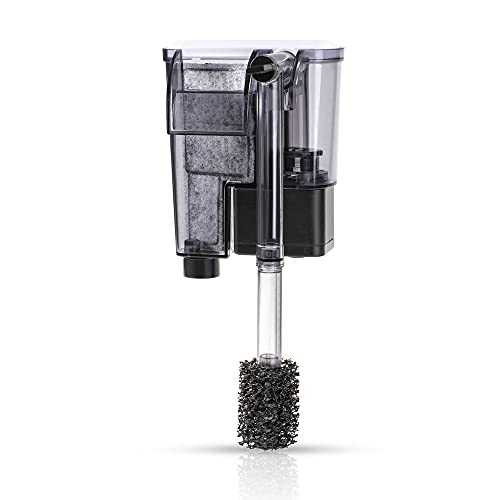
When space is tight and efficiency matters, the DaToo Hang-On Filter stands out for small tank owners who demand reliable performance without sacrificing water quality. It features a 2.5W pump delivering 42GAL/H (160L/H), ideal for 3–10 gallon tanks. Its compact, ultra-thin hang-on design saves space. The flow is adjustable via control knob, and waterfall outflow boosts oxygenation. A bio-foam pre-filter prevents harm to small fish. The super-strength ABS shell resists impact and chemicals. With 100% research-grade activated carbon, it filters 1.5 times more efficiently than standard models. Noise stays below 35dB. Backed by a one-year warranty, it’s built to perform.
Best For: Small aquarium owners with 3–10 gallon tanks who need a quiet, efficient, and space-saving filtration system that ensures safety for small fish and superior water quality.
Pros:
- Compact, ultra-thin hang-on design saves space and integrates easily into small setups
- High filtration efficiency with 100% research-grade activated carbon, outperforming standard filters by 1.5x
- Bio-foam pre-filter and low noise level (≤35dB) enhance safety for small fish and ensure quiet operation
Cons:
- Limited to small tanks (3–10 gallons), not suitable for larger aquariums
- Flow rate may be too strong for very delicate or tiny species despite adjustability
- Hang-on-back design may be less stable on thicker or uneven aquarium rims
Aqueon QuietFlow 10 LED PRO Fish Tank Filter
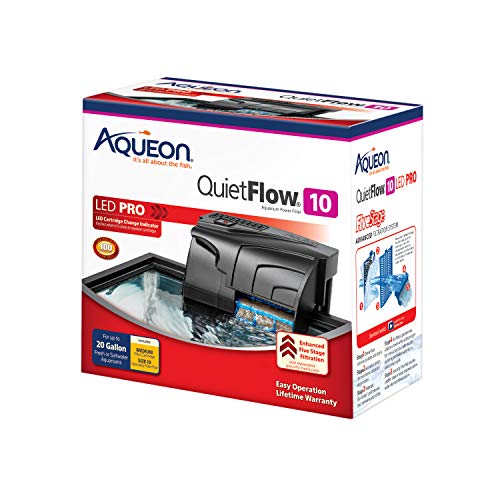
Aqueon QuietFlow 10 LED PRO stands out for aquarium owners seeking reliable, multi-stage filtration in compact systems under 20 gallons. It delivers mechanical, chemical, biological, and optional specialty filtration using one medium Aqueon cartridge and size 10 filter pads. An LED indicator flashes when flow is restricted, signaling replacement-just swap the cartridge. Never rinse the Bioholster; it houses essential beneficial bacteria. Its internal pump guarantees high flow, boosting dissolved oxygen for healthier fish. The design minimizes noise and prevents leaks. Self-priming functionality guarantees startup after power interruptions.
Best For: Aquarists with small to medium freshwater or saltwater tanks up to 20 gallons seeking quiet, efficient, and multi-stage filtration with minimal maintenance hassle.
Pros:
- Offers comprehensive mechanical, chemical, biological, and optional specialty filtration in one compact unit
- LED indicator alerts when cartridge needs replacement, simplifying maintenance
- Internal pump design ensures quiet operation, high water flow, and automatic restart after power outages
Cons:
- Cartridge replacement required regularly, increasing long-term maintenance costs
- Bioholster cannot be cleaned, risking bacterial imbalance if mishandled during filter changes
- Limited to smaller tanks (up to 20 gallons), not suitable for larger aquariums
Fluval C3 Power Filter, Fish Tank Filter for Aquariums up to 50 Gal.

The Fluval C3 Power Filter stands out as the top choice for aquarists managing tanks between 20 and 50 gallons, delivering strong performance across both freshwater and saltwater setups. It uses a 5-stage filtration system for complete water purification. Two mechanical stages trap large and fine debris using removable foam pads that clean easily. Chemical filtration relies on activated carbon to pull toxins and discoloration from the water. Biological filtration features a Bio-Screen pad that blocks waste while hosting beneficial bacteria. A trickle chamber boosts nitrification when used with Fluval C-Nodes, improving ammonia breakdown.
Best For: Aquarists with freshwater or saltwater tanks between 20 and 50 gallons seeking reliable, multi-stage filtration with easy maintenance and strong biological support.
Pros:
- Comprehensive 5-stage filtration system effectively removes debris, toxins, and ammonia
- Removable foam pads and modular design allow for quick and easy cleaning
- Biological trickle chamber enhances nitrification efficiency when paired with Fluval C-Nodes
Cons:
- Requires Fluval C-Nodes for optimal performance in the trickle chamber, sold separately
- Slightly bulkier design may limit placement options in tight aquarium setups
- Higher initial cost compared to basic filter models with fewer filtration stages
Factors to Consider When Choosing a Hang on Back Aquarium Filter
You need to match your hang on back filter to your tank size-using a filter rated for 50 gallons on a 20-gallon tank can cause poor water circulation and stress fish. Look at flow rate, measured in gallons per hour (GPH), and aim for a turnover of 4 to 6 times your tank’s volume per hour; for example, a 30-gallon tank needs 120–180 GPH. Also check noise level, filtration stages (mechanical, chemical, biological), and energy use-some models use as little as 3–5 watts for quiet, efficient operation.
Tank Size Compatibility
When matching a hang on back aquarium filter to your tank, start by checking the filter’s rated capacity, as manufacturers design each model for a specific maximum gallonage. Choose a filter labeled for at least your tank’s total volume-using one rated for less risks poor waste processing. Most filters list a max capacity, like 20 or 50 gallons, based on flow and filtration power. Never exceed this recommendation. If your tank is overstocked or heavily planted, step up to a filter rated for a larger size. That extra capacity guarantees better water quality and less frequent cleaning. An undersized filter causes weak circulation, lowers oxygen levels, and forces you to clean more often. Matching the filter to your tank’s actual size isn’t optional-it’s essential for a balanced, healthy aquarium.
Flow Rate Requirements
Though often overlooked, getting the flow rate right makes or breaks your filter’s performance. You need a turnover of 4 to 6 times your tank’s volume per hour for effective filtration. For example, a 50-gallon tank requires a filter with 200–300 GPH. Larger tanks demand higher GPH to maintain clarity and support biological filtration. Adjustable flow filters let you tailor output for sensitive fish or heavily stocked setups. Too much flow stresses fish and stirs debris; too little causes dead spots and poor circulation. Look for filters with spray bars or directional nozzles to control distribution. These features improve surface agitation and oxygen exchange. Always match the filter’s rated flow to your tank size and livestock needs. A properly tuned flow guarantees consistent mechanical, chemical, and biological filtration. This precision keeps your water crystal-clear and your fish healthy.
Noise Level Considerations
Is a noisy aquarium filter disrupting your room’s peace? Choose a model rated at or below 40 decibels (dB) for quiet operation-levels above this become noticeable in standard room backgrounds. Sound shield designs and internal pump placements act as physical barriers, dampening motor noise before it escapes. Vibration-absorbing materials and sealed motor housings minimize humming and rattling during 24/7 operation. Avoid filters exceeding 200 gallons per hour (GPH) if noise is a concern; higher flow rates increase water turbulence and pump strain, amplifying sound. Automatic restart systems and self-priming motors prevent sudden startup noises after power interruptions, maintaining consistent acoustic performance. Prioritize models engineered for acoustics, not just flow. Look for independent lab-tested dB ratings, not estimates. A truly quiet filter blends into your environment like distant rainfall-present but unobtrusive. Check manufacturer noise specifications before buying.
Filtration Stage Options
A quiet filter keeps your space peaceful, but its ability to clean the water depends on the filtration stages it uses. Most effective models use three-stage filtration: mechanical, chemical, and biological. Mechanical filtration traps debris using dual-layer foam-coarse for large particles, fine for silt-boosting clarity. Chemical filtration relies on activated carbon to absorb odors, dyes, and dissolved pollutants. Biological filtration uses porous media like bio-wheels or ceramic rings, hosting beneficial bacteria that convert toxic ammonia and nitrites into safer nitrates. The bio-wheel’s large surface area increases oxygen exposure, enhancing bacterial efficiency. Some advanced filters add a fourth stage-ion-exchange resins or specialty pads-for targeted removal of nitrates, phosphates, or leftover medications. Choosing a filter with all three core stages guarantees balanced, stable water chemistry. Four-stage systems offer extra protection for sensitive or heavily stocked tanks.
Energy Efficiency
Energy use matters just as much as performance when selecting a hang-on-back filter. Efficient models typically consume 2.5W to 8W, balancing strong filtration with low power draw. Look for high GPH-to-watt ratios-some filters exceed 60 GPH per watt-meaning more flow with less energy. Adjustable flow controls let you tailor circulation to your tank’s needs, avoiding wasted energy from excessive water movement. Self-priming motors restart automatically after outages, eliminating manual resetting and reducing downtime. These motors also operate more efficiently, cutting long-term electricity costs. Filters rated below 40 dB often use optimized motor designs that lower both noise and power use. Think of it like a fuel-efficient car: same distance, less gas. You get steady, reliable performance while keeping energy bills low and environmental impact smaller. Choose efficiency-it adds up over time.
Ease Of Maintenance
How much time do you really want to spend cleaning your filter? Choose a hang on back filter with accessible media compartments so you can quickly swap or rinse cartridges without dismantling the entire unit. Models with reusable sponges or washable media save money and reduce waste over time. Look for units with LED indicators that alert you when flow drops or media needs service-typically every 4 to 6 weeks depending on tank bioload. Modular chambers let you clean mechanical, chemical, and biological stages separately, preserving beneficial bacteria in sponge or biomedia sections. Self-priming pumps restart automatically after outages, avoiding manual siphoning. Units like the Aqueon QuietFlow E and Fluval C4 offer tool-free access, integrated media baskets, and consistent flow rates from 100 to 400 GPH, balancing convenience with reliable performance.
Priming Mechanism
You’ve already considered how easy it is to maintain your hang on back filter, but don’t overlook how it starts up after a shutdown. A self-priming filter automatically fills with water and restarts without manual help, which is essential during power outages. These models use sealed pump designs that maintain prime, so water flow resumes immediately once power returns. Look for units with internal check valves or water traps-these block air from entering the system and prevent dry runs. Airtight seals and fully submerged impellers create the suction needed to start filtration without you pouring water into the intake. Without these, airlocks can stall the pump, especially since hang-on-back filters sit above the waterline. Effective priming guarantees consistent flow rates and avoids dry cycling, which damages motors. Choose a model that’s engineered to stay primed. It just works-no guessing, no extra steps. Reliable startup means stable water conditions and less downtime.
Media Flexibility
Customization begins with the filter’s media capacity and layout. You’ll want removable media compartments that let you tailor filtration to your tank’s needs. Models with separate chambers support mechanical, chemical, and biological media simultaneously, improving water quality through targeted action. Open filter baskets give you full control, allowing you to layer sponge pads, ceramic rings, or bio-balls as needed. This flexibility is ideal for addressing specific issues like nitrate buildup or cloudy water. Reusable trays cut costs and waste-you can rinse and reuse sponges instead of replacing them monthly. Some filters accommodate phosphate removers or activated carbon, helping eliminate odors and yellowing. Adjustable configurations let you swap in fine sponge floss for particle removal or add specialty resins. The best designs maximize media volume while simplifying access. Choose a filter that adapts as your aquarium’s needs change.
Frequently Asked Questions
How Often Should I Clean My Hang on Back Filter?
You should clean your hang on back filter every 3 to 4 weeks. Regular maintenance prevents clogging and maintains ideal water flow. Remove the filter media and rinse it in dechlorinated tank water to preserve beneficial bacteria. Replace filter cartridges every 4 to 6 weeks, or per manufacturer guidelines. Inspect impeller and intake tube monthly for debris. Avoid tap water-it kills bacteria and reduces biological filtration efficiency.
Can I Run Two HOB Filters on One Tank?
Yes, you can run two HOB filters on one tank. Doing so improves water circulation and redundancy in filtration. Use filters with combined flow rates no higher than 10 times your tank’s gallon capacity per hour. Position them on opposite ends to eliminate dead zones. Make certain both intakes and outflows are fully submerged and adjusted to prevent surface disturbance. Dual setups enhance mechanical, chemical, and biological filtration.
Do I Need to Turn off the Filter When Feeding Fish?
You don’t need to turn off the filter when feeding fish. Keeping it running maintains water circulation and prevents waste buildup. Modern hang-on-back filters create surface agitation that helps disperse food evenly, reducing the chance of uneaten food sinking. Turn off only if your fish struggle to eat due to strong current. Even then, adjust flow rate instead. Disabling the filter briefly disrupts beneficial bacteria and oxygen exchange. Steady operation guarantees ideal tank stability and water quality.
Will a HOB Filter Work in a Saltwater Aquarium?
Yes, a HOB filter works in a saltwater aquarium if it’s designed for marine use. You must guarantee the materials resist salt corrosion-look for filters with non-metallic impellers and UV-resistant plastic. Most models support biological, mechanical, and chemical filtration. Match the flow rate to your tank’s size-aim for 4–6 times the tank volume per hour. Always use marine-safe media and maintain consistent water parameters.
Can I Use Aquarium Filter Media From Different Brands?
Yes, you can use aquarium filter media from different brands. Manufacturers design most media to fit universal dimensions, allowing mix-and-match compatibility. You’ll find standard sizes like 2” x 3” or /(4” x 6” across brands. Just verify physical dimensions and flow rate limits. Blending mechanical, chemical, and biological media boosts filtration. Guarantee pore size, surface area, and dwell time align with your tank’s bioload and flow requirements for maximum performance.